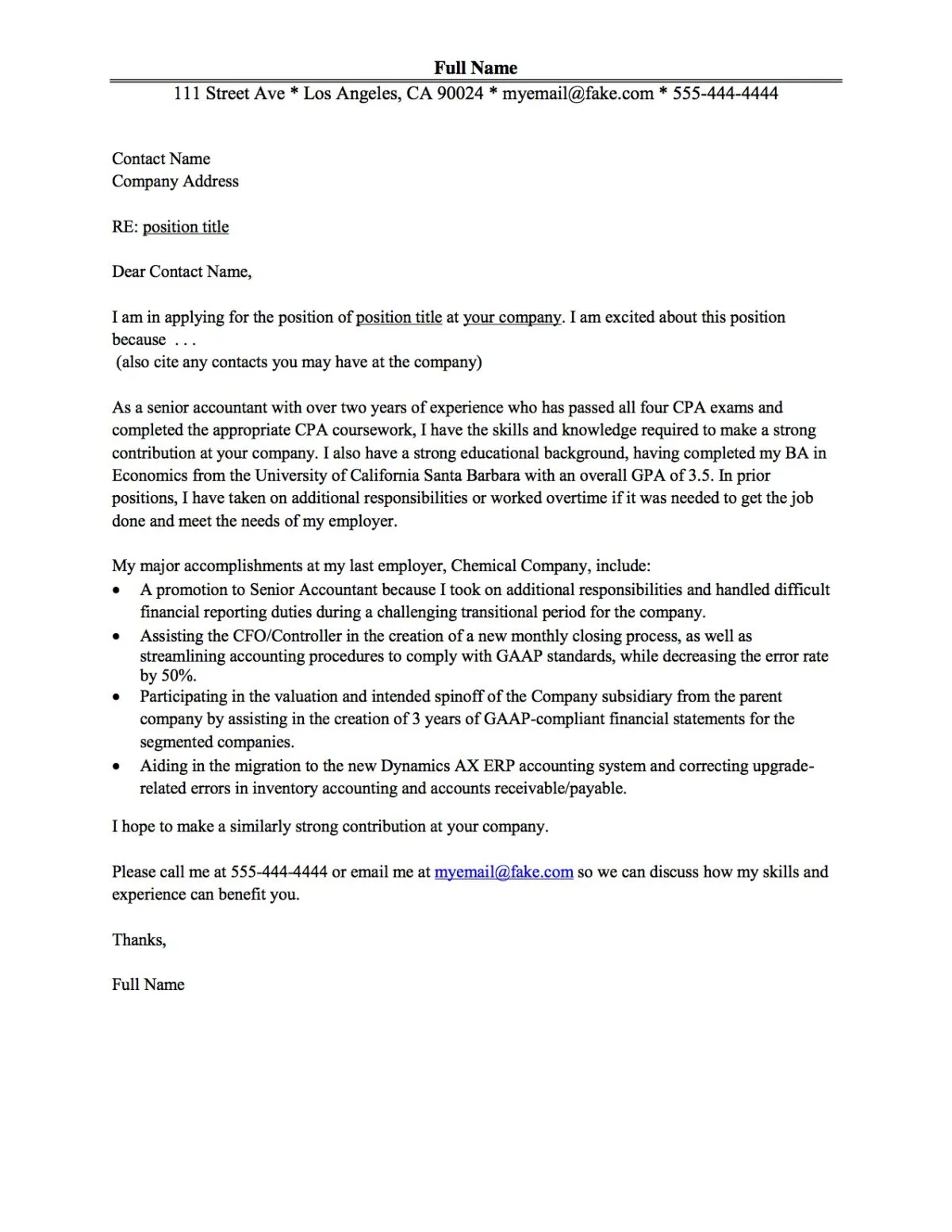
Crafting an Accountant Cover Letter that Impresses
An accountant cover letter is your first chance to make a strong impression on a potential employer. It’s more than just a formality; it’s a crucial marketing tool that showcases your skills, experience, and personality. A well-crafted cover letter can significantly increase your chances of landing an interview by demonstrating your understanding of the role, your enthusiasm for the company, and your ability to communicate effectively. It provides an opportunity to elaborate on your resume, highlighting specific achievements and tailoring your application to the specific requirements of the job. The key is to stand out from the crowd by showing, not just telling, what makes you the ideal candidate. Remember to always customize your cover letter for each position you apply for, emphasizing the skills and experiences most relevant to the specific job description.
Highlighting Your Relevant Experience
When writing your accountant cover letter, focus on highlighting the experience that directly aligns with the job requirements. Don’t just list your previous roles; instead, delve into the specific tasks, projects, and responsibilities that demonstrate your capabilities. Use action verbs to describe your accomplishments and provide context to your experience. For instance, instead of saying ‘Managed accounts payable,’ you could say ‘Implemented a new accounts payable system, reducing processing time by 15% and improving vendor relations.’ This approach not only showcases your experience but also quantifies your achievements, making them more impactful. Consider mentioning any industry-specific experience or certifications that are relevant to the role. The goal is to provide concrete evidence of your ability to perform the duties outlined in the job description.
Quantifying Your Achievements

Accountants often deal with numbers, so it’s natural to quantify your achievements in your cover letter. Whenever possible, use data to illustrate your impact in previous roles. This could include metrics like the amount of money saved, the percentage of efficiency improvement, or the number of accounts managed. For example, instead of stating ‘Improved financial reporting,’ you could say ‘Streamlined financial reporting processes, resulting in a 10% reduction in report generation time and improved accuracy.’ Such specific details provide tangible evidence of your accomplishments and demonstrate your value to potential employers. Think about key performance indicators (KPIs) you’ve influenced, such as reduced errors, improved compliance, or successful project completions. By quantifying your achievements, you create a compelling narrative that sets you apart from other candidates.
Financial Reporting Mastery
Financial reporting is a core skill for accountants, so make sure to emphasize your experience in this area. Describe your experience with financial statement preparation, including balance sheets, income statements, and cash flow statements. Mention any experience with GAAP (Generally Accepted Accounting Principles) or IFRS (International Financial Reporting Standards), as these are critical for ensuring accurate and compliant financial reporting. Highlight any experience with financial analysis, such as variance analysis or trend analysis, and how you’ve used this analysis to improve financial performance. Discuss your experience with audits, both internal and external, and how you’ve ensured compliance with regulations. Use examples to showcase your ability to analyze financial data, identify discrepancies, and provide insightful reports that support decision-making.
Budgeting and Forecasting Expertise
Budgeting and forecasting are vital skills for accountants, so make sure your cover letter reflects your proficiency in these areas. Detail your experience in developing and managing budgets, including the use of budgeting software and techniques. Explain how you have collaborated with different departments to create accurate and realistic budgets. Highlight your experience with financial forecasting, including techniques such as trend analysis, regression analysis, and scenario planning. Showcase any instances where you successfully predicted financial outcomes or identified potential risks and opportunities. Quantify your achievements by mentioning how your budgeting and forecasting efforts have contributed to cost savings, revenue growth, or improved financial stability. This expertise demonstrates your ability to contribute to strategic financial planning and management.
Skills to Include

Your accountant cover letter should prominently feature a list of skills that align with the job requirements. These skills can be divided into technical and soft skills, each playing a critical role in your success. Refer to the job description to identify the specific skills the employer is seeking and make sure to include these in your letter. Be sure to provide examples of how you have utilized these skills in your past experiences. Be specific when mentioning your skills and show how your proficiency with these skills has benefited your former companies and how they will benefit the new company too. Make sure to mention important aspects related to your skill set. Don’t just list skills; provide context to show how you’ve applied them and the results achieved.
Technical Skills for Accountants
Technical skills are the foundation of any accountant’s expertise. They are the specific knowledge and abilities required to perform accounting tasks. Your cover letter should highlight your proficiency in the technical skills that are most relevant to the job you’re applying for. Mention your experience with financial reporting, budgeting, and forecasting. Include your knowledge of accounting principles like GAAP or IFRS, and any certifications you hold, such as a CPA (Certified Public Accountant). Detail your experience with financial analysis, including variance analysis, trend analysis, and ratio analysis. You can also provide your proficiency with specific accounting software and systems, such as QuickBooks, SAP, or Oracle. The idea is to provide a list of skills that directly correlate with the job requirements.
Software Proficiency
Software proficiency is a key technical skill for accountants in the modern workplace. Mentioning your familiarity with accounting software is critical. Identify the specific software systems the employer uses and highlight your experience with these. If you’re proficient in multiple systems, list the most relevant ones and describe your experience with them. Include any experience with database management and data analysis tools, such as Excel, Access, or data visualization software. Describe the way you have used these software programs in previous roles to streamline processes, improve accuracy, or generate insightful reports. Tailor this section to align with the job description, as the specific software requirements will vary depending on the role and the industry.
Soft Skills to Showcase

Soft skills are essential for accountants, especially in the modern workplace where collaboration, communication, and problem-solving are highly valued. Your cover letter should highlight these skills, providing examples of how you’ve used them in your professional experience. Communication skills are particularly important, so mention any experience with preparing and presenting financial reports to both technical and non-technical audiences. Mention your teamwork skills by highlighting your experience working with cross-functional teams and your ability to collaborate effectively. Demonstrate your analytical skills by detailing your experience with problem-solving and your ability to identify and resolve financial discrepancies. Emphasize your attention to detail, organizational abilities, and any project management experience. Provide context to show how these soft skills have contributed to your success.
Tailoring Your Cover Letter
To stand out, customize your cover letter for each job application. Tailoring your cover letter to the specific requirements of the job is crucial for demonstrating your suitability for the role and shows that you’ve invested time in understanding the opportunity. Carefully review the job description to identify the key skills, experiences, and qualifications the employer is seeking. Then, use your cover letter to highlight the aspects of your background that align most closely with these requirements. Use the same language and keywords that are used in the job description to show that you speak the same language as the employer. Customize your letter by addressing the specific needs of the company, and demonstrate how your skills and experience will contribute to their success.
Researching the Company
Before writing your cover letter, research the company to show genuine interest and tailor your application. Visit the company’s website, social media profiles, and any relevant industry news sources. Try to understand the company’s mission, values, and recent achievements, and incorporate this information into your cover letter. Identify any challenges or opportunities the company is facing, and discuss how your skills and experience can help them overcome these challenges or capitalize on these opportunities. Mention specific projects or initiatives that align with the company’s goals, and explain how you can contribute. Researching the company demonstrates initiative and a genuine interest in the role and shows that you are not just submitting a generic application.
Matching Skills to Requirements

Matching your skills to the job requirements is a crucial part of the cover letter writing process. Carefully analyze the job description to identify the key skills and qualifications the employer is seeking. Create a list of your own skills and experiences and then compare the two lists. Highlight the skills and experiences that align most closely with the job requirements, providing specific examples to illustrate how you have used these skills in the past. Use the same keywords and phrases that the employer uses in the job description to show that you have the relevant skills. Make sure to address any specific requirements mentioned, such as specific software proficiencies, industry experience, or certifications. Tailoring your letter in this way greatly increases your chances of making a strong impression and being selected for an interview.
Formatting and Presentation
The format and presentation of your cover letter are critical to creating a professional first impression. Use a clean, easy-to-read font such as Arial or Times New Roman, and maintain consistent formatting throughout the document. Use a professional business letter format, including your contact information, the date, and the hiring manager’s name and title. Keep the tone of your letter professional and concise, avoiding overly casual language or jargon. Use clear, concise paragraphs and avoid long blocks of text. Use bullet points to highlight key achievements or skills to make them stand out. Proofread your cover letter carefully to avoid any spelling or grammatical errors, as this can damage your credibility. The overall goal is to create a polished and professional document that reflects your attention to detail.
Choosing the Right Tone
The tone of your cover letter should be professional, enthusiastic, and tailored to the company and role. Start with a strong opening that grabs the reader’s attention and clearly states the position you’re applying for. Maintain a positive and confident tone throughout the letter, highlighting your achievements and skills without being arrogant. Express genuine enthusiasm for the opportunity and the company. Show that you have researched the company and understand their mission, values, and goals. Avoid using overly formal or generic language; instead, aim for a balance of professionalism and personality. Tailor your tone to match the company culture. If the company culture is more relaxed, it might be appropriate to be slightly less formal. The goal is to create a positive and engaging impression that showcases your personality and enthusiasm.
Proofreading and Editing

Proofreading and editing are essential steps in the cover letter writing process. Errors can undermine your credibility and create a negative impression, so it’s crucial to ensure your letter is free of any mistakes. After you’ve written your cover letter, take a break before proofreading to allow yourself to come back with fresh eyes. Carefully check for any spelling, grammar, and punctuation errors. Read your letter aloud to identify any awkward phrasing or sentence structure issues. Ask a friend or colleague to review your cover letter and provide feedback. They may be able to catch errors that you missed and offer suggestions for improvement. Make sure your contact information is accurate and up to date. By taking the time to proofread and edit your cover letter, you will ensure that it is polished, professional, and presents you in the best possible light.
Making a Strong Impression
To make a strong impression with your accountant cover letter, start with a compelling opening statement that immediately grabs the reader’s attention. Instead of a generic greeting, try mentioning a specific accomplishment or skill that aligns with the job description. Highlight your relevant experience and quantify your achievements using data whenever possible. Tailor your letter to the company and the specific role. Emphasize the skills and experiences that are most relevant to the job requirements. Focus on the benefits you can bring to the employer, rather than simply listing your qualifications. Show enthusiasm for the opportunity and the company, and demonstrate that you’ve done your research. Proofread your letter carefully to ensure it is free of errors and presents you in a professional light. A well-crafted cover letter is a valuable tool for making a positive impression.