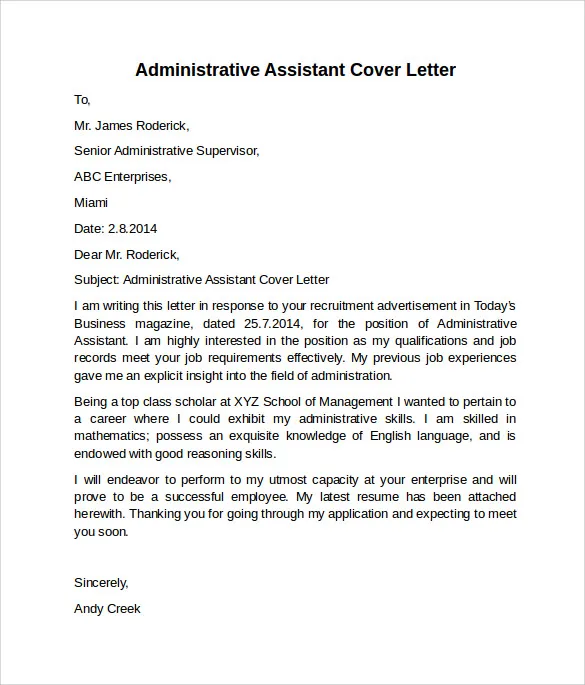
What Is an Administrative Cover Letter
An administrative cover letter is a crucial document that accompanies your resume when applying for administrative positions. It serves as a personal introduction, allowing you to highlight your key skills, experiences, and qualifications in a way that a resume alone cannot. Unlike a resume which is a factual rundown of your career, a cover letter provides a space to showcase your personality, enthusiasm, and specific alignment with the job requirements. The purpose is to convince the hiring manager that you are the best fit for the role. It’s your chance to make a positive first impression and differentiate yourself from other candidates. A well-crafted cover letter can significantly increase your chances of landing an interview, making it an essential part of your job application strategy. Therefore, investing time in creating a compelling cover letter is a worthwhile endeavor for anyone seeking an administrative role.
Why Is an Admin Cover Letter Important
An administrative cover letter is important because it is your opportunity to demonstrate how your skills and experience directly align with the specific requirements of the job. Hiring managers often receive numerous applications, and a cover letter allows you to tailor your application to the particular role and company. It helps you explain any gaps in your employment history or career changes, providing context that a resume might not. Furthermore, a cover letter gives you the chance to showcase your writing skills, attention to detail, and professionalism, which are highly valued in administrative roles. It allows you to express your enthusiasm for the position and the company, demonstrating your genuine interest and making you stand out from the competition. A strong cover letter can set you apart from other candidates and increase your chances of getting an interview.
Highlighting Key Skills

When highlighting your key skills in an administrative cover letter, it’s crucial to focus on those most relevant to the specific job description. Common skills to emphasize include organizational abilities, attention to detail, communication skills (both written and verbal), proficiency in relevant software (e.g., Microsoft Office suite), time management, and problem-solving. Provide specific examples of how you have used these skills in previous roles to achieve positive outcomes. For instance, instead of simply stating “organized,” you could say, “Successfully managed and organized all office documents and records, ensuring easy accessibility and retrieval, resulting in a 20% reduction in time spent on information retrieval.” This approach shows that you not only possess the skills but also have a track record of using them effectively.
Showcasing Experience
Your administrative cover letter should showcase your relevant experience in a way that demonstrates your competence and suitability for the role. Begin by providing a brief overview of your professional background, highlighting your most relevant positions and the duration of your employment. Detail specific responsibilities and accomplishments from each role, using action verbs to describe your contributions. For example, instead of saying “responsible for managing schedules,” write “Managed complex schedules for a team of 10 professionals, ensuring optimal time management and reducing scheduling conflicts by 15%.” Quantify your achievements whenever possible. This helps employers understand the impact of your work. Always tailor your experience to the job description, emphasizing the skills and experiences that align with the employer’s needs.
Quantifying Achievements
Quantifying your achievements in an administrative cover letter is a powerful way to demonstrate your impact and value to potential employers. Instead of general statements, use numbers, percentages, and specific data to illustrate your accomplishments. For example, if you improved office efficiency, mention the percentage of time or resources saved. If you managed projects, indicate the number of projects completed or the budget managed. If you streamlined a process, provide the percentage by which you reduced errors or improved accuracy. This approach provides concrete evidence of your abilities and makes your application more compelling. For example, “Implemented a new filing system that reduced document retrieval time by 30%” or “Managed a budget of $50,000, completing all projects within budget and on time.” Such details make your achievements far more impactful than generic claims.
Formatting Your Cover Letter

Choosing the Right Font and Size
Choosing the right font and size is crucial for readability and professionalism in your administrative cover letter. Stick to classic, easy-to-read fonts such as Times New Roman, Arial, Calibri, or Helvetica. The font size should be between 10 and 12 points to ensure the text is clear and legible. Avoid overly decorative or unusual fonts, which can distract the reader. Ensure consistent formatting throughout the document, including the font type, size, and spacing. Properly formatted cover letters look polished and demonstrates your attention to detail. Always proofread your document to ensure the font and size are consistent and that the layout is visually appealing.
Structuring Your Letter
Structuring your administrative cover letter effectively will make it easier for hiring managers to quickly grasp your key qualifications and why you are a good fit for the job. Begin with a clear and concise header that includes your contact information and the date. Address the letter to the hiring manager by name, if possible; if not, use a professional salutation such as “Dear Hiring Manager.” Structure the body of the letter into distinct paragraphs. Start with an engaging opening that states your interest and briefly mentions why you’re a good match. Follow with body paragraphs detailing your relevant skills and experience, using specific examples and quantifiable results. End with a strong closing paragraph that reiterates your interest, summarizes your key qualifications, and includes a call to action, such as requesting an interview. Maintain a logical flow throughout the letter, ensuring that each paragraph connects to the next and supports your overall message.
Essential Elements to Include

Contact Information and Date
Your administrative cover letter should begin with your contact information and the date. Include your full name, address, phone number, and professional email address at the top of the letter. This allows the hiring manager to easily reach you. Below your contact information, add the date you are sending the letter. If you know the name of the hiring manager, include their name, title, and the company’s address. If not, you can use a general title like “Hiring Manager.” Proper formatting of this section demonstrates professionalism and attention to detail, making your application appear more polished and easier for recruiters to manage.
Opening Paragraph - Captivating the Reader
The opening paragraph of your administrative cover letter is crucial; it’s your first chance to capture the reader’s attention and make a strong impression. Start by clearly stating the position you’re applying for and where you saw the job posting. Briefly express your enthusiasm for the role and the company. Then, include a concise statement about your key qualifications or a specific accomplishment that aligns with the job’s requirements. This opening should be engaging, demonstrating your understanding of the role and highlighting your most relevant skills or experience. Avoid generic openings; instead, tailor the first paragraph to the specific job and company to show your genuine interest and understanding. Aim to make the reader want to learn more about you.
Body Paragraphs - Detailing Your Value

The body paragraphs of your administrative cover letter are where you provide the details about your qualifications, skills, and experience. Use these paragraphs to showcase how your abilities match the job requirements. Focus on the skills and experience mentioned in the job description, providing specific examples of how you have used these skills in previous roles to achieve positive outcomes. Quantify your achievements whenever possible to demonstrate your impact. For example, if you improved office efficiency, state the percentage of time or resources saved. Each paragraph should focus on a specific skill or achievement, making it easy for the hiring manager to quickly assess your suitability for the role. Tailor your content to each job you apply for.
Closing Paragraph - Call to Action
The closing paragraph of your administrative cover letter should leave a strong and positive impression on the hiring manager. Reiterate your interest in the position and the company, demonstrating your enthusiasm and eagerness to contribute to the team. Summarize your key qualifications, emphasizing how your skills and experience align with the job requirements. End with a clear and confident call to action, such as requesting an interview. Include your contact information and express your gratitude for their time and consideration. A well-written closing paragraph not only reinforces your interest but also encourages the hiring manager to take the next step in the hiring process, increasing your chances of getting an interview.
Proofreading and Editing
Proofreading and editing your administrative cover letter is crucial for ensuring it is professional and error-free. Errors in grammar, spelling, or punctuation can undermine your credibility and make a negative impression on the hiring manager. Carefully read your cover letter multiple times, checking for any mistakes. It can be helpful to read your letter aloud or have a friend or colleague review it. Use a grammar and spell-checking tool. Check that your formatting is consistent and that your contact information is correct. Ensure your sentences are clear, concise, and easy to understand. Proofreading is a critical step in the job application process, because it shows that you pay attention to detail and take pride in your work.
Common Mistakes to Avoid

Avoiding common mistakes in your administrative cover letter can significantly improve your chances of making a positive impression. One of the biggest errors is sending a generic cover letter; always tailor your letter to the specific job and company. Avoid simply repeating the information from your resume; your cover letter should expand on your qualifications and provide context. Be sure to carefully proofread your letter for any grammar, spelling, or punctuation errors. Refrain from using overly casual language or slang. Do not include irrelevant information or personal details that are not related to the job. Avoid negative statements about previous employers or roles. Finally, make sure your cover letter is the appropriate length, typically one page.
Using a Professional Tone
Using a professional tone in your administrative cover letter is essential for conveying credibility and competence. Write in a clear, concise, and respectful manner. Avoid overly casual language, slang, or contractions. Maintain a positive and enthusiastic tone throughout the letter, demonstrating your genuine interest in the position and the company. Use formal language and proper grammar, spelling, and punctuation. Address the hiring manager correctly using a professional salutation, such as “Dear Mr./Ms./Mx. [Last Name].” When possible, tailor the tone to match the company culture, but always maintain a level of professionalism. This will help you present yourself as a serious candidate.