Understanding the Power of an Admin Assistant Cover Letter
In the competitive job market, especially for administrative assistant roles, a well-crafted cover letter can be your key to success. It’s more than just a formality; it’s your opportunity to make a strong first impression and showcase your personality, skills, and experience. A cover letter allows you to personalize your application, demonstrate your understanding of the role, and explain why you’re the perfect fit. It’s a chance to highlight your achievements and quantify your contributions in previous roles, setting you apart from other applicants who may only rely on their resumes. Think of your cover letter as a marketing document, selling your unique value proposition to the hiring manager. A compelling letter grabs attention and encourages them to delve into your resume, ultimately increasing your chances of landing an interview and securing your desired administrative assistant position.
Why a Cover Letter Matters for Administrative Assistants
Administrative assistant roles often involve dealing with sensitive information, managing schedules, and communicating with a diverse group of people. A cover letter offers a platform to illustrate these crucial soft skills. It provides context to your resume, clarifying how your skills align with the specific job requirements. Recruiters look for communication proficiency and organizational skills when they recruit for an administrative assistant. Your cover letter should provide clear examples of how you’ve successfully managed projects, resolved conflicts, or implemented efficient processes in the past. It can demonstrate your enthusiasm for the role and the company, showing that you’ve taken the time to research the organization and understand its needs. Therefore, a well-written cover letter can distinguish you from other candidates and increase your chances of getting called to the interview.
Highlighting Key Skills in Your Cover Letter

Administrative assistants need a variety of skills to thrive. When writing your cover letter, be sure to highlight the key skills relevant to the specific job description. This not only shows that you’re qualified, but it also demonstrates your attention to detail and ability to understand the requirements. Focus on the skills the employer values the most. Consider these crucial skills to be your key selling points when applying for the job.
Organizational Skills
Organizational skills are the backbone of any administrative role. In your cover letter, provide examples of how you’ve managed calendars, coordinated meetings, maintained files, or organized projects. Showcase how you’ve implemented systems that improved efficiency or reduced errors. If you’ve used any specific organizational tools or software, mention them. This demonstrates your ability to manage multiple tasks and prioritize effectively. Highlighting successful instances of managing schedules, booking travel, or organizing events helps make your case. The employer wants to know that you are able to plan and implement various administrative tasks.
Communication Skills
Effective communication is essential for administrative assistants. Your cover letter is your chance to demonstrate your written communication skills. Mention your experience with phone calls, email correspondence, and client interactions. Give examples of how you’ve handled challenging situations, resolved complaints, or built positive relationships with clients. Showcase your ability to communicate clearly, concisely, and professionally, both in writing and verbally. This may include your ability to communicate with people from diverse backgrounds and levels of seniority. Highlighting how you successfully facilitate communication between team members and clients proves your communication capabilities.
Technical Proficiency

Administrative assistants often rely on various software and technologies. Mention your proficiency in Microsoft Office Suite (Word, Excel, PowerPoint, Outlook), CRM software, and any other relevant tools. Detail your experience with data entry, report generation, and other tasks that require technical skills. Show that you can quickly learn new software and adapt to changing technologies. Mention your experience with virtual meeting platforms, project management software, and other modern office tools. Including details on software you know shows the employer you’re ready to work immediately.
Crafting a Compelling Cover Letter Structure
A well-structured cover letter makes a positive impact. The layout, content, and tone should all work together to create a compelling narrative. A logical, organized structure will help the hiring manager navigate your skills and experiences efficiently. This section will guide you to build the perfect cover letter.
Header and Contact Information
Begin your cover letter with a professional header that includes your name, address, phone number, and email address. This ensures the hiring manager can easily contact you. Always include the date, and the hiring manager’s name and title, if known, along with the company’s address. If the hiring manager’s name is unavailable, use a general greeting.
Professional Greeting

Start your cover letter with a professional greeting, such as “Dear Mr./Ms./Mx. [Last Name],” or “Dear Hiring Manager.” Avoid generic greetings like “To Whom It May Concern.” Research the hiring manager’s name and use it, if possible, as a personalized approach is always more effective. Make sure that you get the name right to show your attention to detail.
Opening Paragraph Engaging the Reader
Your opening paragraph should immediately grab the reader’s attention. State the position you’re applying for and briefly explain why you’re interested in the role and the company. Mention where you saw the job posting, and express your enthusiasm for the opportunity. Focus on what you can bring to the company. Use concise language and a strong hook to make a memorable first impression.
Body Paragraphs Showcasing Achievements
The body paragraphs are where you showcase your achievements and skills. Use these paragraphs to provide specific examples of your relevant experience. Tailor your examples to the requirements of the job description, highlighting the skills and experiences that align with the role. Use the STAR method (Situation, Task, Action, Result) to structure your examples, making them clear and impactful. Quantify your achievements whenever possible to demonstrate your value. Back up claims with facts.
Quantifying Accomplishments

Whenever possible, quantify your accomplishments to demonstrate your impact. Use numbers and data to show your achievements, such as the percentage of time you saved, the number of projects you managed, or the amount of money you helped save the company. For example, instead of saying “Improved office efficiency,” say “Implemented a new filing system that reduced document retrieval time by 30%.” This adds weight to your claims.
Tailoring to the Job Description
Customize your cover letter to each job application. Carefully review the job description and identify the key requirements and skills. Address those specific requirements in your cover letter, using the same keywords and phrases from the job posting. Show that you understand the role and are a good fit for the company’s culture and needs. Personalize your letter to each employer. This shows you have done your homework.
Closing Paragraph and Call to Action
In your closing paragraph, summarize your key qualifications and reiterate your interest in the position. Express your enthusiasm for the opportunity to contribute to the company. End with a call to action, such as “I am eager to discuss my qualifications further” or “I am available for an interview at your earliest convenience.” Thank the hiring manager for their time and consideration.
Formal Closing

Close your cover letter with a professional closing, such as “Sincerely,” “Best regards,” or “Thank you.” Sign your name if you’re submitting a hard copy or leave space for your signature if submitting an electronic version. Make sure your closing is professional and appropriate for the tone of your cover letter and the company culture.
Cover Letter Examples for Admin Assistant Roles
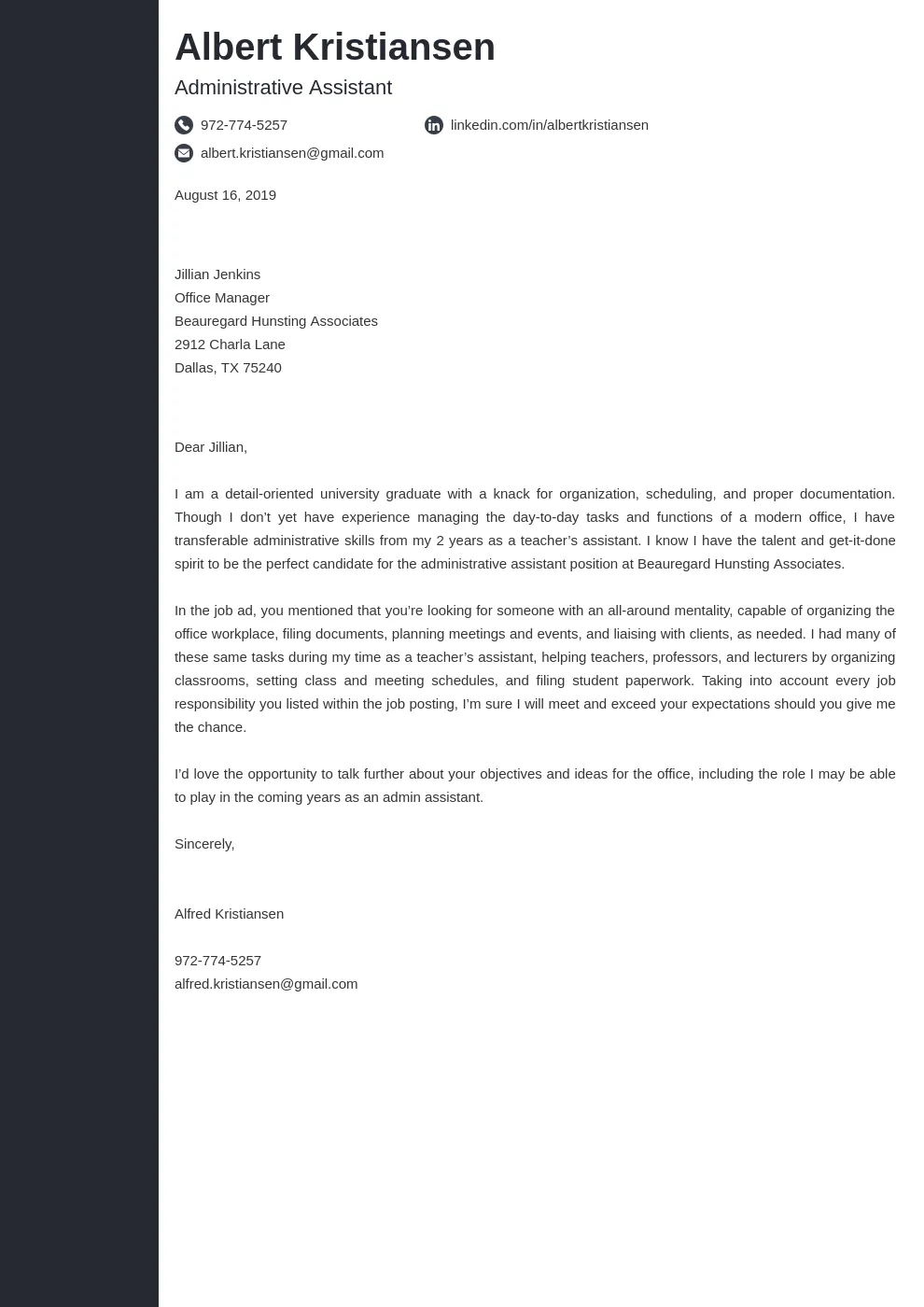
Reviewing cover letter examples can help you understand how to structure your own and highlight your unique skills and experience. Below are examples tailored for various experience levels and specializations.
Example 1 Entry-Level Administrative Assistant
This example is perfect for those new to the field or with limited experience. The focus should be on transferable skills, academic achievements, and any relevant internships or volunteer experiences. Highlight your eagerness to learn and your strong work ethic. Here’s an example:
[Your Name] [Your Address] [Your Phone] [Your Email]
[Date] [Hiring Manager Name] [Company Name] [Company Address]
Dear [Mr./Ms./Mx. Last Name],
I am writing to express my strong interest in the Administrative Assistant position at [Company Name], as advertised on [Platform]. As a recent graduate with a degree in [Your Degree] and a passion for organization and efficiency, I am eager to apply my skills in a professional setting.
During my internship at [Previous Company], I assisted with various administrative tasks, including managing schedules, handling correspondence, and organizing files. I learned the importance of communication and collaboration. I also developed my skills in [List relevant software or skills]. I am confident in my ability to quickly learn new software and processes and contribute to a positive work environment.
I am particularly drawn to [Company Name]’s commitment to [Mention company values or mission]. I am a detail-oriented, highly organized, and enthusiastic individual and am excited about the opportunity to support your team. I am available for an interview at your earliest convenience.
Sincerely, [Your Name]
Example 2 Experienced Admin Assistant

This example is suitable for experienced professionals looking to highlight their accomplishments and leadership skills. Focus on specific achievements, such as streamlining processes, managing projects, or improving office efficiency. Quantify your results to demonstrate your impact. Here’s an example:
[Your Name] [Your Address] [Your Phone] [Your Email]
[Date] [Hiring Manager Name] [Company Name] [Company Address]
Dear [Mr./Ms./Mx. Last Name],
I am writing to express my interest in the Administrative Assistant position at [Company Name], as advertised on [Platform]. With [Number] years of experience in administrative support, I am confident that my skills and expertise align perfectly with your requirements.
In my previous role at [Previous Company], I was responsible for managing calendars, coordinating travel arrangements, and preparing presentations for senior management. I implemented a new scheduling system that reduced meeting scheduling time by 20%. I also streamlined the expense reporting process, which saved the company 10 hours per month. I am adept at using Microsoft Office Suite, and other relevant software. I have a proven track record of providing excellent administrative support.
I am particularly excited about the opportunity to contribute to [Company Name]’s mission. I am a highly organized, detail-oriented, and results-driven professional. I am confident in my ability to quickly learn new processes. I look forward to discussing my qualifications further. I am available for an interview at your earliest convenience.
Sincerely, [Your Name]
Example 3 Admin Assistant with Specialized Skills
This example focuses on specialized skills, such as experience in a specific industry or with particular software. Tailor your cover letter to showcase your expertise in these areas. Emphasize how your skills can benefit the company. Here’s an example:
[Your Name] [Your Address] [Your Phone] [Your Email]
[Date] [Hiring Manager Name] [Company Name] [Company Address]
Dear [Mr./Ms./Mx. Last Name],
I am writing to express my interest in the Administrative Assistant position at [Company Name], as advertised on [Platform]. With my background in the [Industry] industry and my proficiency in [Specialized Software], I am confident that I can make a significant contribution to your team.
In my previous role at [Previous Company], I managed all aspects of administrative support, including data entry, report generation, and client communication. I have extensive experience with [Specialized Software] and used it to improve efficiency and accuracy in the reporting process. I am experienced in providing support to a team of professionals. I am highly organized, detail-oriented, and results-driven.
I am particularly excited about the opportunity to bring my expertise to [Company Name]. I am eager to learn new processes and contribute to a positive work environment. I look forward to discussing my qualifications further. I am available for an interview at your earliest convenience.
Sincerely, [Your Name]
Common Mistakes to Avoid in Your Cover Letter
Avoiding common mistakes can significantly increase your chances of getting an interview. This section identifies the most frequent pitfalls and provides guidance on how to avoid them. Your cover letter must show your capabilities and should make a good impression.
Typos and Grammatical Errors

Typos and grammatical errors can damage your credibility and make you appear unprofessional. Always proofread your cover letter carefully before submitting it. Use a spell checker and grammar checker. Consider asking a friend or colleague to review your letter for errors. Proofreading is an important part of the job application process.
Generic Cover Letters
Avoid using a generic cover letter that is not tailored to the specific job or company. Employers can easily spot generic cover letters. Customize each cover letter to the specific requirements of the job description and show that you understand the company’s values and needs. Research the company and tailor your letter accordingly.
Focusing on Responsibilities
While it’s important to mention your responsibilities, don’t solely focus on them. Instead, highlight your achievements and the impact you’ve made in previous roles. Provide specific examples of how you’ve contributed to the success of your previous employers. Focus on what you have done, not what you were tasked with doing.
Tips for a Standout Admin Assistant Cover Letter
Make your cover letter stand out from the crowd. These additional tips will help you further optimize your cover letter to make an impression.
Showcasing Your Personality
Let your personality shine through in your cover letter. While maintaining a professional tone, let your enthusiasm for the role and company come through. Use a friendly, approachable writing style and add a touch of your personality. Make sure the letter does not sound too robotic.
Proofreading and Editing
Always proofread and edit your cover letter multiple times. Check for typos, grammatical errors, and clarity. Have someone else review your letter for a fresh perspective. Ensure your cover letter is free from errors and easy to read.
Seeking Feedback
Ask a career counselor, mentor, or trusted colleague to review your cover letter and provide feedback. They can offer valuable insights on your writing, content, and overall presentation. Their objective perspective can help you refine your cover letter and increase your chances of success. Consider the feedback and edit your letter accordingly.
Conclusion: Your Cover Letter Success
In conclusion, a well-crafted cover letter is a critical tool in securing an administrative assistant position. By understanding its importance, highlighting your key skills, structuring your letter effectively, and avoiding common mistakes, you can significantly increase your chances of landing an interview. Use the provided examples as a guide and tailor your cover letter to each job application. Remember to proofread and seek feedback. With a compelling cover letter, you’ll be well on your way to securing your dream job. Good luck with your job search!