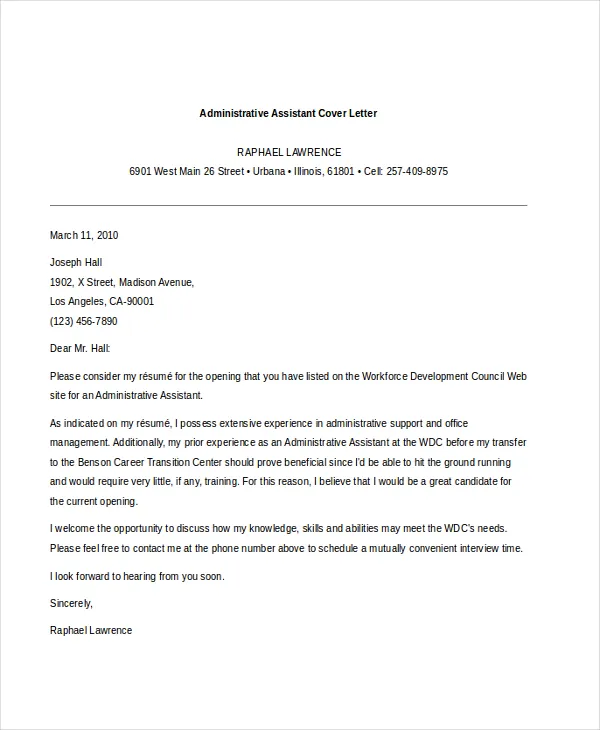
Why a Great Administrative Cover Letter Matters
In the competitive landscape of administrative positions, a well-crafted cover letter is your first and often most crucial opportunity to make a strong impression. It’s not merely a formality; it’s a strategic tool that sets the stage for your application and showcases your suitability for the role. A compelling cover letter provides context to your resume, allowing you to elaborate on your experiences, highlight key skills, and demonstrate your personality. It gives you the chance to articulate your career goals and explain why you are a perfect fit for the specific administrative role and the company. Failing to invest time in a well-written cover letter can result in your application being overlooked, regardless of your qualifications. This guide will provide you with key tips and strategies to create a cover letter that stands out and captures the attention of hiring managers, increasing your chances of securing an interview.
Highlighting Your Skills & Experience
Your cover letter is the ideal space to highlight the skills and experience most relevant to the administrative position you are applying for. Go beyond simply listing your qualifications, and instead, focus on demonstrating how your skills align with the specific requirements outlined in the job description. Consider the core duties of the administrative role, such as managing schedules, handling correspondence, coordinating meetings, and maintaining records. When describing your experience, provide specific examples that showcase your proficiency in these areas. For example, instead of writing, “Managed office correspondence,” you can say, “Efficiently managed all incoming and outgoing office correspondence, reducing response times by 20% and improving communication flow.” By doing so, you not only highlight your skills but also provide measurable results that demonstrate your value to the potential employer.
Key Skills to Showcase

Administrative positions require a blend of hard and soft skills. When writing your cover letter, highlight the skills that are most relevant to the role. Here are some key skills to showcase: attention to detail, organizational abilities, communication skills (written and verbal), time management, problem-solving, and proficiency in relevant software. When describing your skills, use action verbs to bring them to life. For example, instead of writing “Organized files,” try “Developed and implemented a new filing system that improved document retrieval time by 25%.” This specific detail immediately provides value and demonstrates your proactive approach. Tailor your skill selection to the job description; some positions may require advanced computer skills or specific industry knowledge. By focusing on the skills that directly address the requirements of the job, you increase your chances of making a positive impression.
Administrative Software Proficiency
In today’s administrative roles, proficiency in various software programs is a must-have skill. When writing your cover letter, be sure to list the specific software you are skilled in, such as Microsoft Office Suite (Word, Excel, PowerPoint, Outlook), Google Workspace (Docs, Sheets, Slides, Gmail), and any industry-specific software. Mention the extent of your proficiency; for example, whether you have basic, intermediate, or advanced skills. Provide examples of how you have used this software to accomplish tasks in previous roles. For instance, instead of simply stating, “Proficient in Excel,” you could say, “Utilized Excel to create and manage complex spreadsheets, analyze financial data, and generate reports for monthly performance reviews.” Highlighting this proficiency will help you stand out and demonstrate you can immediately contribute to the administrative needs of the organization.
Communication and Interpersonal Abilities
Strong communication and interpersonal skills are vital for administrative roles. Your cover letter is an opportunity to show that you possess these skills. Start by demonstrating your written communication abilities, ensuring that your cover letter is well-written, free of grammatical errors, and clearly conveys your thoughts. Also, describe your experience with verbal communication, such as answering phone calls, assisting clients, and coordinating meetings. Give concrete examples of how you’ve used your communication skills to resolve issues, build relationships, and facilitate successful outcomes. For example, “Effectively communicated with clients to address inquiries and resolve issues, leading to a 15% increase in client satisfaction.” Being able to show that you’re not only able to communicate but able to do it effectively is critical.
Quantifying Achievements for Impact

One of the most effective ways to make your cover letter stand out is to quantify your achievements. Instead of simply stating that you improved a process or streamlined operations, provide specific metrics that demonstrate the impact of your work. For example, instead of saying “Improved office efficiency,” you could say “Improved office efficiency by 15% through the implementation of new workflow processes.” The use of numbers and data makes your claims more credible and provides concrete evidence of your skills and abilities. Focus on achievements that are relevant to the administrative role you are applying for, such as saving time, reducing costs, improving accuracy, or increasing productivity. Be specific and use data to support your claims to show the hiring manager that you can create real value for the organization.
Using Numbers to Demonstrate Success
Numbers are powerful tools in demonstrating your success in administrative positions. Use quantifiable data to highlight your accomplishments. Did you reduce errors in data entry? Mention by how much. Did you improve response times to customer inquiries? Provide the percentage. Did you manage a budget and come in under budget? State the amount saved. For example, “Managed a budget of $100,000 and completed projects 10% under budget.” Numbers provide a clear and concise understanding of your contributions and help the hiring manager quickly assess your capabilities. When incorporating numbers, make sure they are accurate, and the context is clear. For example, if you’re mentioning that you managed a large number of invoices, clarify the time frame (e.g., “Managed over 500 invoices per month”).
Showcasing Relevant Experience
Focus on the experience that is most relevant to the administrative position you’re applying for. Review the job description carefully and identify the key requirements and responsibilities. Then, structure your cover letter to demonstrate how your past roles align with these requirements. Use each paragraph to highlight a specific skill or experience that matches a need of the hiring company. For example, if the job requires experience with scheduling meetings, provide examples of how you’ve successfully managed calendars and coordinated meetings in the past. If it mentions experience in document management, detail your experience with filing systems, record-keeping, and document retrieval. Showcasing only the most relevant experience demonstrates that you understand the needs of the role and can immediately contribute to the organization. Remember, the goal is to convince the hiring manager that you possess the skills and experience needed to excel in the position.
Tailoring Your Cover Letter

Generic cover letters are easily identified and are often discarded. Tailoring your cover letter to each specific job is essential for making a positive impression. Customization shows that you have taken the time to understand the requirements of the role and the values of the company. Before writing your cover letter, carefully review the job description and identify the key skills, qualifications, and responsibilities. Then, customize your letter to address these specific requirements. Highlight the skills and experiences that align with the job description, and provide examples that demonstrate your proficiency. Avoid using generic phrases or templates; instead, use unique wording to make your letter stand out. This also shows that you have a genuine interest in the position and are not just sending out a mass application.
Researching the Company
Demonstrate your interest and understanding of the company by researching the organization before you start writing your cover letter. Visit the company website, review their social media profiles, and read any recent news articles or press releases. Understanding the company’s mission, values, and current projects will help you tailor your cover letter to align with their specific needs. Mentioning specific company initiatives or goals in your cover letter can show that you are genuinely interested in the position and are aware of their operations. For example, if the company emphasizes teamwork, you can share an experience that highlighted your ability to collaborate effectively with others. Use your research to ensure your cover letter is relevant and reflects your understanding of the company and its culture.
Customizing for Each Position
Even if you are applying for similar administrative positions, each job description will have unique requirements. Therefore, tailoring your cover letter to each specific position is essential. Once you have researched the company, thoroughly review the job description again to identify the key responsibilities and required qualifications. Then, customize your cover letter to highlight the skills and experiences that best match the job’s needs. Use the language from the job description in your cover letter to demonstrate that you understand the role. For example, if the job description emphasizes proficiency in a specific software, mention your experience with that software and provide examples of how you’ve used it in the past. By tailoring your cover letter to each position, you show the hiring manager that you are the right candidate and significantly increase your chances of securing an interview.
Formatting and Presentation

The appearance of your cover letter is as important as its content. A well-formatted and visually appealing cover letter demonstrates professionalism and attention to detail, which are crucial for administrative positions. Ensure your cover letter is easy to read, uses a clear font, and has consistent formatting throughout. Proper formatting makes your letter more readable and helps the hiring manager quickly find the information they are looking for. Pay attention to the overall layout, including margins, line spacing, and paragraph alignment. A clean, organized format enhances the readability and ensures your cover letter looks polished and professional. This attention to detail will show your respect for the hiring manager’s time and highlight your commitment to excellence.
Professional Formatting Tips
Choose a professional font, such as Times New Roman, Arial, or Calibri, and maintain a consistent font size (11 or 12 points) throughout your cover letter. Use single-spacing for the text and double-spacing between paragraphs to enhance readability. Set margins to 1 inch on all sides to provide ample white space. Include your contact information (name, phone number, email address) at the top, and the date and the hiring manager’s contact information (if known) at the top of the letter. Use clear, concise language and avoid long blocks of text. Break up your paragraphs to make the content more digestible. Use bullet points where appropriate to highlight key skills or achievements. The overall goal is to create a cover letter that is visually appealing, easy to read, and professional in appearance. These formatting elements will make a positive impact on the hiring manager.
Proofreading and Editing
Before submitting your cover letter, it’s essential to proofread and edit it carefully. A cover letter riddled with errors reflects poorly on your attention to detail and professionalism. Mistakes can create the impression that you are not serious about the application or that you lack the skills necessary for the job. Proofreading is the final stage, so make sure you check for grammatical errors, spelling mistakes, and punctuation issues. Read your cover letter aloud to catch any awkward phrasing or sentence structures. Have someone else review your cover letter. A fresh pair of eyes can catch errors that you might have missed. Consider using grammar-checking software or online tools. Investing time in proofreading and editing is a crucial step in ensuring your cover letter is error-free and conveys your skills and experience clearly and professionally. Doing so will significantly enhance your chances of getting an interview.
Avoiding Common Mistakes

There are several common mistakes that can undermine your cover letter. Avoiding these errors will significantly improve your application. Don’t use a generic or overly formal tone. Keep your tone conversational and professional. Avoid providing too much personal information. Focus solely on your qualifications and how they relate to the job. Don’t include irrelevant information that does not relate to the job description. For example, avoid discussing hobbies that do not add value. Do not make negative statements about your previous employers. Always maintain a positive tone. By being aware of these common mistakes, you can make sure your cover letter represents you professionally.
Errors to Avoid
Many errors can damage the effectiveness of your cover letter. Avoid the most common pitfalls. Avoid typos and grammatical errors, which can make you appear careless. Don’t make the cover letter too long; keep it concise and relevant to the job. Don’t use cliches or generic phrases. Instead, use unique and specific language that showcases your skills and experience. Do not send a cover letter that isn’t personalized; tailoring your letter to each job shows your interest. Don’t misspell the hiring manager’s name or the company’s name. Always double-check these details. Avoiding these errors can significantly increase the impact of your cover letter, helping you make a positive impression on the hiring manager.
Overused Phrases
Many overused phrases can make your cover letter sound generic. Avoid these common cliches to make your letter unique and compelling. Avoid starting your cover letter with, “I am writing to express my interest.” Instead, begin with a strong opening that grabs the reader’s attention. Stay away from phrases like, “I am a team player.” Instead, provide specific examples of how you’ve collaborated effectively with others. Avoid using phrases such as, “I am a hard worker.” Demonstrate this by highlighting your achievements and the results you have delivered. Do not include statements such as, “I am writing to apply for the position.” Instead, clearly state the position you’re applying for and how your skills align. By avoiding these overused phrases, you create a cover letter that is original and shows your individuality.
Call to Action & Closing

The conclusion of your cover letter is your last chance to make a strong impression. A well-crafted call to action and a confident closing can significantly increase your chances of securing an interview. You should restate your interest in the position and briefly summarize why you are a good fit. Express your enthusiasm for the opportunity and demonstrate your understanding of the company’s goals. Your call to action should make it easy for the hiring manager to contact you. Provide your contact information again and indicate your availability for an interview. A strong closing should be confident and professional. A simple closing such as, “I look forward to hearing from you” is a safe option. Ensure your closing is professional and reflects your enthusiasm for the opportunity. This final step can create a strong and positive lasting impression.
Ending with Confidence
Your closing should reflect your confidence and your eagerness for the position. Instead of using generic phrases, tailor your closing to the job. Reiterate your interest in the role and reference the most relevant skills or experiences you’ve highlighted in your cover letter. Keep your closing concise and to the point. A professional closing can be as simple as, “I am eager to learn more about this opportunity and discuss how my skills and experience can benefit your organization.” State your availability for an interview and include your contact information again. Ensure your closing matches the tone of the rest of your cover letter: professional, enthusiastic, and tailored to the job. By ending with confidence, you leave a lasting impression and increase your chances of a positive response.
Contact Information
Always provide your contact information at the end of your cover letter. This makes it easy for the hiring manager to reach you. Include your phone number, your professional email address, and your LinkedIn profile URL. Double-check the accuracy of your contact information. It’s essential that the hiring manager can easily reach you. Ensure that your voicemail greeting is professional. If you have a professional online presence, make sure to include it. Make it easy for the hiring manager to reach you, so you don’t miss any job opportunities. Providing clear, accurate, and easy-to-find contact information increases your chances of getting a call or an email.