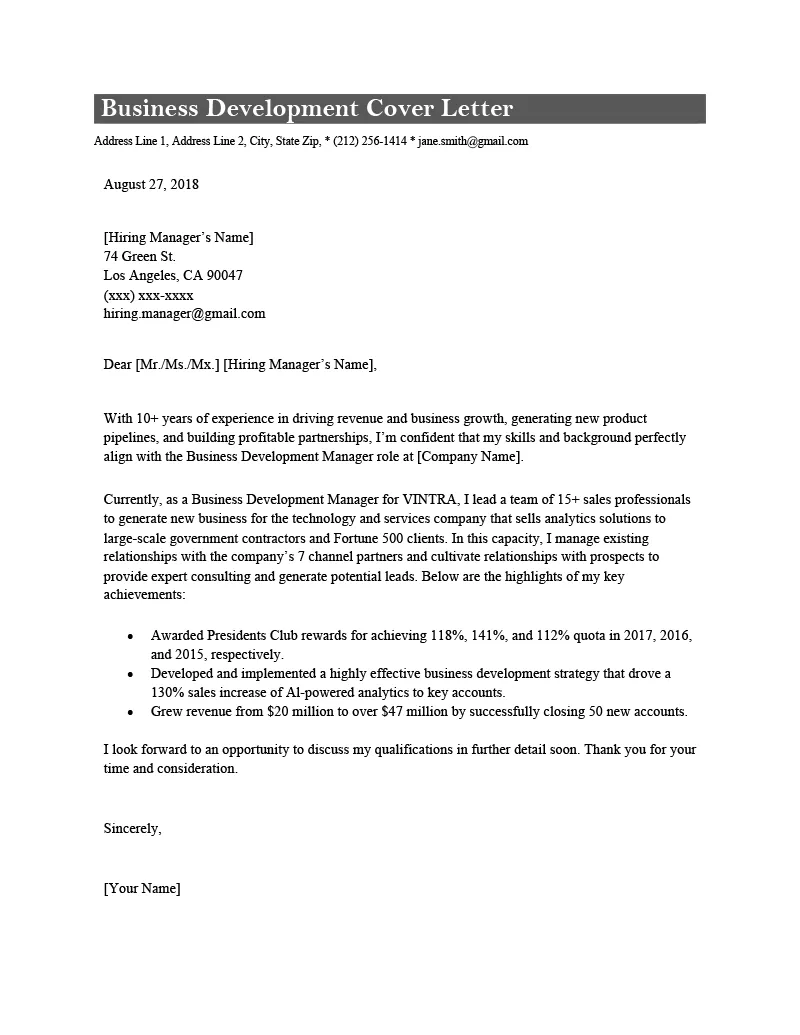
Understanding the Importance of a Business Development Cover Letter
A business development cover letter is your first, and sometimes only, opportunity to make a strong impression on a potential employer. It’s more than just a formality; it’s a crucial tool in showcasing your skills, experience, and enthusiasm for a specific role. In a competitive job market, a well-crafted cover letter can be the deciding factor in whether you land an interview or get passed over. It allows you to go beyond the bullet points of your resume and tell a compelling story about why you are the perfect fit for the company and the position. A great cover letter demonstrates your understanding of the business development field and your ability to contribute to the company’s growth.
Why a Cover Letter Matters
Your cover letter provides context to your resume. It gives you the space to elaborate on your achievements and explain how your skills align with the specific requirements of the job. This personalized approach can significantly increase your chances of getting noticed. Many hiring managers consider a cover letter as a reflection of your communication skills, attention to detail, and your genuine interest in the role and the company. A strong cover letter highlights your ability to think strategically and articulate your value proposition effectively.
Highlighting Your Achievements

Instead of just listing your responsibilities, a cover letter should focus on your accomplishments. Use the STAR method (Situation, Task, Action, Result) to describe your achievements in previous roles. For example, instead of saying “Managed sales team,” you could write, “Led a sales team of 10, resulting in a 20% increase in quarterly revenue through the implementation of a new sales strategy.” This approach demonstrates your ability to deliver results and contribute to the company’s bottom line. Showcasing quantifiable achievements makes your application more compelling and memorable. Use action verbs and specific examples to illustrate your success and highlight your skills.
Key Components of a Successful Business Development Cover Letter
Crafting a successful business development cover letter involves several key components, each playing a crucial role in making a positive impression on the hiring manager. From the header to the closing, every element must be carefully considered and tailored to the specific job and company. The goal is to present yourself as a well-rounded professional with the skills, experience, and enthusiasm needed to succeed in the role.
Header and Contact Information
Start with a professional header that includes your full name, contact information (phone number, email address, and LinkedIn profile URL), and the date. If you know the hiring manager’s name, include it as well. This section sets the tone for the entire letter and ensures the recipient can easily reach you. Make sure your email address is professional; avoid using nicknames or informal addresses.
Professional Salutation

Use a professional salutation, such as “Dear Mr./Ms. [Last Name],” if you know the hiring manager’s name. If you don’t know the name, “Dear Hiring Manager” is a suitable alternative. Avoid generic greetings like “To Whom It May Concern.” Addressing the recipient by name shows that you have done your research and are genuinely interested in the role. Always double-check the spelling of the name to avoid making a negative first impression.
Opening Paragraph
The opening paragraph should grab the reader’s attention immediately. State the position you are applying for and briefly explain where you found the job posting. Express your enthusiasm for the role and the company, and mention something specific that attracted you to the opportunity. This paragraph sets the stage for the rest of your letter and encourages the reader to continue reading. Be concise and focused on the most important aspects of why you are interested.
Body Paragraphs
The body paragraphs are where you showcase your skills, experience, and achievements. Use this space to elaborate on your qualifications and explain how they align with the job requirements. This section should provide specific examples of your accomplishments and demonstrate your ability to contribute to the company’s goals. Organize your content logically, using clear and concise language. Focus on what you can bring to the table and how you have delivered results in the past.
Showcasing Relevant Experience

Focus on the experience that is most relevant to the business development role. Highlight your experience in sales, marketing, lead generation, and client relationship management. Provide details about your previous roles, the companies you worked for, and the specific tasks you performed. Tailor this information to the job description, emphasizing the skills and experiences that the employer is looking for. Mention any industry-specific knowledge or experience that is relevant to the company’s field.
Quantifying Accomplishments
Wherever possible, quantify your accomplishments with specific numbers and metrics. For example, instead of saying “Increased sales,” say “Increased sales by 15% within one year.” Use data to demonstrate the impact of your work and provide concrete evidence of your success. Quantifiable achievements are more persuasive and make a stronger case for your qualifications. Use metrics like revenue growth, customer acquisition rates, cost savings, and market share gains.
Highlighting Skills
Highlight the skills that are most important for the business development role. This includes skills such as communication, negotiation, problem-solving, strategic thinking, and leadership. Provide examples of how you have used these skills in the past to achieve positive results. Be specific and provide context. Mention any software or tools that you are proficient in, such as CRM systems or project management software. Tailor your skills to match the job requirements.
Expressing Enthusiasm

Throughout your cover letter, express your genuine enthusiasm for the role and the company. Show that you have researched the company and understand its mission, values, and goals. Explain why you are excited about the opportunity and what you hope to achieve. Demonstrate your passion for business development and your commitment to helping the company succeed. Enthusiasm is contagious and can make you stand out from other candidates.
Call to Action and Closing
In your closing paragraph, include a call to action. Express your interest in an interview and provide your availability. Thank the hiring manager for their time and consideration. Use a professional closing, such as “Sincerely” or “Best regards,” followed by your name. Review the entire letter to ensure it flows well and conveys your key strengths and interest in the role. Proofread carefully for any errors before submitting.
Formatting and Design Tips
The formatting and design of your cover letter can significantly impact its readability and overall effectiveness. A well-formatted cover letter is easier to read and makes a positive impression on the hiring manager. The goal is to present your information clearly and professionally. Pay attention to every detail.
Font and Readability

Choose a professional and easy-to-read font, such as Times New Roman, Arial, or Calibri. Use a font size of 11 or 12 points. Ensure that the font is consistent throughout the letter. Use appropriate spacing and margins to make the letter visually appealing. Avoid using excessive bolding or underlining, as this can make the letter look cluttered. Keep the layout clean and uncluttered to improve readability.
Length Considerations
Keep your cover letter concise and to the point. Ideally, it should be no more than one page long. Use clear and concise language, avoiding unnecessary jargon or filler words. Focus on the most relevant information and avoid repeating information that is already in your resume. Brevity is key, as hiring managers often have limited time to review applications.
Proofreading and Editing
Proofread your cover letter carefully for any typos, grammatical errors, or inconsistencies. Errors can create a negative impression and detract from your qualifications. Use a grammar checker and spell checker, but also read the letter aloud to catch any errors that might be missed. Ask a friend or colleague to review your letter as well. Ensure that the formatting is consistent and that the letter is free of any errors that could reflect poorly on your attention to detail.
Tailoring Your Cover Letter

A generic cover letter is unlikely to impress a hiring manager. Tailoring your cover letter to each job application is essential. This shows that you have taken the time to understand the role and the company and are genuinely interested in the opportunity. Customizing your cover letter increases your chances of success. Focus on the requirements of the specific job and company.
Researching the Company
Before writing your cover letter, research the company thoroughly. Visit their website, read their “About Us” page, and review their social media profiles. Understand their mission, values, products, services, and target market. This information will help you tailor your cover letter to the company’s specific needs and demonstrate your interest in the role and the organization. Show that you understand the company’s goals and how your skills and experience align with those goals.
Customizing for the Role
Carefully review the job description and identify the key requirements and qualifications. Tailor your cover letter to highlight your skills and experiences that match those requirements. Use the same keywords and phrases that are used in the job description. Provide specific examples of how you have demonstrated those skills in the past. This ensures that your cover letter is directly relevant to the role and makes a strong case for your candidacy.
Keywords and Applicant Tracking Systems

Many companies use Applicant Tracking Systems (ATS) to screen resumes and cover letters. These systems scan for keywords and phrases that match the job description. To increase your chances of passing the ATS, include relevant keywords and phrases in your cover letter. Read the job description carefully and incorporate the most important keywords naturally. Avoid keyword stuffing, which can make your cover letter appear unnatural. Use the keywords in a way that makes sense in the context of your skills and experience.
Common Mistakes to Avoid
Avoiding common mistakes can significantly increase your chances of success. Simple errors can undermine your application and create a negative impression. Attention to detail is a key skill in business development. Ensure that your cover letter reflects your professionalism and attention to detail by avoiding these common pitfalls.
Generic Content
Avoid using a generic cover letter template that is not tailored to the specific job or company. Generic content shows a lack of effort and may suggest that you are not genuinely interested in the role. Customize your cover letter for each application, highlighting your relevant skills, experience, and enthusiasm for the specific opportunity. Research the company and address the hiring manager by name whenever possible. Show that you have taken the time to understand their needs and are a good fit for the role.
Typos and Grammatical Errors
Typos and grammatical errors can undermine your credibility and create a negative impression. Always proofread your cover letter carefully before submitting it. Use a grammar checker and spell checker, but also read the letter aloud to catch any errors that might be missed. Ask a friend or colleague to review your letter as well. A cover letter filled with errors suggests a lack of attention to detail and a lack of professionalism.
Lack of Enthusiasm
A cover letter should express your enthusiasm for the role and the company. Avoid using a tone that is too formal or impersonal. Show that you are genuinely interested in the opportunity and excited about the prospect of contributing to the company’s success. Use language that conveys your passion for business development and your desire to learn and grow within the organization. A cover letter that lacks enthusiasm is unlikely to capture the hiring manager’s attention.