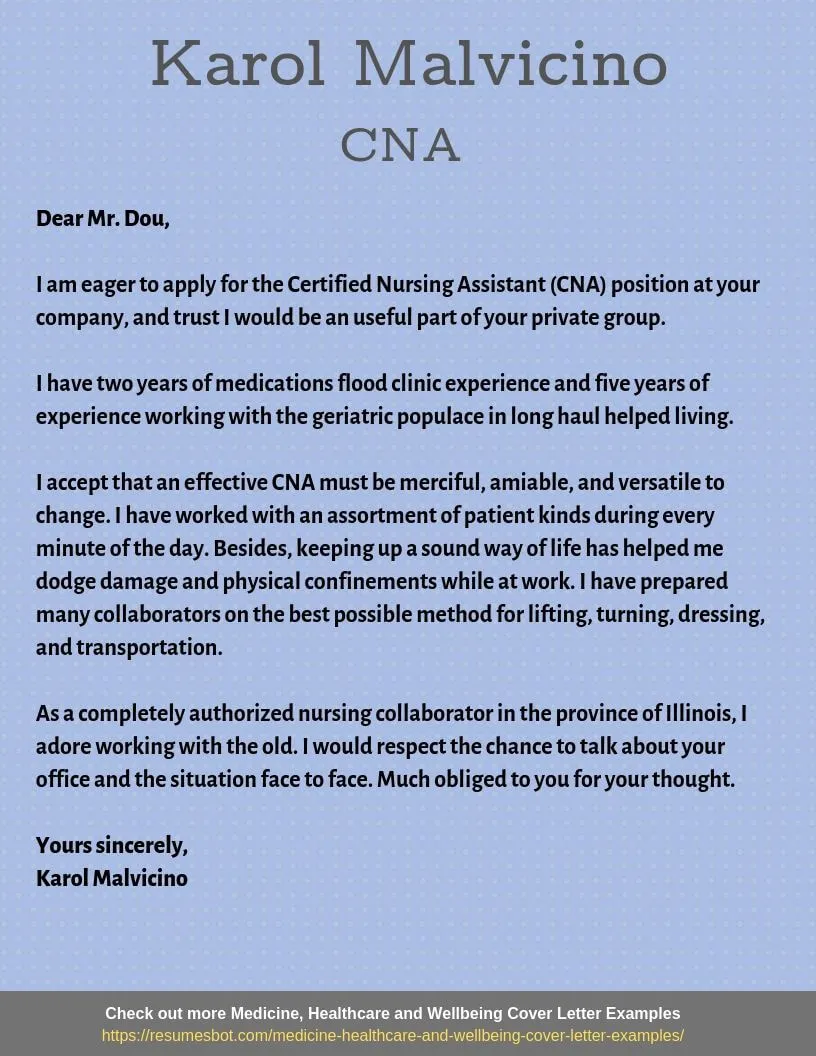
Why You Need a CNA Cover Letter
A Certified Nursing Assistant (CNA) cover letter is more than just a formality it’s your first opportunity to make a strong impression and demonstrate why you’re the perfect fit for a particular role. In a competitive job market, especially within healthcare, a well-crafted cover letter can set you apart from other applicants. It offers a space to expand on the information in your resume, showcasing your personality, passion for patient care, and specific skills that align with the job requirements. Think of it as your personal introduction, allowing you to highlight your enthusiasm and make a connection with the hiring manager before they even consider your resume. By taking the time to write a compelling CNA cover letter, you increase your chances of securing an interview and ultimately landing your desired position. It is an essential tool for any CNA looking to advance their career and make a meaningful impact on patients’ lives.
What to Include in Your CNA Cover Letter
A comprehensive CNA cover letter should include specific elements that effectively communicate your qualifications and suitability for the role. Start with your contact information and the date, followed by the hiring manager’s name and the facility’s address if known. Then, craft an introductory paragraph that immediately grabs the reader’s attention by stating the position you’re applying for and how you learned about the opportunity. The body of your letter should highlight your relevant skills and experiences, such as patient care, vital sign monitoring, and assisting with daily living activities. Mention any certifications and licenses you possess, ensuring they are up-to-date. Most importantly, demonstrate your passion for patient care by mentioning your ability to build rapport with patients, provide emotional support, and work as part of a team. Close your letter with a call to action, expressing your enthusiasm for an interview and thanking the hiring manager for their time and consideration.
Contact Information

Begin your cover letter by providing your full name, address, phone number, and professional email address. Ensure that your contact information is accurate and up-to-date. This section allows the hiring manager to easily reach you. Your email address should be professional. Double-check all the information to avoid errors. The contact information should be located at the top of the letter, either on the left or right side, depending on your preferred format. This allows for easy access, as it is visible without having to scroll through the document.
The Introductory Paragraph
The introductory paragraph is crucial, as it’s your first opportunity to make a positive impression. Start by clearly stating the position you’re applying for, making it obvious that you’re a qualified candidate. Briefly mention how you learned about the job opening (e.g., through a job board, a referral, or the company’s website). Express your enthusiasm for the opportunity and explain why you are drawn to this specific role or facility. If you have any relevant connections or experiences that immediately align with the job, briefly mention them. The goal is to capture the reader’s attention from the outset and make them want to read further, showcasing your enthusiasm and highlighting your suitability for the role.
Highlighting Skills and Experience
This section is the core of your cover letter, where you showcase your skills and experience as a CNA. Focus on the key requirements outlined in the job description and provide specific examples of how you’ve demonstrated those skills in previous roles. Mention your experience with patient care, including tasks such as assisting with bathing, dressing, and feeding. Highlight your ability to monitor vital signs, administer medications, and provide emotional support to patients and their families. Quantify your achievements whenever possible. For instance, instead of saying ‘Provided excellent care,’ say ‘Consistently provided compassionate care to a caseload of 15+ patients.’ Tailor your skills and experience to align with the requirements of the specific job, emphasizing how your background makes you the ideal candidate. This section’s strength will directly influence the hiring manager’s perception of your capabilities.
Certifications and Licenses

Clearly state your CNA certification and any other relevant licenses or certifications. Include the issuing authority, the certification number, and the expiration date. Confirm that your certifications are current and valid, as this is crucial for CNA roles. If you possess additional certifications like CPR or First Aid, mention them as well. This demonstrates your commitment to patient safety and your preparedness for any medical emergencies. Emphasize any specialized training that relates to the job, such as experience with specific patient populations or medical equipment. Highlighting these certifications assures the employer of your credentials. This section must be accurate, as the employer relies on this information to ensure compliance.
Emphasizing Passion and Patient Care
Healthcare is all about compassion, empathy, and dedication. In your cover letter, clearly state your passion for caring for others. Share specific instances where you’ve gone above and beyond to provide excellent patient care, showing genuine empathy and understanding. Discuss your ability to build strong relationships with patients and their families, ensuring that their emotional and physical needs are met. Mention your teamwork skills and your ability to collaborate effectively with nurses and other healthcare professionals. Demonstrate a genuine interest in the well-being of patients, assuring the hiring manager that you’re not just performing a job, but truly care about making a positive difference in people’s lives. Provide specific examples of how you have made patients feel comfortable.
Closing Your Cover Letter
In your closing paragraph, summarize your key qualifications and reiterate your interest in the position. Express your enthusiasm for the opportunity to discuss your qualifications further in an interview. Thank the hiring manager for their time and consideration. Include a call to action, such as stating that you’re available for an interview at their earliest convenience, which demonstrates your initiative and eagerness. Make sure to include your phone number and email again, as a reminder. End with a professional closing, such as “Sincerely” or “Respectfully,” followed by your full name. This final section should leave a lasting, positive impression, encouraging the hiring manager to contact you.
Proofreading and Formatting Tips

Before submitting your cover letter, proofread it meticulously for any grammatical errors, spelling mistakes, or typos. Ensure that your language is professional and clear, using concise and impactful sentences. Carefully format your letter for readability, using a standard font like Times New Roman or Arial, and a font size between 10 and 12 points. Use clear and concise spacing between paragraphs and sections. Make sure that your letter is well-organized and easy to read. Consider having someone else review your cover letter to catch any errors you might have missed. A polished, error-free cover letter demonstrates your attention to detail and professionalism, which is critical in healthcare. Make sure that the layout is clean and the information is easily accessible. Proofreading is a critical step in the job search.
CNA Cover Letter Examples
Reviewing CNA cover letter examples can provide valuable insight into structuring your own letter and highlighting your skills effectively. Look for examples that match the specific roles or facilities you’re applying to. Pay attention to how the candidates showcase their experience, skills, and passion for patient care. Use these examples as inspiration, tailoring them to reflect your unique qualifications and the job requirements. Remember that your cover letter should be original and reflect your individual personality and career goals. Take what you need from the examples and adapt them to make them your own. Be sure to adapt the example to reflect your own achievements, and provide your own personal spin.