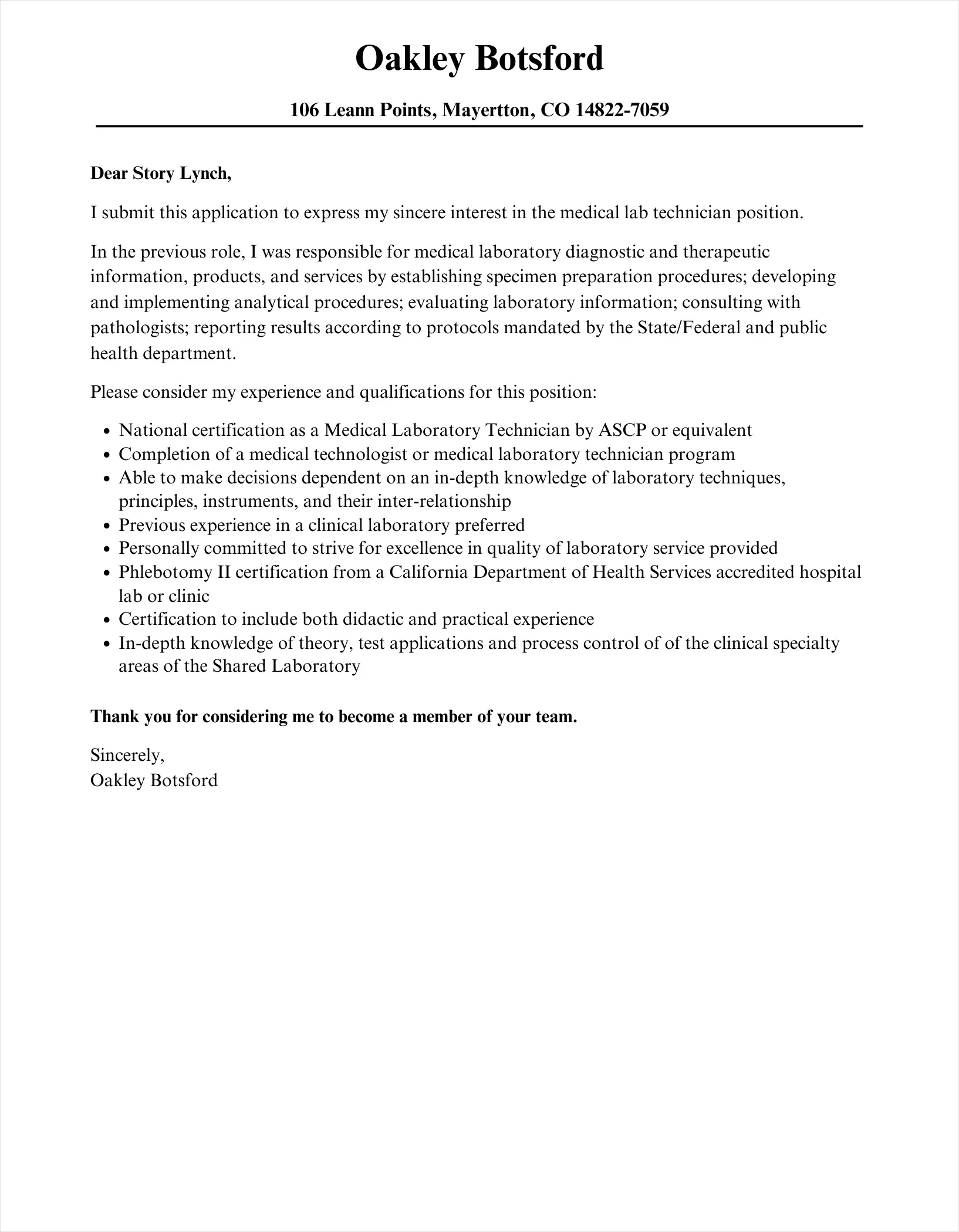
Why Cover Letters Matter for Lab Technicians
In the competitive field of laboratory science, a well-crafted cover letter can be the key to unlocking your dream job as a lab technician. While your resume provides a comprehensive overview of your qualifications, a cover letter offers a unique opportunity to showcase your personality, express your enthusiasm for the role, and demonstrate how your skills and experience align with the specific requirements of the position. Think of it as your personal introduction, a chance to make a strong first impression and convince the hiring manager that you are the ideal candidate. Many hiring managers consider cover letters an essential part of the application process, using them to assess your communication skills, attention to detail, and genuine interest in the opportunity. Without a compelling cover letter, your application might get lost in the pile, so investing time and effort into crafting a standout letter is crucial for success. A great cover letter can elevate your application and significantly increase your chances of landing an interview, ultimately leading you closer to your career goals. Remember, the cover letter is more than just a formality, it is your chance to shine.
Highlighting Skills in Your Cover Letter
When writing your cover letter, it’s important to highlight the skills that make you a strong lab technician candidate. Focus on demonstrating both your technical abilities and your soft skills, providing specific examples to illustrate how you’ve used these skills in past roles. The goal is to show, not just tell, the hiring manager why you are a good fit. This is achieved by providing concise examples of your accomplishments and how you can benefit the laboratory. By tailoring your skills to match the job description, you show you understand the role’s requirements and can perform the duties successfully. A well-written skills section can quickly catch the hiring manager’s attention and differentiate you from other candidates. Remember to use keywords from the job posting to further align your application with the employer’s needs. This helps the recruiter quickly understand the value you bring to the table, making it more likely for them to move you to the next stage of the hiring process.
Technical Skills Examples

Lab technicians rely heavily on their technical skills to perform their daily tasks. Your cover letter should include specific technical skills relevant to the job you’re applying for. These might include experience with various laboratory equipment like microscopes, centrifuges, and spectrophotometers. Detail any experience with specific laboratory techniques like PCR, ELISA, or cell culturing, highlighting your proficiency and any certifications you may have. Be sure to mention your experience with data analysis software or laboratory information management systems (LIMS). Quantify your accomplishments when possible. Instead of just stating you performed tests, mention the number of samples you processed per day or week, or any improvements you made to lab processes. This shows employers that you are efficient and results-oriented. Including these details helps employers understand the breadth and depth of your technical knowledge.
Soft Skills Examples
Besides technical abilities, soft skills are equally important for a lab technician’s success. Your cover letter should emphasize these skills and provide examples of how you use them in a lab setting. Highlight your attention to detail by describing a time you caught an error in data or followed strict protocols to ensure accurate results. Mention your ability to work collaboratively in a team, detailing any experience with team projects or successful collaborations. Good communication is essential, so include an instance where you clearly communicated complex information to a supervisor or colleague. Focus on how you effectively manage your time and prioritize tasks, and consider your organizational skills in lab settings, such as maintaining accurate records or managing inventory. Highlighting these soft skills will show potential employers that you have a well-rounded skill set.
Top 5 Cover Letter Examples for Lab Technicians
Reviewing examples can give you a great idea of how to structure your cover letter. Each lab technician position will have its unique needs, so tailoring your cover letter to the job description is essential. Below are cover letter examples for specific roles, that you can use to learn how to highlight skills, experiences, and accomplishments. Remember to customize these templates to best fit your own background and the specific requirements of each job. Good luck!
Example 1 Research Lab Technician

A research lab technician cover letter should emphasize experience with lab techniques and experiments. This example includes mentions of experimental design, data analysis, and experience with research lab equipment. You should also mention your knowledge of safety protocols and your ability to contribute to a research team. When writing the cover letter, describe your contributions to a project or successful research outcome.
Example 2 Clinical Lab Technician
Clinical lab technician cover letters must emphasize skills in diagnostic testing and patient sample processing. Highlight experience with blood and tissue samples, use of lab equipment, and the ability to follow standard operating procedures (SOPs). Include any experience with quality control, and emphasize your attention to detail and ability to work under pressure. If you have experience in a clinical setting, be sure to include any patient-related experience to emphasize your commitment to patient care.
Example 3 Quality Control Lab Technician
Quality control (QC) lab technician cover letters should showcase experience with quality control procedures, testing methods, and adherence to industry standards. This includes experience with inspections, audits, and the ability to identify and resolve discrepancies. Mention any experience with regulatory compliance, documenting results, and implementing improvements to QC processes. Be sure to emphasize your detail-oriented nature, ability to follow protocols, and experience with analyzing data.
Example 4 Microbiology Lab Technician

Microbiology lab technician cover letters should focus on experience with microbiological techniques. Highlight your knowledge of microbial cultures, staining techniques, and the ability to identify and analyze microorganisms. Experience with sterile techniques, use of specialized equipment, and the ability to maintain a clean lab environment are crucial skills to highlight. Mention any experience with antibiotic susceptibility testing or any work in pathogen identification.
Example 5 Histology Lab Technician
For histology lab technician cover letters, it’s important to show experience with tissue processing, sectioning, and staining. Highlight your proficiency with laboratory equipment, such as microtomes and tissue processors. Include your ability to analyze and interpret results, maintain accurate records, and adhere to quality control standards. Mention experience with any specialized techniques, such as immunohistochemistry (IHC) or special stains. Be sure to include any experience working with patient samples and your attention to detail.
Formatting Your Cover Letter
The format of your cover letter is just as important as its content. A well-formatted cover letter is easy to read and reflects your professionalism. Use a clear and consistent font, such as Times New Roman or Arial, and ensure your text is well-organized with appropriate spacing and margins. Properly formatted cover letters are easier for hiring managers to review, and give a good impression of your attention to detail.
Contact Information and Date

At the top of your cover letter, include your full name, phone number, email address, and professional online profiles (such as a LinkedIn profile). Directly below your contact information, include the date, followed by the hiring manager’s name, title, and the company’s address. Addressing the hiring manager by name shows you’ve taken the time to research the company and shows your attention to detail.
Salutation and Body
Start your cover letter with a professional salutation, such as “Dear Mr./Ms./Mx. [Last Name],” or “Dear Hiring Manager,” if you can’t find the name of the contact person. The body of the cover letter should be concise and well-organized, usually consisting of three to four paragraphs. Each paragraph should focus on a specific point, such as highlighting your relevant skills, explaining your interest in the role, or detailing your relevant experience. Use clear, direct language and avoid jargon or overly complex sentences. Keep your writing concise and easy to understand.
Closing and Signature
End your cover letter with a professional closing, such as “Sincerely,” “Best regards,” or “Thank you for your consideration.” Leave space for your handwritten signature, followed by your typed name. Proofread your cover letter carefully before submitting it to ensure there are no errors in grammar or spelling. A well-written and properly formatted cover letter can go a long way in making a positive impression on a potential employer.
Tailoring Your Cover Letter for Each Application

One size does not fit all when it comes to cover letters. To maximize your chances of success, tailor your cover letter to each job application. This means reviewing the job description carefully and highlighting the skills and experiences that match the requirements. Generic cover letters are less likely to impress a hiring manager. Customization demonstrates your genuine interest in the role and the company. Tailoring your cover letter shows you understand the job’s requirements and you can explain exactly why you’re the best fit. The process of customization shows you’ve done your research and taken the time to provide a relevant, tailored application.
Researching the Company
Before you start writing, research the company and the specific role you’re applying for. Visit the company’s website to learn about their mission, values, and recent projects. Understanding their goals will help you tailor your cover letter to show how your skills and experiences align with their needs. Investigate the job description to understand the position’s requirements and the skills the employer is seeking. Mentioning specific information about the company and referencing their projects in your cover letter can show your genuine interest. Researching the company shows the hiring manager that you care and that you are willing to do your research to learn about them.
Matching Skills to Job Requirements
Carefully compare your skills and experiences with the requirements listed in the job description. Identify the key skills and experiences the employer is looking for, and highlight them in your cover letter. Provide specific examples of how you’ve used these skills in previous roles, quantifying your accomplishments whenever possible. For instance, if the job description requires experience with a particular piece of equipment, mention your proficiency with that equipment and any related projects or results. By clearly aligning your skills with the job requirements, you show the hiring manager that you are a strong candidate for the position.
Proofreading and Editing

Before submitting your cover letter, proofread it carefully for any errors in grammar, spelling, or punctuation. Consider having a friend, family member, or career advisor review your cover letter for a second opinion. Ensure that your language is clear, concise, and professional. Proofreading is one of the most important steps in preparing your cover letter and shows that you care about attention to detail. Correcting errors and ensuring a polished final product can significantly boost your chances of landing an interview. Remember that a well-written, tailored cover letter is your best chance of standing out in a competitive job market.