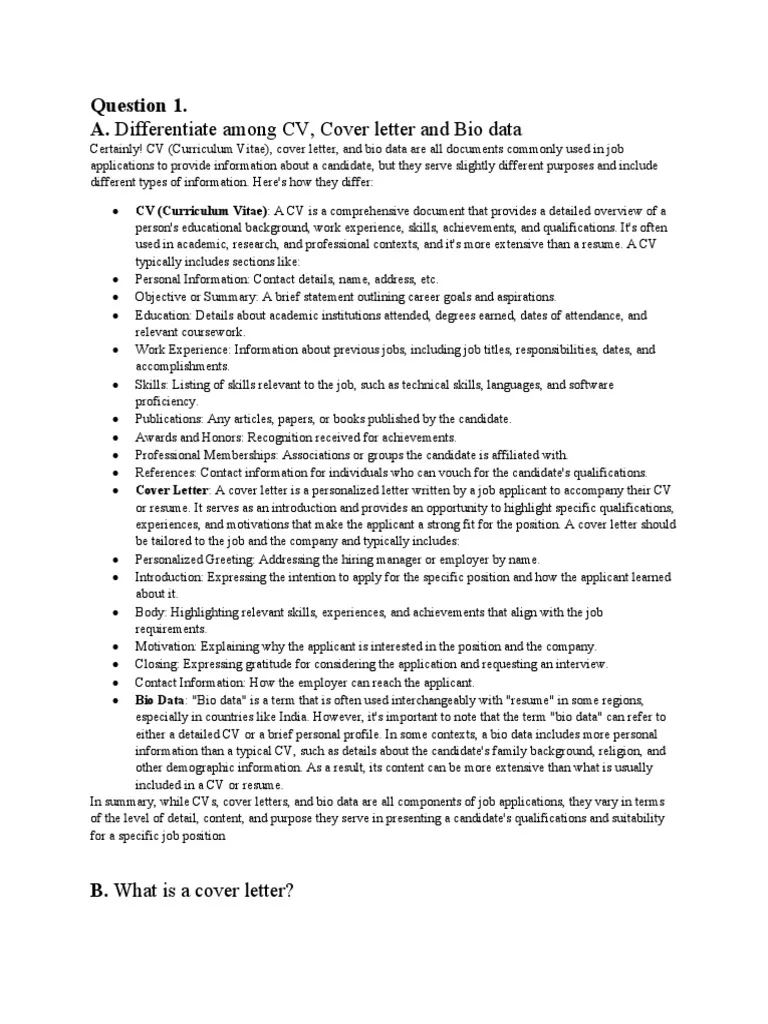
What is a Cover Letter for Employment
A cover letter for employment is a crucial document that accompanies your resume when applying for a job. It serves as an introduction, allowing you to provide additional context and highlight your qualifications, skills, and experiences. Unlike a resume, which offers a brief overview of your professional background, a cover letter enables you to showcase your personality, express your enthusiasm for the position, and explain why you are the perfect fit for the role. It is your chance to make a strong first impression and persuade the hiring manager to read your resume with keen interest. Writing a well-crafted cover letter is often the deciding factor for getting an interview.
The Purpose of a Cover Letter
The primary purpose of a cover letter is to introduce yourself to a potential employer and express your interest in a specific job opening. It provides a platform to elaborate on your skills and experiences, demonstrating how they align with the requirements of the position. Furthermore, a cover letter allows you to explain any gaps in your employment history, address potential concerns, and showcase your unique value proposition. It serves as a means to communicate your personality, enthusiasm, and genuine interest in the company and the role. By highlighting your achievements and illustrating how you can contribute to the organization’s success, a cover letter significantly increases your chances of securing an interview.
Why is a Cover Letter Important

A cover letter is important because it is your first impression and a chance to stand out from other applicants. It enables you to personalize your application, demonstrating that you have taken the time to understand the job requirements and the company’s values. A well-written cover letter provides an opportunity to showcase your communication skills, which are essential in any professional environment. It allows you to tell a story about your career, highlighting how your skills and experiences align with the job description, setting you apart from candidates who might only rely on their resume. Employers often use cover letters to gauge your writing skills and attention to detail. In today’s competitive job market, a cover letter can be the differentiator.
Key Elements of a Cover Letter
A compelling cover letter comprises several key elements that work together to create a persuasive narrative. These elements include your contact information, the recipient’s contact information, a professional greeting, a captivating opening paragraph, a section to highlight your skills and experience, a closing paragraph with a call to action, and a formal closing. Each of these components serves a specific purpose, contributing to the overall effectiveness of the cover letter. Understanding these elements and how they interrelate is critical for creating a cover letter that captures the attention of hiring managers and persuades them to consider your application favorably. Pay close attention to these details, and you’ll have more chances of getting hired.
Your Contact Information
At the top of your cover letter, include your full name, phone number, email address, and optionally, your LinkedIn profile URL. This information should be clearly displayed so the hiring manager can easily contact you. Use a professional email address and ensure that your contact information is up-to-date and accurate. Including your contact details at the beginning ensures that the reader can easily reach out to you. Presenting this information in a clear and organized manner demonstrates your professionalism and attention to detail, which are important attributes that employers look for in potential candidates.
The Recipient’s Contact Information

Below your contact information, include the hiring manager’s name, title, the company’s name, and the company’s address. Researching the name of the hiring manager shows you have taken initiative. If you can’t find the hiring manager’s name, use a general greeting such as ‘Dear Hiring Manager’ or ‘Dear [Department Name] Team’. This demonstrates that you’ve taken the effort to personalize your application and makes it more likely that your cover letter will be noticed. If the job posting doesn’t include these details, you can often find them on the company’s website or LinkedIn. Including this information adds a professional touch to your letter and shows you’re committed.
Greeting the Hiring Manager
Start your cover letter with a formal greeting. Using the hiring manager’s name, if known, is always preferable. ‘Dear Mr./Ms./Mx. [Last Name]’ is a respectful way to address the hiring manager. If you are unsure of the name, you can use a general greeting like ‘Dear Hiring Manager’ or ‘Dear [Department Name] Team’. Avoid generic greetings like ‘To Whom It May Concern,’ which can appear impersonal and may not make a good impression. Make sure you get the person’s name right, as a misspelling is an easy way to turn off a hiring manager. Your greeting sets the tone for the entire letter.
Write a Compelling Opening Paragraph
The opening paragraph is your opportunity to immediately capture the reader’s attention. State the position you are applying for and how you found the job posting. Briefly mention why you are interested in the role and the company. Highlight your most relevant skills or achievements that align with the job requirements. The opening paragraph should create a strong first impression and encourage the hiring manager to continue reading. Think of it as your elevator pitch—it must be concise, engaging, and demonstrate your enthusiasm for the opportunity. It is key to making a good impression.
Highlight Your Skills and Experience

In the body of your cover letter, provide specific examples of how your skills and experience align with the job requirements. Use the job description to identify the key skills and qualifications the employer is seeking. Write a section describing how you have demonstrated these skills in previous roles. Avoid simply restating your resume. Instead, provide compelling narratives that showcase your accomplishments and contributions. Use action verbs to describe your responsibilities and achievements. Make sure to tailor this section to each specific job application to highlight the most relevant aspects of your background. Include examples of how you solved problems or achieved goals. Focus on transferable skills and how these translate to the role you want.
Quantify Your Achievements
Whenever possible, quantify your achievements to demonstrate the impact of your work. Use numbers and data to illustrate your accomplishments and show the tangible results you have achieved in previous roles. For example, instead of saying ‘Managed social media accounts,’ say ‘Increased social media engagement by 30% in six months.’ Providing quantifiable results makes your accomplishments more credible and impactful. It gives the hiring manager a clear understanding of your capabilities and potential contributions to the company. Quantifying your achievements helps to support your claims and leaves a lasting impression on the reader. It also differentiates you from other applicants.
Demonstrate Your Interest in the Company
Show genuine interest in the company by mentioning their mission, values, or recent achievements. Research the company’s culture and demonstrate that your values align with theirs. Explain why you are interested in working for this particular organization. This demonstrates that you have taken the time to learn about the company and that you are not just sending out generic applications. Mention specific projects or initiatives the company is involved in that resonate with you. Highlighting your research demonstrates that you’re prepared and have an understanding of the company. It also shows that you’re interested in something beyond just getting any job. This can significantly increase your chances of getting hired.
Showcase Your Value Proposition

In your cover letter, clearly state your value proposition—what you can bring to the company. Highlight your key skills, experiences, and how they align with the role’s requirements. Focus on your unique selling points and what makes you stand out from other candidates. Show how you can contribute to the company’s goals and solve their problems. Your value proposition should be concise, compelling, and tailored to the specific job and company. Clearly articulate your unique value proposition will help the hiring manager understand why they should hire you over other applicants, showcasing that you’re the best fit for the role and the organization. Explain what makes you special.
Closing the Cover Letter Effectively
The closing of your cover letter is equally as important as the opening. It is the final impression you will leave on the hiring manager. In this section, you should express your gratitude for their time and consideration. Reiterate your interest in the position and the company, and include a clear call to action. Your closing should be professional, enthusiastic, and encourage the hiring manager to take the next step. A strong closing leaves the reader with a positive image of you and motivates them to reach out.
Express Gratitude and Call to Action
Thank the hiring manager for their time and consideration. Reiterate your interest in the position and express your enthusiasm for the opportunity. Include a clear call to action, such as stating that you look forward to hearing from them soon or that you are available for an interview at their earliest convenience. Make it easy for the hiring manager to contact you. Always end your letter with a professional closing, such as ‘Sincerely,’ ‘Best regards,’ or ‘Yours sincerely,’ followed by your full name. This shows professionalism and respect. A clear call to action increases the chances of the reader acting on your request.
Proofread and Edit Your Cover Letter

Before submitting your cover letter, meticulously proofread and edit it for any errors. Check for spelling mistakes, grammatical errors, and punctuation issues. Ensure that your sentences are clear, concise, and easy to understand. Have a friend or family member review your letter for a fresh perspective. Errors can make a negative impression and undermine your credibility. Pay attention to the formatting of your cover letter to ensure it is consistent and professional. Proofreading is essential for demonstrating attention to detail and professionalism. Take a moment to check and correct your letter before submitting it to avoid any potential issues.
Cover Letter Formatting Tips
The formatting of your cover letter contributes significantly to its overall impact. A well-formatted letter is easy to read and visually appealing, reflecting your attention to detail. Correct formatting enhances readability and ensures your message is conveyed effectively. It shows professionalism and makes a good impression. Proper formatting is key to making your cover letter stand out.
Choose the Right Font and Size
Select a professional and readable font, such as Times New Roman, Arial, or Calibri. Use a font size between 10 and 12 points for the body of your letter. Ensure that the font is consistent throughout the document. Avoid using overly decorative or unusual fonts, as they can be difficult to read. Your choice of font contributes to the overall readability and professional appearance of your cover letter. Choosing an appropriate font and size will help in making your letter easy to read. Make sure the font looks clean and modern.
Keep it Concise and Easy to Read

Keep your cover letter concise and to the point. Aim for one page in length. Use clear and concise language to convey your message effectively. Use short paragraphs and bullet points to break up text and make it easier to scan. Avoid long, complex sentences. A well-structured and easy-to-read cover letter is more likely to be read thoroughly. Short paragraphs and bullet points will make your letter more reader-friendly. The more easy it is to read, the better.
Tailoring Your Cover Letter
Tailoring your cover letter to each job application is crucial for demonstrating your genuine interest and suitability for the role. Customizing your cover letter is essential for conveying the value you bring to the role. It shows you’re not just sending a generic template but have carefully considered the specific requirements and expectations. Personalization makes your application more effective. You want to be the best candidate.
Researching the Company and Role
Before writing your cover letter, research the company and the specific role you are applying for. Understand the company’s mission, values, and recent achievements. Carefully review the job description to identify the key skills, qualifications, and experiences the employer is seeking. By understanding the company and the role, you can tailor your cover letter to highlight the most relevant aspects of your background. Tailoring your letter shows that you’re interested in the company. Researching the company and the role will make it easier to write a compelling letter.
Customizing for Each Application

Customize your cover letter for each job application. Address the specific requirements and expectations outlined in the job description. Highlight the skills and experiences that align with the role. Use keywords from the job description throughout your cover letter. Mention specific accomplishments or projects that are relevant to the position. Personalize your cover letter by referencing the company’s mission or recent activities. Customizing the cover letter increases your chances of getting noticed. Ensure your letter matches the details of the job.
Common Mistakes to Avoid in a Cover Letter
Avoiding common mistakes will significantly improve the effectiveness of your cover letter. Common errors can detract from your qualifications and create a negative impression. Understanding what to avoid will help ensure your cover letter presents you in the best possible light. By avoiding these mistakes, you can create a more effective cover letter and increase your chances of landing an interview.
Using Generic Language
Avoid using generic language that could be used for any job application. Refrain from using clichés, such as ’team player’ or ‘hard worker,’ without providing specific examples. Use specific and compelling language to describe your skills and achievements. Tailor your language to the specific job and company. Generic language makes it difficult for you to stand out. Make it personal and specific, using vivid language that showcases your personality and accomplishments.
Spelling and Grammatical Errors
Always proofread your cover letter carefully for spelling and grammatical errors. Errors can damage your credibility and make you appear careless. Use spell-check and grammar-check tools, but also review the letter yourself. A well-written cover letter shows attention to detail. Proofread your letter multiple times, and consider having someone else review it. The appearance of your letter is very important. Make sure you look polished and professional.
Including Irrelevant Information
Focus your cover letter on the skills, experiences, and achievements that are relevant to the job. Avoid including information that is not directly related to the position or the company. Keep your cover letter concise and to the point. Make sure everything in your letter supports your candidacy for the job. The more direct you are, the better. Don’t include extra information, and make sure what you do include is relevant.
Cover Letter Examples
Reviewing cover letter examples can provide valuable insights into structure, style, and content. Analyzing successful examples allows you to learn how to effectively showcase your qualifications and tailor your letter to specific job applications. Examples provide inspiration, guidance, and a clearer understanding of how to highlight your strengths. Examining samples for diverse roles and industries will help you create a compelling cover letter.
Example Cover Letter for a Marketing Role
A cover letter for a marketing role typically highlights your marketing expertise, including skills in content creation, campaign management, and market analysis. The letter should demonstrate your ability to understand and target specific audiences, as well as your capacity to develop and implement effective marketing strategies. Include specific achievements such as successful campaigns or increased lead generation. Focus on the value you bring and how you can contribute to the company’s marketing goals. Demonstrate creativity, analytical skills, and a passion for marketing, showcasing how your expertise drives results.
Example Cover Letter for an Entry Level Position
An entry-level cover letter should emphasize your education, skills, and any relevant experiences you have, such as internships or volunteer work. Focus on your enthusiasm for the role and your eagerness to learn and grow within the company. Highlight transferable skills, such as communication, teamwork, and problem-solving. Tailor your letter to the specific requirements of the job, showcasing how your skills and experiences align with the position’s responsibilities. Even if you have limited experience, demonstrate your potential and your willingness to contribute.
Where to Find Cover Letter Templates
Many online resources offer cover letter templates to help you create a professional and effective cover letter. These templates provide a starting point and can guide you through the structure and content of a cover letter. Using these resources can save time and ensure that your cover letter meets professional standards. Customize templates to fit your skills and the specific job. Several cover letter templates are available online that you can use. These resources will ensure a well-formatted, professional cover letter.
Online Resources and Templates
Numerous websites and platforms offer free cover letter templates. These resources provide a variety of templates suitable for different industries and roles. Research these resources to find templates that align with your needs. Templates can provide structure and guidance. Remember to customize the templates to reflect your skills and experiences. Templates will help you get started, but make sure you customize the templates for the job.
Professional Cover Letter Writing Services
For a polished and professional cover letter, consider using professional cover letter writing services. These services employ expert writers who can create customized cover letters that highlight your strengths and meet industry standards. A professional service can significantly increase your chances of securing an interview and landing the job. Professional services will give you a great letter. Consider using one if you need help and want to get the job.