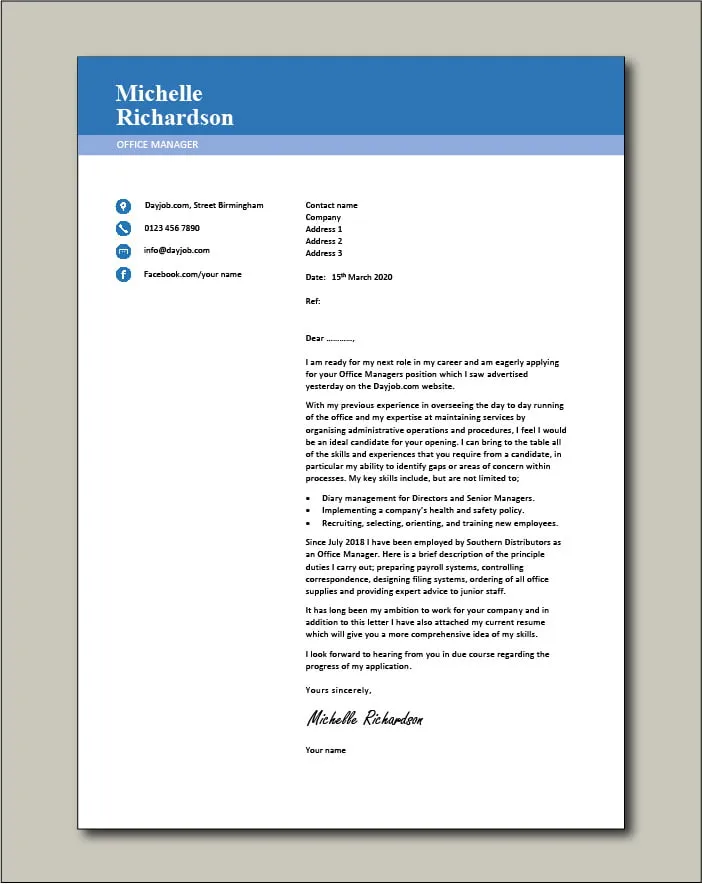
Why You Need an Office Manager Cover Letter
As an aspiring office manager, your cover letter serves as your first impression on a potential employer. It’s your opportunity to showcase your skills, experience, and enthusiasm in a way that a resume alone cannot. A well-crafted cover letter provides context to your resume, highlighting specific achievements and demonstrating how your qualifications align with the specific requirements of the job. It’s a chance to personalize your application and convey your genuine interest in the company and the role. In the competitive landscape of office management, a compelling cover letter can significantly increase your chances of landing an interview.
Key Components of a Winning Cover Letter
A winning cover letter for an office manager position consists of several essential components, each contributing to its overall effectiveness. These components work together to create a persuasive narrative that convinces the hiring manager of your suitability for the role. From the salutation to the closing, every element plays a crucial role in conveying your professionalism, skills, and enthusiasm.
Contact Information & the Date

Begin with your contact information (name, address, phone number, and email) at the top of the letter, followed by the date. This ensures the employer can easily reach you and provides a formal structure to your letter. Ensure your contact details are current and professional. It’s a standard practice to align this information to the left or right, depending on the overall formatting style you choose.
The Hiring Manager’s Name and Title
Always address the hiring manager by name if possible. Research the company to find out who the hiring manager is, and use their title. Addressing the letter to a specific person shows that you’ve taken the time to learn about the company and demonstrates your attention to detail. If you can’t find a name, use a professional title like “Hiring Manager” or “Recruiting Team”.
Crafting a Compelling Opening
Your opening paragraph should immediately grab the reader’s attention and state the purpose of your letter. Clearly mention the position you are applying for and how you learned about the opportunity. Consider including a brief statement that highlights your most relevant skill or experience to hook the reader. This opening sets the tone for the rest of the letter and encourages the hiring manager to keep reading.
Highlighting Relevant Skills & Experience

The body of your cover letter is where you showcase your skills and experience. Select the most relevant qualifications from your resume and expand upon them. Use specific examples to demonstrate how you’ve used these skills to achieve results in previous roles. Tailor your descriptions to align with the requirements outlined in the job description. Focus on skills such as organization, communication, time management, and proficiency with office software.
Showcasing Achievements & Quantifiable Results
Whenever possible, quantify your accomplishments. Use numbers and data to illustrate your impact in previous roles. For example, mention how you improved office efficiency by a certain percentage, reduced costs, or increased employee satisfaction. Providing concrete evidence of your successes makes your claims more credible and demonstrates the value you can bring to the company. Achievements show what you have delivered in the past.
Tailoring Your Cover Letter to the Job
Avoid sending generic cover letters. Customize each letter to the specific job and company. Research the company’s values, mission, and culture, and demonstrate how your skills and experience align with their needs. Show that you understand the specific requirements of the position and address them directly. Tailoring your letter increases your chances of being noticed and shows that you are genuinely interested in the opportunity.
Using Keywords from the Job Description

Carefully review the job description and incorporate relevant keywords into your cover letter. Use these keywords naturally throughout the text to demonstrate that you possess the required skills and qualifications. This not only helps the hiring manager quickly identify your suitability but can also help your application pass through applicant tracking systems (ATS). Be strategic in your keyword use; don’t simply stuff them into your letter.
Demonstrating Your Understanding of the Role
Show the hiring manager that you understand the responsibilities and challenges of the office manager position. Briefly describe your approach to common tasks, such as managing schedules, coordinating office supplies, or handling administrative duties. Highlighting your knowledge of office management best practices and your ability to streamline processes can set you apart from other applicants.
Expressing Enthusiasm & Interest
Convey your genuine enthusiasm for the position and the company. Explain why you are interested in working for them and what attracts you to the role. Mention anything specific that resonates with you about the company’s mission, values, or recent achievements. Showing excitement helps the hiring manager see you as a motivated and engaged candidate. Make sure to inject personality.
Writing a Strong Closing

End your cover letter with a strong closing paragraph. Reiterate your interest in the position and thank the hiring manager for their time and consideration. Include a call to action, such as expressing your availability for an interview or stating your eagerness to discuss your qualifications further. Provide your contact information again to make it easy for the employer to reach you.
Proofreading & Formatting Tips
Before submitting your cover letter, it is essential to proofread it carefully and ensure it is formatted correctly. Errors in grammar, spelling, and formatting can create a negative impression and detract from your qualifications. Taking the time to review your letter thoroughly will help you present a professional image and increase your chances of success.
Formatting your Cover Letter
Choose a clean and professional font, such as Times New Roman, Arial, or Calibri, with a font size between 10 and 12 points. Use single spacing within paragraphs and double spacing between paragraphs. Maintain consistent margins and use clear headings to organize your content. Ensure the overall layout is easy to read and visually appealing. Consistency in your formatting is key for professionalism.
Proofread your Cover Letter

Carefully proofread your cover letter for any errors in grammar, spelling, punctuation, and syntax. Use a spell checker and grammar checker, but don’t rely on them entirely. Read your letter aloud to catch any awkward phrasing or inconsistencies. Have a friend or family member review it as well. A second pair of eyes can often catch mistakes that you might miss. It is always a good idea to check your cover letter again after any edits.
Cover Letter Samples to Inspire You
Reviewing cover letter samples can provide valuable insights and help you create your own effective letter. Use these samples as a guide to understand how to structure your letter, highlight your skills, and tailor your content to the specific job. Adapt the samples to fit your experience and the requirements of the position you are applying for. Here are two sample cover letter formats.
Sample Cover Letter Format 1
This is a more formal format. It typically begins with the date and the hiring manager’s contact information, followed by a formal salutation like “Dear Mr./Ms. [Last Name].” The body of the letter follows a clear structure, with distinct paragraphs for introducing yourself, highlighting skills, providing examples, and expressing interest. The closing is formal, often ending with “Sincerely” or “Respectfully,” followed by your signature and typed name. This format suits more conservative industries or organizations.
Sample Cover Letter Format 2

This format is slightly more modern and may be used in more creative or less formal environments. While it still includes the standard contact information, the formatting can be more visually appealing. The salutation might be less formal, such as “Dear [Hiring Manager Name]” or even “Hello [Hiring Manager Name],” depending on the company culture. The tone in the body is often more conversational, and the closing is more personable, such as “Best regards” or “Thank you.” It’s important to choose a format that fits the specific company you are applying to.
Common Mistakes to Avoid
Avoid these mistakes in your cover letter to make a better first impression. Paying attention to these points will significantly improve the quality of your application.
Ignoring the Job Description
One of the most common mistakes is failing to address the specific requirements of the job description. If you are not addressing the specific skills, experiences, and qualifications needed, then you are not increasing your chances of being selected. Always tailor your cover letter to the job you are applying for and highlight how your experience matches the requirements outlined in the job description.
Using Generic Language
Avoid using generic, cliché phrases that don’t provide any specific information about your skills or accomplishments. Replace generic sentences with specific examples and quantifiable results. Instead of stating “I am a hard worker,” provide an example of a project you completed successfully and the outcome. The best cover letters use specific language to show what you did, not just tell.
Typos and Grammatical Errors
Typos and grammatical errors can create a negative impression and undermine your credibility. Proofread your cover letter carefully, use a spell checker and grammar checker, and have someone else review it before submitting. A single error can make you look careless and unprofessional. It’s worth it to take the time to make sure your application is spotless.
Finalizing and Submitting Your Cover Letter
Once you have finalized your cover letter, there are a few key steps to take before submitting it. Proper formatting, saving the document correctly, and following the application instructions are all critical to ensuring your application is received and considered professionally. Here are the steps.
Saving Your Cover Letter
Save your cover letter with a clear and professional file name. Include your name and the job title in the file name to make it easy for the hiring manager to identify your application. For example, use “Jane Doe - Office Manager Cover Letter.” Save your cover letter as a PDF file to ensure that the formatting remains consistent across different devices and platforms. This protects the format and readability of your cover letter.
Submitting Your Cover Letter Online
Follow the instructions provided in the job posting or application portal. Often, you will be asked to upload your cover letter and resume as separate files. Double-check that you are attaching the correct documents. After submitting, it is a good idea to send a follow-up email if the instructions allow, to confirm receipt of your application. Make sure to be concise and professional in your email.