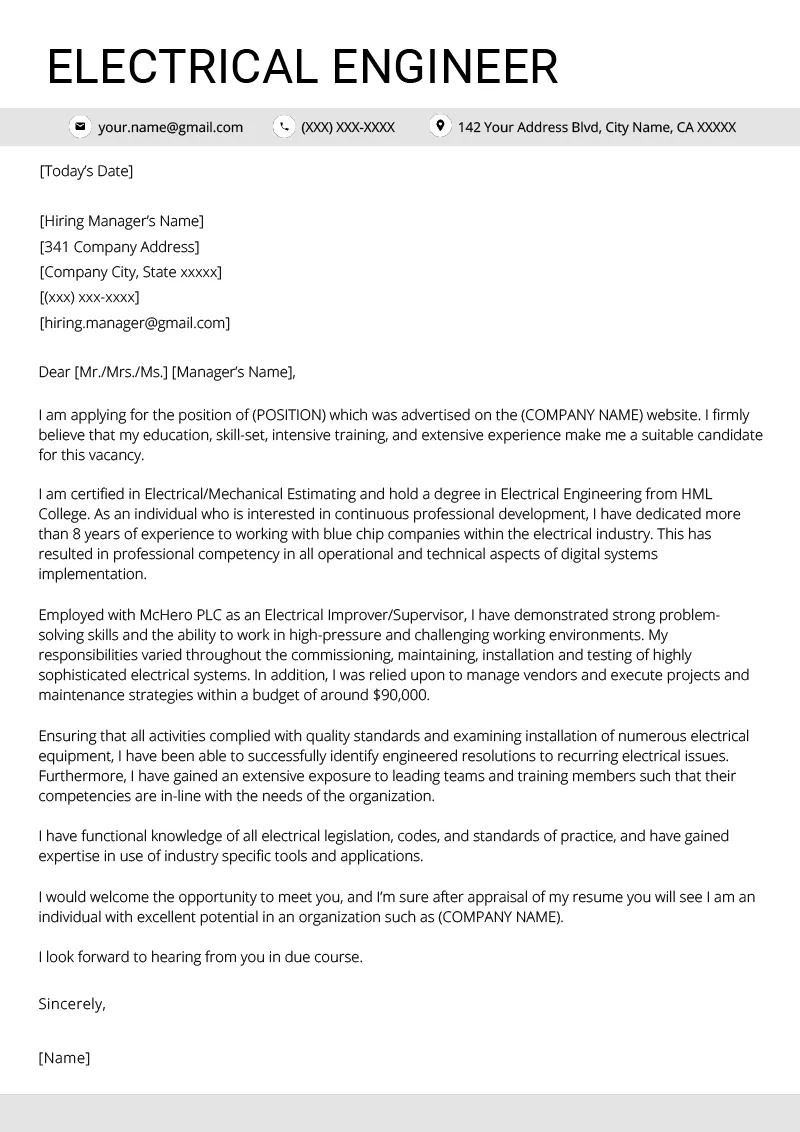
Crafting Your Electrical Engineering Cover Letter
A well-crafted cover letter is your first opportunity to make a strong impression on a potential employer. It’s more than just a formality; it’s a chance to introduce yourself, highlight your skills, and express your enthusiasm for the position and the company. For electrical engineering fresh graduates, the cover letter becomes even more crucial, as it allows you to showcase your potential beyond just your academic record. This guide will provide you with the essential tips and strategies for creating a compelling cover letter that will set you apart from other candidates. The goal is to secure that all-important interview and take the first step in your electrical engineering career.
Understanding the Importance of a Cover Letter
In the competitive field of electrical engineering, a cover letter serves as your personal marketing tool. It’s your opportunity to tell your story, explaining why you are the ideal candidate for the role. A cover letter provides context to your resume, allowing you to elaborate on your skills, experiences, and career goals. It’s a chance to demonstrate your communication skills, attention to detail, and genuine interest in the position. Hiring managers often use cover letters to gauge a candidate’s writing ability, personality, and fit within the company culture. Failing to submit a well-written cover letter can lead to an immediate rejection, therefore investing time and effort into crafting a strong cover letter is vital for any electrical engineering fresh graduate.
Highlighting Your Skills and Education

Your cover letter is the perfect platform to highlight your skills and educational background in a concise and engaging manner. Focus on the skills and experiences that directly align with the job requirements. Instead of just listing your qualifications, provide specific examples of how you’ve applied these skills in projects, coursework, or internships. Quantify your achievements whenever possible, such as the number of projects completed, the efficiency improvements you achieved, or the cost savings you contributed to. Remember that your educational background is also a key component of your qualifications. Mention your degree, GPA (if impressive), relevant coursework, and any academic awards or honors you’ve received. Ensure your cover letter paints a clear picture of your abilities and potential to the hiring manager.
Key Skills for Electrical Engineering
Electrical engineering encompasses a wide range of skills, both technical and soft skills. Highlighting the right skills in your cover letter is crucial for catching the attention of employers. Think about the specific skills that align with the job description and ensure these skills are clearly showcased in your cover letter. These skills should not only be listed, but also explained in the context of previous projects and experiences. Remember to balance technical skills with soft skills, as employers are looking for well-rounded candidates capable of contributing to a team environment.
Technical Skills
Technical skills are the cornerstone of an electrical engineer’s toolkit. Focus on highlighting your proficiency in areas such as circuit design, power systems, control systems, and signal processing. Mention any specific software, tools, or equipment you are familiar with, such as CAD software (e.g., AutoCAD, Altium Designer), simulation tools (e.g., SPICE, MATLAB), and programming languages (e.g., C++, Python, or assembly language). Show your understanding of electrical engineering principles by providing examples of how you’ve applied these skills in projects. The more specific you are, the better, and always try to correlate your skills with the requirements listed in the job description.
Software Proficiency

Software proficiency is a significant asset in the modern electrical engineering landscape. Include a dedicated section to showcase your software skills. List the software you are proficient in, such as simulation tools, programming languages, and design software. Quantify your experience with each tool if possible, for example, “Proficient in MATLAB, using it for over 2 years in various simulation projects.” Mention any certifications you hold, or training you’ve completed related to these tools. Highlight how you’ve used these software tools in your projects to solve problems or achieve specific results. Remember to tailor the software mentioned to match the job description, emphasizing the tools that the employer values most.
Soft Skills
While technical skills are important, soft skills can set you apart from other candidates. Soft skills relate to your interpersonal and communication abilities. Highlight skills such as teamwork, communication, problem-solving, and time management. Provide examples of how you’ve used these skills in your projects, academic collaborations, or extracurricular activities. For instance, describe how you effectively communicated technical concepts to a non-technical audience during a project presentation, or how you resolved a conflict within a team to ensure project success. Emphasize your ability to work collaboratively, adapt to challenges, and contribute positively to a team environment.
Academic Achievements
As a fresh graduate, your academic achievements are a key measure of your potential. Highlight your GPA if it’s above average, or if you have a strong GPA overall. Mention any honors, awards, or scholarships you received, as these demonstrate your academic excellence. You should provide details about relevant projects or coursework. Include any publications or presentations you have made, as these show your ability to contribute to your field and share your knowledge. Showing your academic achievements provides potential employers with an understanding of your capabilities and dedication to your field.
Relevant Coursework

Detailing your coursework is important as it directly demonstrates your specific knowledge in relevant areas of electrical engineering. Instead of simply listing all your courses, focus on those that align with the job requirements. For instance, if the job requires experience with power systems, emphasize coursework related to power generation, transmission, and distribution. Mention any projects completed during these courses that are relevant to the job. By highlighting this, you demonstrate your knowledge and provide specific examples of your training. Including relevant coursework also helps demonstrate your ability to learn new concepts and adapt to the demands of the role.
Projects and Practical Experience
Projects and practical experience are invaluable for demonstrating your skills and knowledge. Describe any personal, academic, or internship projects you have completed. Outline your role in each project, your responsibilities, and the technologies you used. Quantify your achievements whenever possible. For example, “Designed and implemented a control system for a robotic arm, improving its precision by 15%.” If you have relevant internship experience, provide details about your role, the company, and your contributions. Focus on what you learned and the challenges you overcame. This allows the employer to better visualize your skills.
Formatting Your Cover Letter
Formatting your cover letter correctly is very important. A well-formatted cover letter is easy to read and reflects your attention to detail. Stick to a professional font such as Times New Roman, Arial, or Calibri, with a font size between 10 and 12 points. Use single spacing within paragraphs and double spacing between paragraphs. Use clear headings and bullet points to organize your information. The layout should be clean, and the text aligned to the left. The goal is to make your cover letter visually appealing and easy for the hiring manager to read. This small detail shows professionalism.
Contact Information and Date

At the top of your cover letter, include your contact information: your name, phone number, email address, and LinkedIn profile URL. Follow this with the date of your cover letter. Make sure that the contact information is correct and easy to find. If you have a personal website or portfolio showcasing your projects, you may add the URL as well. By providing your contact information at the top, you make it easy for the employer to contact you. Make sure to use a professional email address.
Addressing the Hiring Manager
Always address your cover letter to a specific person if possible. Research the hiring manager’s name and title. If you can’t find a specific name, use a general greeting like “Dear Hiring Manager.” Avoid generic greetings like “To Whom It May Concern.” Addressing the hiring manager by name shows that you have taken the time to research the company and are serious about the position. It shows that you are taking a personalized approach. If you do not know the hiring manager’s name, ensure you address the department that is hiring (e.g., “Dear Hiring Manager, Electrical Engineering Department”).
Opening and Closing Statements
The opening paragraph is your opportunity to grab the reader’s attention. Clearly state the position you are applying for and briefly mention where you saw the job posting. Then, highlight your most relevant skills and express your enthusiasm for the opportunity. The closing paragraph should reiterate your interest in the position and thank the reader for their time and consideration. Reiterate your enthusiasm and provide a call to action, such as “I look forward to discussing my qualifications in an interview.” Always end the letter with a professional closing, such as “Sincerely” or “Best regards,” followed by your name.
Tailoring Your Letter to the Job

Never submit a generic cover letter. Tailor each cover letter to the specific job and company you are applying to. Carefully review the job description and identify the key skills, experiences, and qualifications that the employer is seeking. Then, tailor your cover letter to align with these requirements. Use the same keywords and phrases that are used in the job description. Explain how your skills and experiences match the job’s specific requirements. Make sure that your cover letter is customized to demonstrate your understanding of the role and the company’s needs.
Researching the Company
Before writing your cover letter, research the company thoroughly. Understand their mission, values, products or services, and recent projects. Use this information to personalize your cover letter and demonstrate your genuine interest in the company. Explain why you are excited about the opportunity to work for them. Show that you have an understanding of the company’s goals and how your skills can contribute to their success. Demonstrate your research of the company by mentioning specific projects or achievements of theirs that excite you.
Matching Skills with Job Requirements
The most important part of tailoring your cover letter is to match your skills with the job requirements. Carefully analyze the job description, and make a list of the skills and experiences the employer is looking for. Review your skills and experiences, and identify those that match the requirements. Use specific examples from your academic projects, internships, or coursework to illustrate how you have demonstrated those skills. Focus on providing examples that highlight the skills the employer values most. By matching your skills to the job requirements, you make it clear that you are a qualified candidate.
Showcasing Your Enthusiasm

Expressing enthusiasm is vital. It shows the employer that you are truly interested in the position and the company. In your cover letter, explain why you are excited about the opportunity and what aspects of the role or company appeal to you. Mention specific projects, technologies, or company initiatives that interest you. This will help the hiring manager see your genuine enthusiasm. Personalize your expression of enthusiasm by mentioning specific projects or technologies. Be genuine and let your passion for electrical engineering shine through.
Proofreading and Editing
Proofreading and editing are essential steps. Errors can create a negative impression. Take the time to carefully proofread your cover letter for any typos, grammatical errors, and formatting issues. Read your letter aloud, or have a friend, family member, or career counselor review it. Use a spell checker and grammar checker, but don’t rely on them completely. Always proofread your work. A clean, error-free cover letter shows attention to detail and professionalism. Double-check everything.
Common Mistakes to Avoid
Be aware of some common mistakes that can undermine your cover letter. By avoiding these, you can improve your chances of getting an interview. Common mistakes often include generic language, grammatical errors, and ignoring instructions. Avoid these pitfalls to ensure your cover letter makes a positive impression.
Generic Language
Avoid using generic language that can make your cover letter sound impersonal and uninspired. Steer clear of phrases such as “I am a hard worker” or “I am a team player.” Instead, use specific examples to demonstrate these qualities. Quantify your achievements and provide details about your skills and experiences. Tailor your cover letter to the specific job. This will show that you are truly interested in the position. Generic language suggests that you have not taken the time to understand the role or the company.
Typos and Grammatical Errors
Typos and grammatical errors can ruin your chances. They can also create a negative impression. They show a lack of attention to detail and can signal a lack of professionalism. Before you submit your cover letter, proofread it carefully for any errors. Use a spell checker and grammar checker, but always proofread your work. Check your letter for correct grammar, spelling, punctuation, and capitalization. If possible, ask a friend, family member, or career counselor to review your cover letter. Making sure it’s perfect is important.
Ignoring Instructions
Always follow the instructions provided in the job posting. If the employer has specified a particular format, font, or length for the cover letter, adhere to it. Ignoring instructions demonstrates that you do not pay attention to details. In the worst-case scenario, your application may be rejected. If there are no specific instructions, use a professional format and keep your cover letter concise and to the point. Always make sure you have followed all instructions.
Using a Template
While templates can be a starting point, avoid using them without customization. Using a generic template without personalizing it will often lead to a cover letter that is not as strong. Tailor the template to the specific job and company. Customize the content to reflect your skills, experiences, and enthusiasm for the position. Demonstrate your understanding of the job and company by including relevant details. Use a template as a guide. Your letter should reflect your unique qualifications and your genuine interest in the opportunity.
Call to Action
Include a clear call to action in your cover letter. Tell the hiring manager what you want them to do next. Express your interest in an interview. Reiterate your contact information so it is easy for the employer to reach you. The call to action should be concise and direct, and this helps the employer take the next step. Make it easy for them.
Thanking the Reader
Always thank the reader for their time and consideration. A simple thank-you shows your appreciation. It is also a professional courtesy. Express your gratitude for the opportunity to be considered for the position. Include a closing statement that expresses your hope to hear from them soon. Your closing statement helps the employer remember you and enhances your chances of getting an interview.