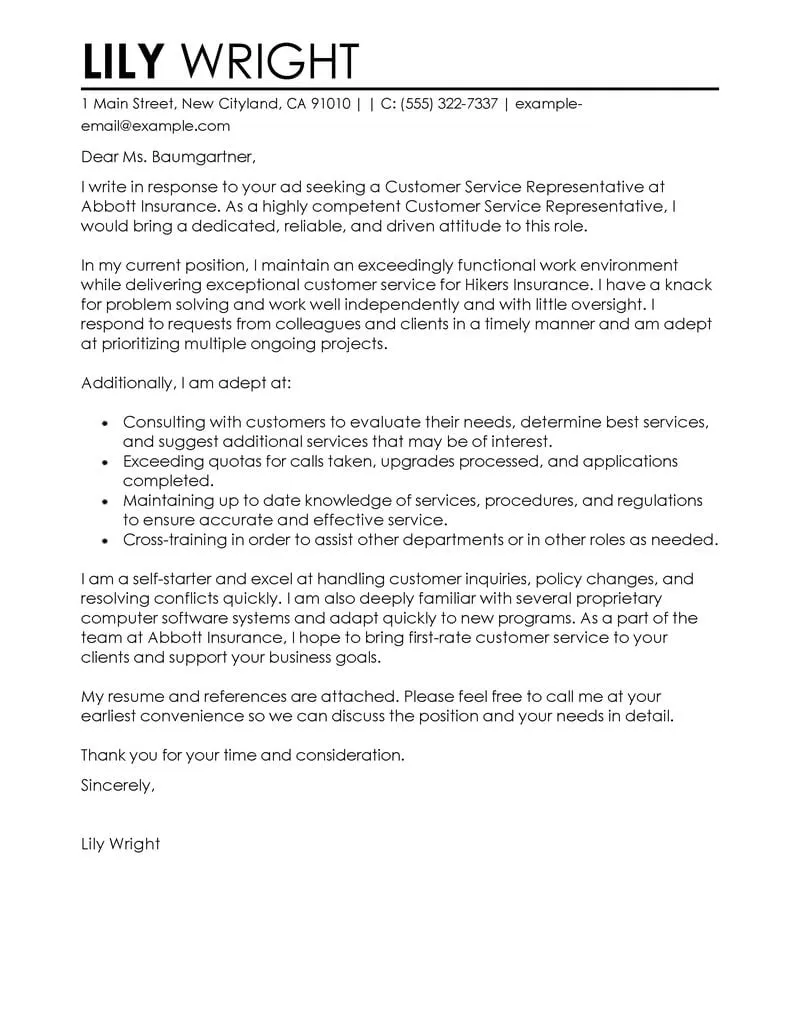
Understanding the Customer Service Rep Role
Before you start crafting your customer service rep cover letter, it’s crucial to understand the role itself. Customer service representatives are the frontline of any company, acting as the primary point of contact for customers. They are responsible for addressing inquiries, resolving issues, and providing support. A strong understanding of this role helps you tailor your cover letter to showcase your relevant skills and experiences, making you a more compelling candidate. This understanding demonstrates to the hiring manager that you are not just applying for a job, but are truly interested in the specifics of the position and what it entails within the company’s structure.
Key Responsibilities of a Customer Service Rep
The responsibilities of a customer service rep are varied, but primarily involve communication, problem-solving, and ensuring customer satisfaction. They answer questions, handle complaints, process orders, and provide information about products or services. Highlighting your ability to manage these responsibilities is essential. Showing that you are adept at multi-tasking, managing stressful situations, and consistently providing positive interactions are all desirable qualities. Your cover letter should provide specific examples of how you have successfully handled these responsibilities in the past, thus illustrating your capabilities to prospective employers.
Essential Skills for Customer Service Success

Several key skills contribute to success in customer service. Communication skills, both verbal and written, are paramount. Problem-solving, active listening, empathy, and patience are also crucial. Moreover, technical skills like computer proficiency and the ability to navigate CRM software can be beneficial. When writing your cover letter, be sure to emphasize these skills, backed by specific examples of how you’ve used them. For example, you can mention a time you used active listening to understand a customer’s issue, leading to a satisfactory resolution. A visual of customer service skills can be included with the image filename ‘customer-service-rep-skills’.
Crafting a Compelling Cover Letter
A well-written cover letter is your first opportunity to impress a potential employer. It should be concise, professional, and tailored to the specific job and company. The goal is to go beyond simply listing your qualifications; you must demonstrate how your skills and experience align with the company’s needs. Start by researching the company and understanding their values, which will inform your writing style and word choice. Focus on what makes you unique and why you are the best fit for the role, keeping the hiring manager engaged from the first paragraph to the last. Remember, a strong cover letter is not just about listing qualifications but telling a story that resonates with the employer.
Header and Contact Information
The header of your cover letter should include your full name, contact information (phone number and email address), and the date. If you know the name of the hiring manager, include it as well. Always use a professional email address, avoiding nicknames or unprofessional language. Make sure your contact information is accurate and up-to-date. A professional header creates a positive first impression and ensures the recruiter can easily reach you. The image filename for the header can be ‘customer-service-rep-cover-letter-header’.
Professional Greeting

Start your cover letter with a professional greeting. If you know the hiring manager’s name, use it; otherwise, use a general greeting like ‘Dear Hiring Manager’ or ‘Dear [Company Name] Hiring Team’. Avoid generic greetings like ‘To Whom It May Concern,’ as they show a lack of personalization. A personalized greeting shows that you have taken the time to research and tailor your cover letter for the specific company and position. This small detail can make a significant impact and demonstrate your attention to detail and proactive approach.
Opening Paragraph: Grab Their Attention
The opening paragraph is your chance to make a strong first impression. Briefly state the position you are applying for and where you saw the job posting. Then, immediately highlight your most relevant skills or experiences. Hook the reader by mentioning something that makes you stand out from the crowd, such as a significant achievement or a particular skill directly related to the job. The opening paragraph should capture the hiring manager’s interest and make them want to continue reading. Do not simply restate the job description, instead create a succinct and engaging introduction that gets right to the point.
Highlighting Your Skills and Experience
The body of your cover letter should provide more detail about your skills and experience. Refer to the job description and highlight the skills and qualifications that the employer is looking for. Use specific examples to illustrate your abilities. For each skill or experience you mention, explain how you used it, what you achieved, and the impact it had. Use action verbs to describe your accomplishments, such as ‘managed,’ ‘resolved,’ ‘improved,’ or ‘increased.’ This section is the meat of your cover letter, where you can show how you are the ideal candidate. A visual example of how to highlight achievements can be shown with the image filename ‘customer-service-rep-achievements’.
Quantifiable Achievements

Whenever possible, quantify your achievements. Instead of saying, ‘Improved customer satisfaction,’ say, ‘Improved customer satisfaction by 15% within six months.’ Numbers provide concrete evidence of your abilities and make your accomplishments more impactful. Use data to demonstrate the value you brought to previous employers or projects. These quantified achievements give the hiring manager a clearer picture of your capabilities and how you have contributed to previous successes. Use relevant data and metrics to make your claims more credible and convincing, leaving no room for ambiguity.
Showcasing Relevant Skills
Focus on skills that are most relevant to the customer service role. These include communication, problem-solving, active listening, empathy, and patience. Provide examples of how you have demonstrated these skills in previous roles. For instance, describe a time you used active listening to de-escalate a difficult situation or resolve a customer issue effectively. Tailor your examples to match the requirements outlined in the job description. Highlighting these core customer service abilities and backing them with concrete examples will help you stand out from other candidates, showing you can not only talk the talk, but also walk the walk.
Tailoring Your Letter to the Job
Do not use a generic cover letter. Customize each letter for each job application. Refer to the job description and company website to understand the specific requirements and values of the company. This may require you to research their products, services, and customer service strategies. Tailoring your letter demonstrates that you are genuinely interested in the position and have taken the time to understand the company’s needs. Customize each letter to reflect the particular skills, experiences, and qualities the employer seeks. Demonstrate that you’ve put in the work to show yourself to be a good fit.
Researching the Company

Before writing your cover letter, thoroughly research the company. Visit their website, read about their products or services, and understand their mission and values. This will help you tailor your letter to the company’s specific needs and culture. Mentioning specific aspects of the company can show your genuine interest and commitment. The research will also help you use appropriate language and showcase how your skills and experience align with the company’s goals. A visual representing this point can be included, using ‘customer-service-rep-company-research’ as the image filename.
Matching Skills to Requirements
Carefully review the job description and identify the key skills and qualifications the employer is seeking. Then, in your cover letter, explicitly state how your skills and experiences match these requirements. Use the same keywords that are used in the job description, but make sure to incorporate them naturally. Provide specific examples to illustrate how you have demonstrated those skills in the past. This ensures that the hiring manager sees that you understand their needs and can meet them effectively. It will make your letter stand out if you include a few of the keywords from the job description.
Using Keywords Effectively
Many companies use Applicant Tracking Systems (ATS) to screen resumes and cover letters. These systems scan for keywords that match the job description. To ensure your letter gets noticed, include relevant keywords throughout. However, avoid keyword stuffing, which is when you overload your letter with keywords in an unnatural way. Instead, integrate the keywords seamlessly into your sentences and examples. Focus on the most important keywords, and make sure they are relevant to your skills and experience. This will increase your chances of passing the ATS and getting your cover letter read by a human. A balance is necessary here.
Formatting and Presentation

The format and presentation of your cover letter can significantly impact the reader’s perception. A clean, professional layout makes your letter easy to read and demonstrates your attention to detail. Poor formatting can make your cover letter appear unprofessional and detract from its message. It’s important to use a professional font, consistent formatting, and proper spacing. The visual appearance of your cover letter should reflect professionalism and clarity. A visual representation for formatting tips can use the image filename ‘customer-service-rep-formatting’.
Font and Readability
Choose a professional font, such as Times New Roman, Arial, or Calibri. These fonts are easy to read and widely accepted. Avoid using decorative or unusual fonts, as they can distract from the content. Ensure the font size is readable (typically 11 or 12 points). Use appropriate line spacing (usually 1.15 or 1.5) to make the text easy on the eyes. The goal is to make your letter look clean and easy to read, as this increases the reader’s attention span, thereby improving the likelihood of them paying attention to your skills.
Length and Structure
Keep your cover letter concise and focused. Aim for a single page. Use a clear structure with a header, greeting, opening paragraph, body paragraphs (highlighting skills and experience), and a closing paragraph. Each paragraph should have a clear purpose, and the information should flow logically. Avoid lengthy paragraphs that can overwhelm the reader. Ensure the content is well-organized, with a clear introduction, body, and conclusion. Your cover letter should act as a persuasive summary of your qualifications, but the details should remain on your resume.
Proofreading and Editing

Proofreading and editing are crucial steps in the cover letter writing process. Errors in grammar, spelling, and punctuation can undermine your credibility and diminish your chances of getting hired. Read your cover letter multiple times, and consider asking a friend or family member to review it as well. Use spell check and grammar check tools, but do not rely solely on them. The goal is to present a polished, error-free document. Proofreading also includes verifying the accuracy of company names, job titles, and other specific details. You can use the image filename ‘customer-service-rep-proofreading’ to visualize this important step.
Common Mistakes to Avoid
Certain mistakes can significantly damage your chances of getting hired. Avoiding these common pitfalls will greatly improve the effectiveness of your cover letter. Be sure to proofread carefully to eliminate these mistakes. Remember that the cover letter represents you, and mistakes reflect poorly on your attention to detail and your professionalism. Paying attention to these common pitfalls helps you refine your cover letter and make it more impactful. A visual representation of a closing with a call to action can use the image filename ‘customer-service-rep-closing’.
Generic Letters
Avoid sending generic cover letters that are not tailored to the specific job or company. These letters often lack impact and fail to demonstrate your interest in the position. Tailor your letter to show you understand the company’s needs and what they are looking for in a customer service rep. Use the job description and company information to showcase your specific skills and experience. A generic letter tells the employer that you put little effort into the process and likely are not very enthusiastic about the opportunity. Customization is key; avoid the ‘one size fits all’ approach.
Typos and Grammatical Errors

Typos and grammatical errors are a major turn-off for hiring managers. These errors indicate a lack of attention to detail and can make you appear unprofessional. Always proofread your cover letter carefully, and consider having someone else review it as well. Use spell check and grammar check tools, but do not rely solely on them. Ensure your writing is clear, concise, and free of errors. A clean, error-free letter shows you care about your presentation and are attentive to detail, which is crucial for a customer service role.
Ignoring the Job Description
Failing to address the requirements outlined in the job description is a common mistake. The job description provides specific information about the skills, experience, and qualifications the employer is seeking. Ignoring these requirements means your cover letter may not resonate with the hiring manager. Read the job description carefully and tailor your cover letter to highlight how your skills and experience match the needs of the role. Be sure to use the same keywords found within the description. Show the employer that you understand the specific requirements of the role, and you can meet them. The key is to prove that you have what it takes, based on their criteria.
Closing Your Cover Letter
The closing paragraph should express your interest in the position and thank the hiring manager for their time and consideration. Reiterate your enthusiasm for the role and the company. Use a professional closing, such as ‘Sincerely,’ or ‘Best regards,’ followed by your full name. Include a call to action, such as inviting the hiring manager to contact you for an interview. A strong closing leaves a lasting positive impression, demonstrating your enthusiasm and professionalism, thereby increasing your chances of getting the job. A visual representing this can use the image filename ‘customer-service-rep-closing’.
Expressing Gratitude
Always thank the hiring manager for their time and consideration. This shows respect and professionalism. A simple ‘Thank you for considering my application’ is a good starting point. Expressing gratitude can create a positive lasting impression, making the hiring manager more inclined to remember you. This small gesture can increase your chances of a positive outcome. Expressing gratitude demonstrates your appreciation for the opportunity.
Call to Action
End your cover letter with a clear call to action. Invite the hiring manager to contact you for an interview or to discuss your qualifications further. For example, you can say, ‘I am eager to discuss my qualifications in more detail and can be reached at [phone number] or [email address].’ A call to action encourages the hiring manager to take the next step. Include your contact information so the hiring manager can easily get in touch with you. A visual can be included with the image filename ‘customer-service-rep-submitting’.
Reviewing and Submitting Your Cover Letter
Before submitting your cover letter, review it carefully to ensure it is error-free and tailored to the specific job. Check for any typos, grammatical errors, and formatting inconsistencies. Make sure your contact information is accurate. Ensure your cover letter is saved in a professional format (e.g., PDF). Double-check the job posting for submission instructions. Following these steps will increase your chances of a successful application. The final step is to submit your well-crafted cover letter. The image filename can be ‘customer-service-rep-submitting’.