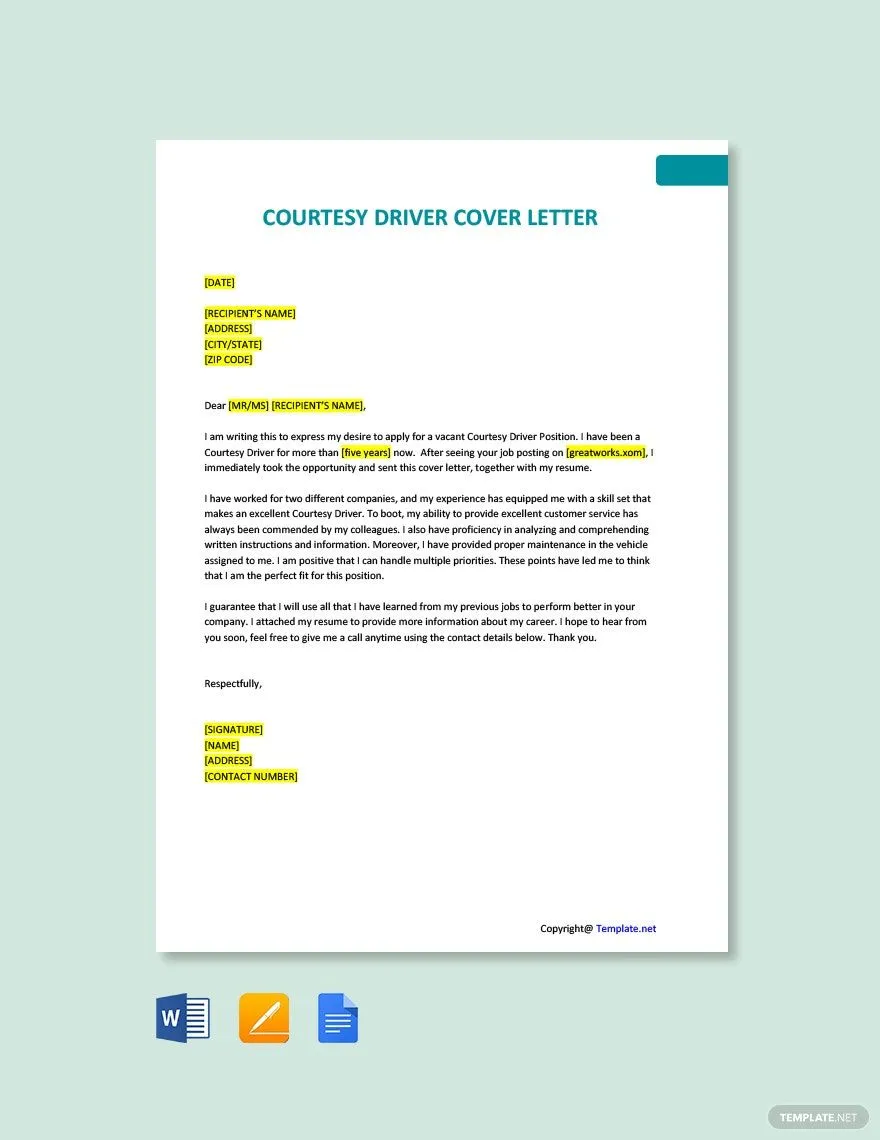
Understanding the Driving Job Cover Letter
A cover letter for a driving job is your first opportunity to make a strong impression on a potential employer. It serves as an introduction, showcasing your qualifications, skills, and experience in a concise and compelling manner. Unlike a resume, which provides a factual overview of your work history, a cover letter allows you to demonstrate your personality, express your enthusiasm for the position, and explain why you are the ideal candidate. It’s a crucial document that can significantly influence whether or not you’re invited for an interview. A well-crafted cover letter is a clear differentiator. It shows attention to detail and communicates that you’ve taken the time to understand the job requirements and company culture. This initial effort can set you apart from other applicants and increase your chances of landing the driving job you desire.
Key Components of a Winning Cover Letter
A winning cover letter for a driving job comprises several key components, each playing a vital role in presenting you as a qualified and enthusiastic candidate. These elements, when combined, create a persuasive narrative that highlights your suitability for the role. From the header to the closing, every section should be carefully considered and crafted to ensure your letter captures the hiring manager’s attention. Attention to detail, organization, and clarity are essential throughout. Remember, the aim is to not only present your skills and experience but also to show your personality and dedication to the job. A well-structured cover letter demonstrates professionalism and reinforces your commitment to securing the driving position. By focusing on these core components, you can create a cover letter that effectively showcases your qualifications and increases your chances of success.
Header Information

The header of your cover letter provides essential contact information and establishes the letter’s formal nature. It should begin with your full name and contact details, including your phone number and email address. Ensure your email address is professional and easy to read. Below your information, include the date and, directly beneath that, the hiring manager’s name and title, if known, along with the company’s address. This formatting is crucial as it allows the recipient to easily identify who you are and how to reach you. Using the correct formatting also shows attention to detail, a key characteristic for driving jobs. If the hiring manager’s name is unavailable, use the title of the person responsible for hiring or use a general greeting such as ‘Hiring Manager’.
Applicant’s Contact Details
Accurately presenting your contact information is vital. In the header, start with your full name, ensuring it is consistent with your resume. Following this, include your phone number, making sure it is a number where you can be easily reached and where you have a professional voicemail setup. Next, provide a professional email address that is easy to read and doesn’t contain any unprofessional nicknames or slang. This is the primary way employers will contact you. Consider including a link to your professional online profile, such as LinkedIn, if applicable. Ensure this information is easy to read and clearly formatted, enabling the hiring manager to swiftly reach you. An error here can cost you your job opportunity.
Employer’s Contact Details
Directly under your contact details and the date, you should include the employer’s contact information. Start with the name of the hiring manager or the specific person you are addressing the letter to. If the name is unknown, use the appropriate job title, such as ‘Hiring Manager.’ Following the name or title, include the company’s full address. This demonstrates your attention to detail and shows that you have tailored your letter for the specific job opening. If the job posting does not explicitly mention the hiring manager’s name, it’s acceptable to research this information online. Using the correct details adds a personalized touch, indicating that you’ve taken the time to understand the company. A well-formatted address is an indicator of your professionalism and organizational abilities.
Greeting the Hiring Manager

The greeting sets the tone for your entire cover letter. It should be formal and professional. If you know the hiring manager’s name, use ‘Dear Mr./Ms./Mx. [Last Name]’. This personalizes your letter and shows that you have done your research. If the hiring manager’s name is unavailable, the safest approach is to use a general greeting such as ‘Dear Hiring Manager’ or ‘Dear [Company Name] Hiring Team’. Avoid generic greetings like ‘To Whom It May Concern,’ as they can make your letter feel less personalized. Whatever greeting you choose, ensure it is appropriate for the company culture and the job itself. The greeting should be followed by a colon, which is the standard format for formal business letters. A well-chosen greeting immediately grabs the attention of the reader.
Crafting a Compelling Opening Paragraph
The opening paragraph is crucial as it’s your first opportunity to capture the hiring manager’s attention. Start by clearly stating the position you are applying for and where you saw the job posting. Briefly mention why you are interested in the role and the company. This paragraph should hook the reader and encourage them to continue reading. Tailor this section to show your enthusiasm and to highlight any specific aspects of the job that appeal to you. For instance, if the job emphasizes safety, mention your commitment to safe driving practices. Keep it concise, approximately 3-4 sentences long, and ensure it directly addresses the job requirements. This introduction sets the stage for the rest of your letter and provides a glimpse of your qualifications and interest in the driving job. Your goal is to make the hiring manager want to learn more.
Highlighting Relevant Experience and Skills
This is where you showcase your relevant experience and skills. Focus on experiences and skills that directly relate to the driving job you are applying for. Briefly describe your previous driving jobs, emphasizing your responsibilities and accomplishments. Quantify your achievements whenever possible – for example, how many miles you drove safely or any accolades you received. Highlight your skills, such as excellent navigational abilities, strong communication skills, and knowledge of safety regulations. Use keywords from the job description to demonstrate that you meet the employer’s needs. Explain how your experience and skills align with the job requirements and company values. It’s not just about listing your previous roles; it is about illustrating how your experience translates into success in this specific driving position. Show, don’t just tell, the hiring manager why you are a great fit.
Detailing Driving Experience

When detailing your driving experience, be specific about the types of vehicles you have operated and the types of routes you have driven. Mention the size and type of vehicle (e.g., Class A CDL, semi-truck, delivery van, etc.) you’re experienced with. Provide details of the cargo you have handled and any specialized training or certifications related to it (e.g., hazardous materials, oversized loads). Include the geographical areas you have experience driving in, whether local, regional, or long-haul. Mention the duration of your experience in each role, providing exact dates to give the hiring manager a clear understanding of your work history. This level of detail ensures that the employer fully appreciates the breadth of your experience, which increases your chances of being selected for an interview. The goal is to provide a complete picture of your driving capabilities and expertise.
Certifications and Licenses
Clearly list all the certifications and licenses you possess. At a minimum, include your Commercial Driver’s License (CDL) class, along with any endorsements such as Hazmat, Tanker, or Doubles/Triples. Mention any other relevant certifications like defensive driving courses or first aid training. Include the issuing state and the expiration dates for all your licenses and certifications, ensuring the employer knows that your credentials are current. If you are applying for a specialized driving role, such as a school bus driver, list the relevant certifications required for that position. This is a key section that quickly proves your eligibility for the job. Make it easy for the hiring manager to see at a glance that you are legally qualified to drive the required vehicles. Make sure your documents are current.
Addressing Skills
Detail the essential driving and related skills necessary for the job. Highlight skills such as safe driving practices, map reading, and the use of GPS. Include your ability to perform pre-trip and post-trip inspections, and your knowledge of vehicle maintenance. Showcase your expertise in following traffic laws and regulations and your ability to handle unexpected situations. Also, mention your familiarity with electronic logging devices (ELDs) if you have that experience. Emphasize your problem-solving skills and your capacity to adapt to changing road conditions. The more skills you can showcase, the better. Tailor this section to include skills mentioned in the job description. Make sure that you are an all-around driver.
Showcasing Professionalism and Soft Skills

Beyond technical skills, employers value professionalism and soft skills. Include your communication abilities, detailing how you communicate effectively with dispatchers, customers, and other drivers. Showcase your ability to work independently and as part of a team. Highlight your organizational skills and ability to manage your time efficiently, especially when dealing with tight schedules. Demonstrate your reliability and dependability by emphasizing your commitment to punctuality and attendance. Explain your dedication to safety and compliance with all regulations. Show your adaptability and your ability to remain calm and composed under pressure. Employers look for drivers who possess these soft skills because they contribute to the overall efficiency and professionalism of the driving operation.
Tailoring the Letter to the Job Description
Customization is key to a successful cover letter. Always tailor your letter to the specific job description. Review the job requirements carefully and incorporate relevant keywords throughout your letter. Show how your skills and experience align with the specific needs of the role. If the job description emphasizes certain skills, like experience with specific routes or types of cargo, highlight those in detail. Show that you have researched the company and understand its mission and values, and reflect this understanding in your letter. Tailoring your letter demonstrates that you’ve invested time and effort, which significantly increases your chances of getting noticed. By directly addressing the requirements of the job, you demonstrate that you are a well-qualified and attentive candidate.
Researching the Company
Before writing your cover letter, conduct thorough research on the company. Visit their website, read about their mission, values, and recent news. Understand their services, the type of vehicles they use, and the routes they typically cover. Check their social media profiles for any insights into their culture and operations. Incorporate the knowledge gained during your research into your cover letter, showing the hiring manager that you are interested in the company. Mentioning their values or their commitment to a specific area can demonstrate that you have aligned yourself with the company’s goals. This effort reflects your initiative and your genuine interest in working for the organization. Research shows a level of care that is appreciated by the hiring team.
Matching Skills to Requirements

Carefully compare your skills and experience with the job requirements listed in the job description. Identify the keywords used in the description and incorporate them naturally into your cover letter. Provide specific examples of how you have demonstrated those skills in previous roles. If the job requires experience with a specific type of vehicle, route, or cargo, be sure to highlight your related experience. If the job emphasizes safety, detail your commitment to safety protocols and your accident-free driving record. By directly matching your skills to the job requirements, you make it easy for the hiring manager to see that you are a strong fit for the role. This step significantly increases your chances of receiving an interview invitation. Show how you are a great fit.
Emphasizing Achievements and Results
Instead of just listing responsibilities, focus on your achievements and results. Quantify your accomplishments whenever possible. For instance, instead of saying ‘Drove long distances,’ say ‘Drove over 500,000 miles accident-free.’ Instead of saying ‘Maintained good relationships with clients,’ state ‘Received positive feedback from clients on over 95% of deliveries.’ Use metrics to demonstrate your effectiveness and the value you bring to an organization. These results provide concrete evidence of your skills and capabilities, making your cover letter more persuasive. Highlighting achievements and results makes a strong case for your qualifications, and it sets you apart from other applicants. This is a great way to be noticed.
Writing a Strong Closing Paragraph
The closing paragraph should reiterate your interest in the driving job and thank the hiring manager for their time and consideration. Re-state your enthusiasm for the opportunity to join the company. Summarize why you believe you are the best candidate for the role, drawing on the key points of your letter. Keep the closing brief and to the point, and ensure it leaves a positive lasting impression. Include a call to action, expressing your eagerness to discuss your application further in an interview. End with a professional closing, such as ‘Sincerely’ or ‘Best regards’, followed by your full name. The closing paragraph should leave the hiring manager with a clear understanding of your interest and your suitability for the role.
Expressing Enthusiasm and Availability

Throughout your cover letter, express genuine enthusiasm for the driving job and the company. Show that you are eager to contribute your skills and experience to the role. Mentioning specific aspects of the job or the company that appeal to you can demonstrate your interest. In the closing paragraph, clearly state your availability for an interview. Provide your contact information again to make it easy for the hiring manager to reach you. Be specific about your availability, whether it is immediately or within a specific time frame. Showing your enthusiasm and your readiness to discuss your application increases the likelihood of a positive response. Remember, show you are excited for the role!
Including a Call to Action
A call to action encourages the hiring manager to take the next step. In your closing paragraph, include a clear and concise call to action, such as ‘I am eager to discuss my qualifications further in an interview’ or ‘I look forward to hearing from you soon.’ Make it easy for the hiring manager to know what you want them to do next. Ensure your call to action is polite and professional. By including a call to action, you actively guide the hiring manager towards the next step in the hiring process, which may be scheduling an interview. This reinforces your interest and increases your chances of getting contacted. Always include a polite call to action.
Proofreading and Formatting
Proofreading and formatting are crucial steps in ensuring your cover letter is polished and professional. Carefully review your letter for any grammatical errors, typos, and spelling mistakes. Use a spell-checker and grammar checker, but also read the letter aloud to catch any errors that might be missed. Ensure your formatting is consistent and easy to read, with clear headings, ample white space, and appropriate font choices. Choose a standard font like Times New Roman, Arial, or Calibri, and use a font size between 10 and 12 points. Make sure your letter is well-structured, with a logical flow and clear paragraphs. A well-proofread and formatted cover letter shows attention to detail, indicating to the hiring manager that you are meticulous and professional.
Ensuring Clarity and Conciseness
Your cover letter should be clear and concise. Keep your sentences and paragraphs short and to the point. Avoid jargon and complex language. Ensure your message is easy to understand. The goal is to effectively communicate your qualifications and enthusiasm in a brief space. Use active voice to make your writing more direct and engaging. Cut unnecessary words and phrases to keep your letter focused. A concise cover letter reflects well on your communication skills and shows that you value the hiring manager’s time. Always get straight to the point and show that you are a great fit for the role. Clarity and conciseness are key!
Reviewing for Errors
Always review your cover letter for any errors before submitting it. After you have written and edited your letter, take a step back and review it again with fresh eyes. Check for grammatical errors, spelling mistakes, and typos. Ensure your formatting is consistent and professional. Have a friend, family member, or career counselor review the letter as well. A second pair of eyes can often catch errors that you might miss. Make sure all details are accurate, including names, dates, and job titles. A careful review before submission shows your attention to detail and commitment to presenting yourself in the best possible light. Review the job posting once more to ensure your letter addresses all the required aspects.
Formatting Guidelines
Following formatting guidelines can make your cover letter more readable and professional. Use a standard font like Times New Roman, Arial, or Calibri. Maintain a font size between 10 and 12 points. Use single-spaced lines with a double space between paragraphs. Use left alignment for the body of your letter. Make sure the header is aligned to the left and the date to the right. Use clear headings and subheadings to organize your content. If you are sending your cover letter electronically, save it as a PDF to ensure that the formatting remains consistent. This also prevents potential issues, such as the hiring manager’s computer failing to open your cover letter. Correct formatting reflects professionalism and can give your cover letter an advantage.