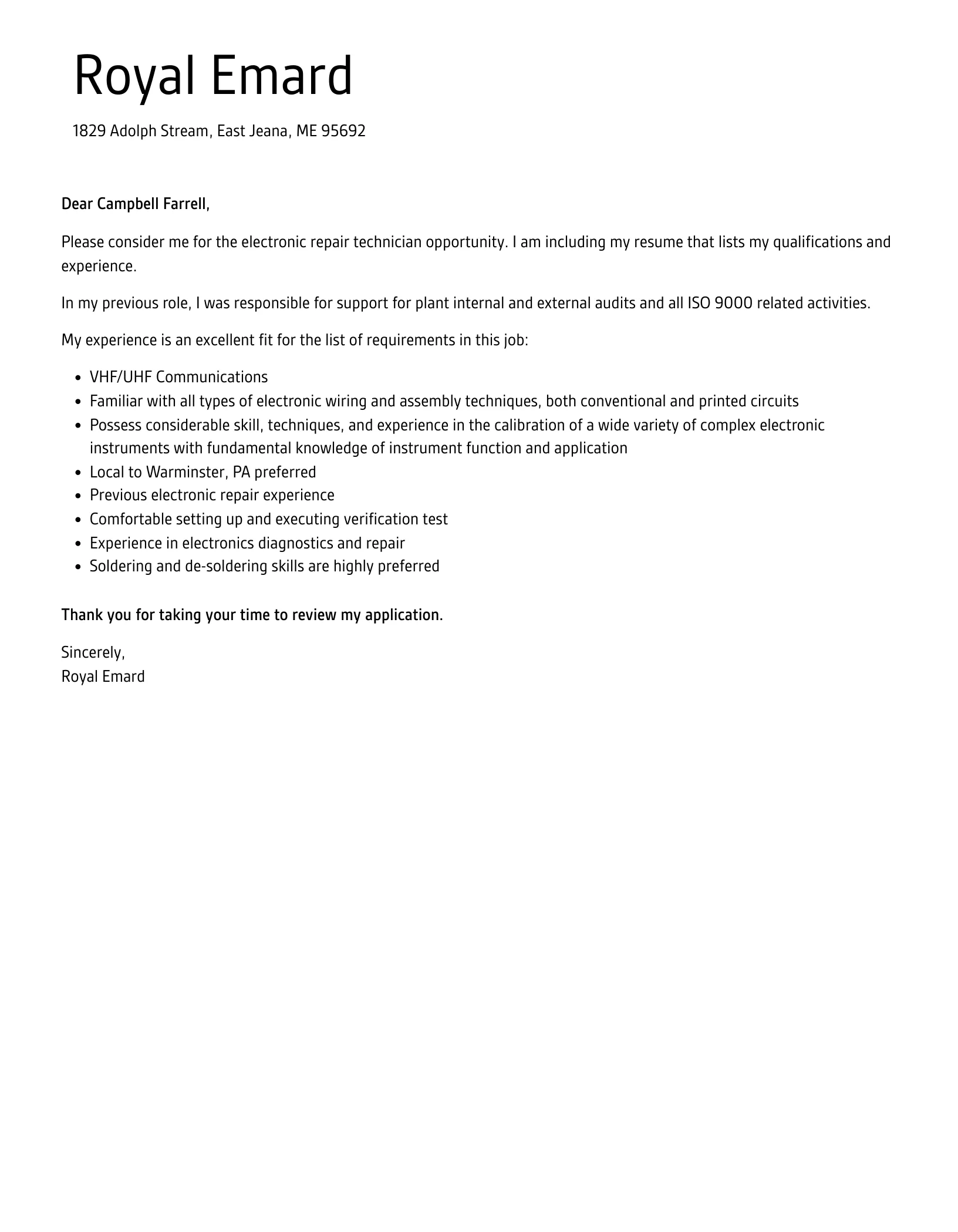
Understand the Electronic Technician Cover Letter’s Purpose
An electronic technician cover letter serves as your initial introduction to a potential employer, offering a concise summary of your qualifications and aspirations. Unlike a resume, which provides a detailed history of your work experience, a cover letter is designed to highlight the most relevant aspects of your background and explain why you are a suitable candidate for the specific position. It’s your opportunity to showcase your personality, enthusiasm, and communication skills, setting you apart from other applicants. The primary objective of your cover letter should be to secure an interview by persuading the hiring manager that you possess the necessary skills, experience, and personal attributes to excel in the role. Therefore, it is crucial to tailor your cover letter to each specific job, emphasizing the skills and experiences that align with the employer’s needs and expectations. A well-crafted cover letter demonstrates your professionalism, attention to detail, and genuine interest in the opportunity, significantly increasing your chances of moving forward in the application process.
Highlight Your Technical Skills
Technical skills are at the core of an electronic technician’s expertise. Your cover letter must vividly showcase these abilities. Begin by listing the specific technical skills that match the job description. Include proficiency in areas such as troubleshooting, circuit analysis, soldering, testing, and repairing electronic equipment. Mention your experience with specific tools, software, and technologies relevant to the role, such as oscilloscopes, multimeters, schematic reading, and programming languages. Quantify your skills whenever possible; for instance, mention the types of equipment you’ve repaired, the size of circuits you’ve worked on, or the level of programming experience you possess. Use action verbs to demonstrate your capabilities, such as ‘diagnosed,’ ‘repaired,’ ‘maintained,’ and ’tested.’ Provide context for your skills by mentioning the environments or industries in which you have applied them. Tailor your description to align with the job requirements, ensuring the employer recognizes your competence and ability to contribute to their team. By highlighting the most relevant technical skills, you effectively communicate your suitability for the position and demonstrate your value as an electronic technician.
Detail Your Experience

Detailing your experience is critical in demonstrating your practical capabilities as an electronic technician. Start by providing a brief overview of your work history, including previous employers, job titles, and the duration of your employment. Focus on the roles where you’ve directly applied your technical skills and achieved tangible results. When describing your experience, use the STAR method (Situation, Task, Action, Result) to provide context and highlight your achievements. For each role, explain the situation or challenge you faced, the specific task you were assigned, the actions you took, and the results you accomplished. Quantify your achievements whenever possible. For instance, mention the percentage by which you improved efficiency, reduced downtime, or decreased repair costs. Showcase your ability to solve complex problems, work independently, and collaborate within a team. Tailor your description to align with the specific requirements outlined in the job description, emphasizing experiences most relevant to the role. By detailing your relevant experience, you provide concrete evidence of your ability to perform the job duties and add value to the company, increasing your chances of moving forward in the application process.
Emphasize Relevant Certifications
Certifications significantly boost your credibility and demonstrate your commitment to professional development. In your cover letter, prominently list any relevant certifications you hold. Examples include certifications from organizations like the Electronics Technicians Association (ETA), such as the Certified Electronics Technician (CET) designation. Other valuable certifications could include those related to specific equipment or technologies, like certifications from manufacturers or specialized training programs. Include the name of the certification, the issuing organization, and the date you obtained it. If the job description lists specific certifications as requirements or preferences, make sure these are highlighted in your cover letter. Explain how these certifications have prepared you for the role, detailing the skills and knowledge gained through the certification process. Mention any continuing education or ongoing professional development activities you undertake to stay current with industry advancements. By emphasizing your certifications, you confirm your qualifications and commitment to excellence, adding to your application’s appeal.
Showcase Soft Skills and Attributes
While technical skills are essential, soft skills and personal attributes significantly contribute to your overall suitability as an electronic technician. In your cover letter, showcase the soft skills that demonstrate your ability to thrive in a professional environment. Highlight your communication skills, both written and verbal, emphasizing your ability to explain technical concepts clearly. Mention your problem-solving abilities, showing your capacity to approach challenges systematically and find effective solutions. Illustrate your teamwork skills by describing experiences where you collaborated with others to achieve common goals. Include attributes such as attention to detail, reliability, and a strong work ethic. Provide examples of how you have used these skills and attributes in past roles. Tailor these skills to align with the job description, ensuring the employer understands how your personality and abilities align with the company culture and the requirements of the position. By showcasing your soft skills, you provide a more complete picture of yourself, demonstrating your ability to succeed in the role.
Structuring Your Electronic Technician Cover Letter

Header and Contact Information
Your cover letter should begin with a professional header that includes your contact information. At the top, include your full name, address, phone number, and email address. Ensure your email address is professional and easy to read. Also, include the date and the recipient’s contact information. If you know the hiring manager’s name, address your letter directly to them. If not, address it to the hiring manager or the appropriate department. This demonstrates your attention to detail and professionalism. Proper formatting of your header not only provides the necessary contact details but also creates a polished first impression. Make sure all information is accurate and up-to-date, and the contact details are easily accessible, so the hiring manager can quickly reach you to schedule an interview.
Greeting and Introduction
The greeting and introduction set the tone for your cover letter. Start with a professional greeting, such as “Dear Mr./Ms. [Last Name],” if you know the hiring manager’s name. If the name is unknown, use a general greeting like “Dear Hiring Manager.” Your introduction should immediately grab the reader’s attention and clearly state the position you’re applying for. Briefly mention where you saw the job posting and express your enthusiasm for the opportunity. Highlight one or two key skills or experiences that make you a strong candidate. The introduction should be concise, typically consisting of only a few sentences. Its primary goal is to make the reader interested in learning more about your qualifications. Making a strong first impression will set you apart from other applicants and encourage the hiring manager to continue reading.
Body Paragraphs

The body paragraphs are the core of your cover letter, where you provide details about your skills, experience, and qualifications. Use 2-3 paragraphs to describe your relevant skills and achievements. Focus on the requirements of the job and explain how your background makes you a good fit. Use specific examples to illustrate your abilities, quantifying your accomplishments whenever possible. Support your claims with tangible evidence that aligns with the company’s needs. Tailor your descriptions for each job to ensure you emphasize the most relevant information. Show a clear connection between your skills and the job duties. The body paragraphs are your opportunity to demonstrate your knowledge, enthusiasm, and suitability for the role, making sure the employer understands how your abilities can benefit the company. Keep your language clear, concise, and professional. Provide specific examples of how you’ve used your skills to solve problems, improve efficiency, or achieve success in your previous roles.
Call to Action and Closing
Your cover letter’s closing paragraph must include a strong call to action and a professional closing. Express your enthusiasm for the opportunity and reiterate your interest in an interview. Clearly state your availability for an interview and how the hiring manager can contact you. Thank the hiring manager for their time and consideration. End with a professional closing, such as “Sincerely,” “Best regards,” or “Yours sincerely,” followed by your full name. Review your letter to ensure it has a clear and concise message, and is free of errors. Ensure that the closing and call to action reflect your confidence and eagerness to move forward in the hiring process. By ending with a strong call to action, you encourage the hiring manager to take the next step.
Proofreading and Formatting for Success
Formatting and Layout Essentials

Proper formatting and layout are critical for a professional cover letter. Use a clear, easy-to-read font, such as Arial, Times New Roman, or Calibri, with a font size between 10 and 12 points. Maintain consistent formatting throughout the document, including the font style, size, and spacing. Use single-spacing for the body of your letter, with a blank line between each paragraph. Ensure that your margins are standard (typically one inch on all sides) and that the text is left-aligned. Proofread your cover letter meticulously for any errors in grammar, spelling, and punctuation. Maintain a professional tone throughout the letter. By paying close attention to these formatting essentials, you can ensure that your cover letter is easy to read and visually appealing, which leaves a good impression with the hiring manager.
Proofreading for Accuracy
Proofreading your cover letter is a vital step to ensure your application is professional and error-free. Thoroughly review your cover letter for any grammatical errors, spelling mistakes, and punctuation errors. Check for any inconsistencies in your formatting and layout. Read your cover letter aloud to catch any awkward phrasing or sentence structure issues. Use a grammar and spell-checking tool, but do not rely solely on these tools; they may not catch all errors. Ask a friend, family member, or career advisor to review your cover letter for a second opinion. Ensure your letter is tailored to the specific job and contains accurate information about your skills and experience. By meticulously proofreading and seeking feedback, you will ensure your cover letter presents you in the best possible light and enhances your chances of getting an interview.
Tailoring Your Letter for the Job
Research the Company and Position

Before you write your cover letter, thoroughly research the company and the specific position you’re applying for. Visit the company’s website to learn about its mission, values, and recent projects. Review the job description carefully, noting the required skills, experience, and qualifications. Tailor your cover letter to address the needs of the specific role and the company. Use keywords and phrases from the job description in your cover letter to demonstrate that you have the skills and experiences they seek. Show how your skills and experiences align with their needs and how you can contribute to their goals. This targeted approach demonstrates your interest and understanding of the opportunity, significantly increasing your chances of moving forward.
Use Keywords from the Job Description
Using keywords from the job description is a critical strategy for creating an effective cover letter. Carefully review the job description, identifying the key skills, experience, and qualifications the employer is seeking. Integrate these keywords naturally into your cover letter. Use the exact wording from the job description when possible. For example, if the job description emphasizes ’troubleshooting’ and ‘circuit analysis,’ use these terms in your descriptions of your skills and experience. This strategy ensures that your application is aligned with the employer’s requirements, showing the recruiter that you’ve read and understood their needs. It also increases the chances that your cover letter will pass through any applicant tracking systems used by the company. By strategically using keywords, you improve your chances of being selected for an interview.
Common Mistakes to Avoid
Avoid these common mistakes to increase your chances of cover letter success. Don’t use generic cover letters. Each cover letter should be customized for the job. Avoid grammatical errors, spelling mistakes, and typos. Proofread carefully. Don’t go over one page in length. Keep your cover letter concise and focused. Don’t simply repeat your resume. Use the cover letter to highlight and expand on your most relevant skills and experiences. Avoid clichés and overly casual language. Write in a professional, yet engaging tone. Finally, don’t be negative or complain. Your cover letter should be a positive and enthusiastic representation of yourself. By avoiding these common pitfalls, you’ll create a cover letter that truly represents your skills and increase your chances of landing an interview.