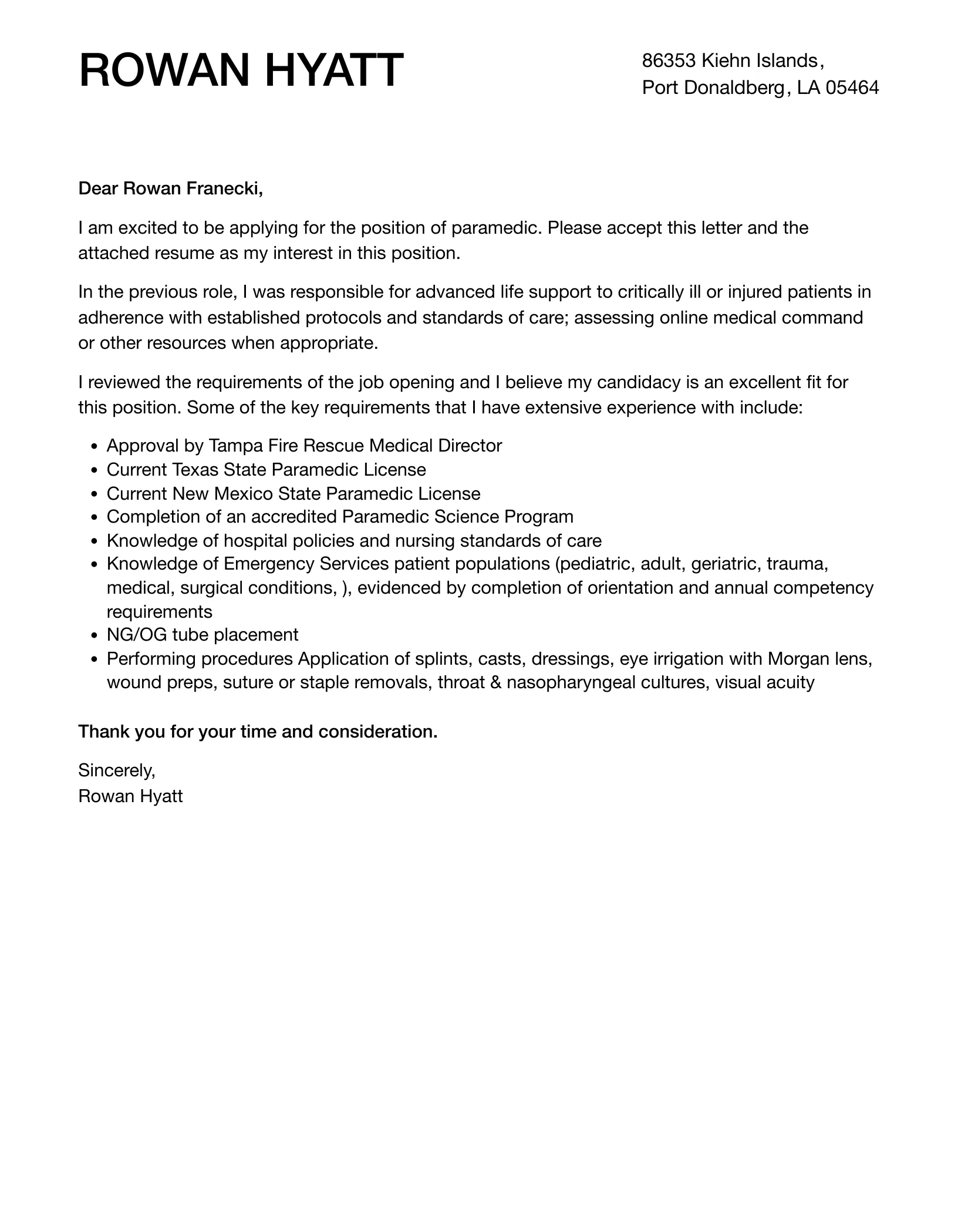
Highlighting Your EMT Skills
Your EMT cover letter is your first impression on potential employers. It’s your chance to showcase your abilities and make a compelling case for why you’re the ideal candidate. It should be more than just a repetition of your resume; it’s an opportunity to highlight your specific skills, experiences, and the unique value you bring to their team. Start by clearly stating your EMT certification and any specializations you hold, like Advanced EMT or Paramedic, if applicable. Tailor the language to reflect the specific job description; employers look for candidates who understand their requirements. Consider including a concise summary of your key skills in the opening, such as patient assessment, administering medications, providing basic and advanced life support, or operating medical equipment. This immediately tells the reader that you possess the required expertise.
Certifications and Training
Always include a list of your current certifications. This is vital. List your EMT certification level (e.g., EMT-Basic, Advanced EMT), as well as any other relevant training or certifications. This might include CPR/AED, First Aid, specialized courses such as pediatric advanced life support (PALS), or pre-hospital trauma life support (PHTLS). Include the issuing organization and the dates of certification and/or expiration. This instantly tells the hiring manager that your qualifications are up-to-date and match the requirements of the position.
Relevant Experience

Focus on describing your experience in a way that highlights your accomplishments. Instead of simply listing your job duties, provide specific examples of how you’ve made a difference. Quantify your achievements whenever possible. For example, mention the number of patients you’ve assisted, any specific procedures you’ve performed, or any specific successes you’ve had, like improved patient outcomes or successful resuscitation. If you have experience in specific environments (e.g., ambulance, hospital, or event medical services), make sure to mention it. The details make the difference between a cover letter that gets read, and one that gets passed over. Employers are looking for people who not only have the required skills but also have demonstrated their abilities in real-world situations. Use action verbs at the beginning of each statement to grab the attention of the employer.
Showcasing Your Soft Skills
Soft skills are as important as technical skills, and they show an employer the kind of colleague you’ll be. In addition to hard skills, your EMT cover letter should highlight your soft skills. These include communication, teamwork, problem-solving, and emotional intelligence, all of which are essential for EMTs. Provide examples of how you have demonstrated these skills in previous roles. The best cover letters don’t just list skills; they demonstrate how those skills are applied in practical scenarios.
Communication and Teamwork
Emphasize your ability to communicate effectively with patients, their families, and other healthcare professionals. Provide examples of how you’ve successfully communicated complex medical information to patients in a clear and understandable manner. Give an example of a time you collaborated effectively with a team to improve patient care, or to handle a difficult situation. Teamwork and clear communication are essential in the fast-paced world of emergency medicine. Your cover letter is your opportunity to show you understand this dynamic.
Problem-Solving and Critical Thinking

Detail instances where you successfully used critical thinking skills to assess a patient’s condition, make quick decisions under pressure, and provide the best possible care. Describe instances where you adapted your approach based on a patient’s changing condition or used available resources creatively to resolve a challenge. These examples demonstrate your ability to handle the unexpected and your dedication to providing the best care possible.
Formatting Your Cover Letter
The appearance of your cover letter is as important as its content. A well-formatted letter is easy to read and makes a good impression. Use a professional font like Times New Roman or Arial in a readable size (e.g., 11 or 12 points). Use clear headings and bullet points to organize information and make it easy for the reader to find key details. Ensure the margins are consistent and that the document is properly spaced. Poor formatting can detract from the message you are trying to convey and give the impression that you are not detail-oriented. Keep it concise, clear, and easy to navigate.
Contact Information
Begin your cover letter with your full name, address, phone number, and email address. This information should be clearly visible at the top of the letter. Ensure your email address is professional. It is a good idea to include a link to your LinkedIn profile, if you have one.
Opening Statement

In the opening paragraph, state the position you’re applying for and how you learned about the opening. Briefly mention why you are interested in the role and the company. It’s a good idea to convey your enthusiasm. Make sure your opening is engaging, concise, and clearly indicates the purpose of your letter.
Body Paragraphs
The body paragraphs are where you highlight your skills, experience, and accomplishments. Use one or two paragraphs to showcase the most relevant aspects of your experience. Relate your skills and experience to the requirements listed in the job description. Provide specific examples of your accomplishments. Use action verbs and quantify your achievements whenever possible.
Closing Paragraph
In your closing paragraph, restate your interest in the position and thank the reader for their time and consideration. Express your enthusiasm to learn more about the opportunity and reiterate your availability for an interview. Use a professional closing such as “Sincerely” or “Respectfully” followed by your name.
Proofreading and Editing

Before submitting your cover letter, proofread it carefully for any grammatical errors, spelling mistakes, or typos. Check for clarity, consistency, and flow. It’s a good idea to have a friend or colleague read your cover letter for feedback. A polished, error-free cover letter demonstrates your attention to detail and professionalism. Double-check the company and the hiring manager’s name; a typo can make you appear careless, and could lead to your application not being considered.
Tailoring Your Cover Letter
A generic cover letter is unlikely to impress employers. The most effective cover letters are tailored to the specific job and the specific employer. This requires some extra effort, but it significantly increases your chances of getting noticed. Tailoring ensures that your skills and experience align with the employer’s needs and the requirements of the role.
Researching the Employer
Before writing your cover letter, research the employer. Learn about their mission, values, and any recent achievements. This information will help you tailor your letter to their specific needs and demonstrate your genuine interest in the company. You can often find this information on the company’s website or on their LinkedIn page. Showing that you know something about the organization is a good way to impress a potential employer.
Matching Skills to Requirements

Carefully review the job description and identify the key skills and qualifications the employer is seeking. Then, highlight those skills and qualifications in your cover letter, providing specific examples of how you have demonstrated them in the past. This shows the employer that you understand the job requirements and that you are a good fit for the role. When you provide the examples, try to match the language and terms the employer has used to show you’ve understood and digested their needs.
Using Keywords Effectively
Incorporate keywords from the job description throughout your cover letter. This will help your application get past applicant tracking systems (ATS) and catch the attention of the hiring manager. However, don’t overuse keywords; make sure your letter reads naturally. Keywords are most useful when they are part of the language of the job, and therefore make your letter seem tailored to that job.
What to Avoid
There are several common mistakes that can undermine your cover letter and hurt your chances of getting an interview. Avoiding these pitfalls will help you make a more positive impression and improve your odds of success. It’s important to remember that your cover letter is a sample of your written communication skills; mistakes can be very costly.
Common Mistakes

There are several common mistakes that can easily sink your application. Knowing what they are, and how to avoid them can make a big difference.
Generic Language
Avoid using generic, impersonal language. Phrases like “To whom it may concern” or “I am writing to express my interest” are overused and fail to capture the reader’s attention. Instead, personalize your letter and tailor it to the specific employer and position. Use the hiring manager’s name if possible. Show enthusiasm and a genuine interest in the role.
Typos and Grammatical Errors
Typos and grammatical errors can damage your credibility and give the impression that you are not detail-oriented. Always proofread your cover letter carefully before submitting it. It’s also a good idea to have someone else review it as a fresh pair of eyes can often catch mistakes you may have missed. Poor grammar and spelling instantly undermine your application, and make it more likely that the employer will pass on your application.