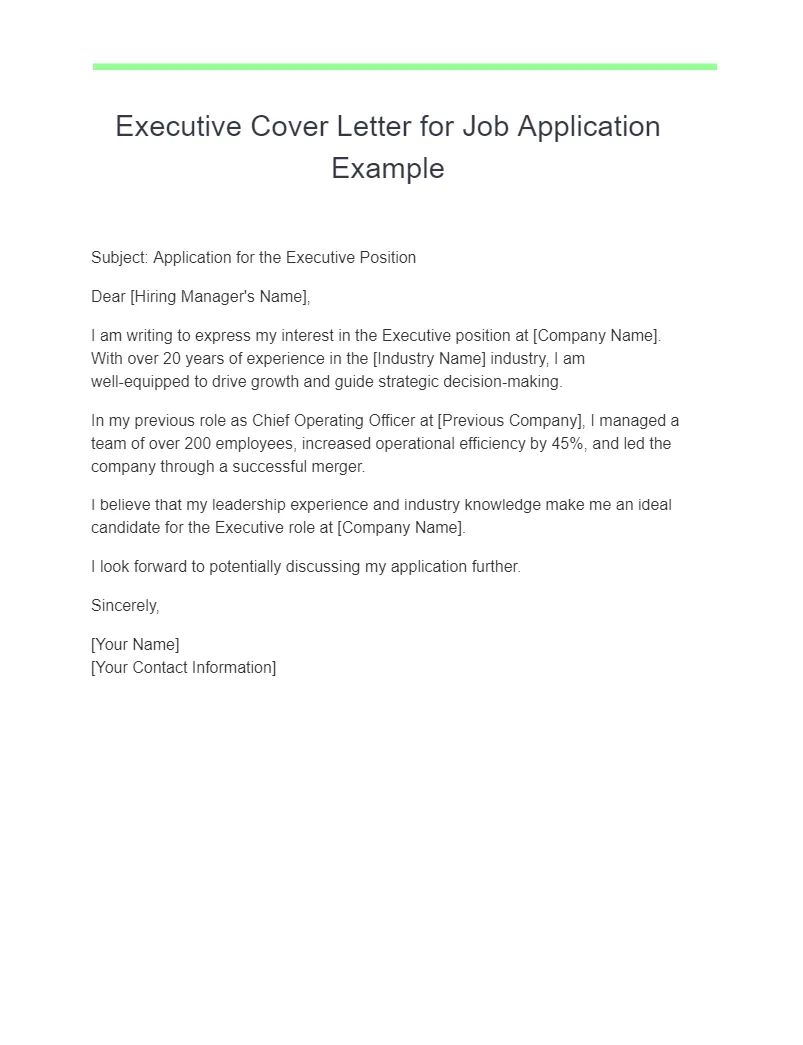
What Is an Executive Cover Letter
An executive cover letter is a critical document that accompanies your resume when applying for high-level positions in a company. Unlike a standard cover letter, an executive cover letter is meticulously crafted to showcase your unique leadership abilities, strategic thinking, and significant accomplishments. It serves as your personalized introduction, emphasizing your most relevant skills and experiences, and demonstrating how you can add substantial value to the organization. This letter gives you the opportunity to craft a compelling narrative and make a powerful first impression, going beyond merely listing your qualifications. It highlights your understanding of the organization’s needs and how you can contribute strategically to their goals.
Why Executive Cover Letters Matter
Executive cover letters are indispensable tools for making a strong first impression and demonstrating your suitability for a leadership position. They provide a platform to articulate your unique value proposition, illustrating how your skills and experience align with the company’s strategic goals. Hiring managers at the executive level seek individuals who can communicate their vision effectively and display a deep understanding of the business landscape. Your executive cover letter immediately establishes you as a strategic thinker, a problem solver, and a strong leader. It lets you demonstrate your understanding of the role, the company’s challenges, and the industry trends, ultimately setting you apart from other candidates who might solely rely on their resumes.
Key Components of a Stellar Executive Cover Letter

A successful executive cover letter comprises several critical components that work together to present a comprehensive picture of your professional capabilities. These elements include concise contact information, a compelling professional summary, detailed achievements, quantifiable results, a clear demonstration of leadership skills, and an in-depth understanding of industry knowledge. These key areas should not only highlight your past accomplishments but also illustrate how you added value to previous organizations. A well-crafted executive cover letter goes beyond simply listing qualifications; it tells a narrative that aligns with the specific role’s needs and the company’s overall goals. It demonstrates your deep understanding of the business landscape and your ability to make strategic contributions.
Contact Information
Begin your executive cover letter with your full name, professional title (if applicable), phone number, email address, and LinkedIn profile URL. Ensure your contact information is prominently and clearly displayed at the top of the document. This should mirror the information on your resume for consistency. Accurate contact information is crucial, ensuring the hiring manager can easily reach you. Double-check all details to avoid any errors that could hinder communication. Make sure your email address sounds professional and is appropriate for executive-level roles. A well-presented contact section is a must for any executive cover letter, showcasing your attention to detail and professionalism.
Professional Summary
Your professional summary is a concise, impactful statement designed to grab the reader’s attention immediately. It should highlight your core competencies, years of experience, and the value you bring to an organization. Think of it as your personal elevator pitch. This section must be tailored to the specific role and demonstrate your understanding of the company’s needs. For instance, if the company emphasizes growth, your summary should reflect your experience in driving revenue or expanding market share. Focus on your leadership abilities and strategic thinking. This is where you make your first strong impression, so ensure it’s clear, concise, and highly relevant to the position and the company’s goals. Use strong action verbs and quantifiable achievements to make it as compelling as possible.
Highlighting Your Achievements

In this section, showcase your most significant professional achievements using the STAR method (Situation, Task, Action, Result). This structured approach provides context, explains the challenges you faced, details the actions you took, and clearly states the positive outcomes. Instead of merely listing your responsibilities, concentrate on what you accomplished and how you made a tangible difference. Mention awards, recognitions, or milestones achieved. Emphasize results and quantifiable data (e.g., increased revenue by X%, reduced costs by Y%, or improved customer satisfaction by Z%). These examples demonstrate your capabilities and provide concrete evidence of your value. This gives the hiring manager clear evidence of the impact you could bring to their organization and validates your ability to achieve similar results.
Quantifiable Results
Quantifiable results are essential because they provide solid evidence of your past performance and the value you bring to an organization. Use metrics and data to support your claims and demonstrate your impact. Numbers are often more persuasive than words, so wherever possible, back up your achievements with hard data (e.g., Increased sales by 20% in one year, Reduced operational costs by 15%, or Improved customer retention by 10%). Provide specific examples and use percentages, dollar amounts, or other relevant metrics to illustrate your contributions. Quantifiable results offer tangible proof of your abilities and show that you are a results-oriented leader, capable of making a measurable difference in the company’s performance. Data driven achievements make your claims more credible and help the hiring manager understand the concrete impact you can make.
Demonstrating Leadership Skills
Executive positions demand robust leadership skills, so ensure you highlight your abilities. Provide specific examples of how you have led teams, motivated employees, and driven successful outcomes. Mention your ability to create and execute strategic plans, make difficult decisions, and inspire others to achieve their goals. Include examples of how you’ve navigated crises or led organizations through periods of change. Showcase your communication skills, your ability to build consensus, and your dedication to fostering a positive and productive work environment. Emphasize how you have mentored and developed talent within your previous organizations, demonstrating your commitment to building a strong team and leaving a lasting impact on the company culture. This proves your capacity to manage and inspire high-performing teams and contribute to the company’s long-term success.
Showcasing Industry Knowledge

Demonstrate your deep understanding of the industry you’re applying to by highlighting relevant trends, challenges, and opportunities. Show that you have kept up to date with industry news and developments. Mention any relevant certifications or professional affiliations that demonstrate your expertise. Highlight any innovative strategies or forward-thinking initiatives you’ve implemented. Research the company and the industry, tailoring your letter to show how you can use your knowledge to benefit the organization. This level of understanding shows that you can contribute to the company’s strategic planning and overall success. This section proves your commitment to the field and your ability to contribute meaningfully from day one. Your industry knowledge showcases your ability to quickly become a valuable asset.
Tailoring Your Cover Letter to the Role
Every executive cover letter should be meticulously tailored to the specific role you are applying for. Avoid sending a generic letter; customize it to align with the job description and the company’s particular needs and values. Carefully review the job posting and identify the key requirements, skills, and values. In your cover letter, explicitly address how your experience and qualifications align with these requirements. Incorporate keywords from the job description throughout your letter. Research the company to understand its mission, culture, and current challenges. Demonstrate that you understand their goals and that your skills and experience can help them achieve success. Tailoring your cover letter shows that you’ve invested the effort to understand the role and are genuinely interested in the opportunity.
Researching the Company
Before drafting your executive cover letter, thoroughly research the company. Visit their website, read industry news, and review their social media profiles. Understand their mission, values, and recent accomplishments. Identify any challenges they might be facing and how your skills can help solve them. Tailor your cover letter to address their specific needs and demonstrate that you understand their business. This research is essential for demonstrating genuine interest and illustrating that you are not just applying for a job, but actively looking to contribute to their success. This thorough preparation allows you to highlight your strategic thinking and your ability to align your skills with the company’s goals and culture, increasing your chances of a positive outcome.
Addressing Specific Requirements

Thoroughly review the job description and identify the key requirements. In your cover letter, directly address each requirement and provide specific examples of how your experience and skills meet those criteria. If the job description emphasizes leadership, provide examples of your leadership skills and the positive outcomes you have achieved through your leadership. If the role demands experience in strategic planning, highlight your experience in developing and executing strategic plans. By directly addressing the requirements, you demonstrate that you have carefully read the job description and that you have a clear understanding of the company’s needs. This targeted approach is key to persuading the hiring manager that you are, without question, the best fit for the role and understand what the company is looking for.
Formatting and Design
The formatting and design of your executive cover letter should be professional, clean, and exceptionally easy to read. Choose a professional font such as Times New Roman, Arial, or Calibri. Use a font size between 11 and 12 points. Maintain consistent formatting throughout the document. Utilize clear headings and bullet points to organize your information and make it easy for the reader to scan. Ensure proper spacing and margins to enhance readability. Avoid excessive use of bolding, italics, or underlining. A well-formatted cover letter shows your strong attention to detail and professionalism, which are crucial qualities for executive-level roles. A clean and organized design helps the reader quickly grasp the essential information, thus making a positive and lasting impression.
Using the Right Tone
The tone of your executive cover letter should be professional, confident, and enthusiastic. Adopt a tone that reflects your leadership experience and strategic thinking. Avoid being overly casual or informal. Use formal language and maintain a professional tone throughout the document. Remain positive and proactive, highlighting your accomplishments and showcasing your potential contributions to the company. The tone you adopt should align with the company’s culture, so tailor your language to match their style. Project confidence and demonstrate your enthusiasm for the opportunity to make a strong, positive first impression. Your writing style should reflect your leadership abilities and your dedication to achieving excellence in your field.
Proofreading and Editing

Proofreading and editing are essential steps in the cover letter writing process. Meticulously review your letter for any grammatical errors, typos, or inconsistencies. Use a grammar checker and spell-checker to assist you. Have a trusted colleague or friend proofread your letter, as a fresh pair of eyes can often catch mistakes you might have missed. Make sure that the formatting is consistent and professional. A lack of errors demonstrates your attention to detail and commitment to quality, which are critical for executive positions. A well-edited and proofread cover letter reinforces your professionalism and increases your chances of getting an interview. Thoroughly check every aspect of the letter, from the spelling and grammar to the consistency of your formatting. This will ensure that your letter is as impactful as possible.
Avoiding Common Mistakes in Executive Cover Letters
Several common mistakes can undermine the effectiveness of an executive cover letter. Awareness of these pitfalls can significantly improve your chances of success. Avoid the overuse of clichés, generic content, and neglecting to address the job description’s requirements. Also, keep your cover letter to an appropriate length. These issues can quickly render your cover letter ineffective and may lead to rejection.
Overuse of Clichés
Avoid using clichés and overused, generic phrases in your executive cover letter. These phrases are often overused and can make your writing sound unoriginal and uninspired. Avoid clichés like ’team player,’ ‘results-driven,’ or ‘hard worker.’ Instead, use original language and provide specific examples that demonstrate your skills and accomplishments. The use of clichés demonstrates that you may not have invested the time to craft a personalized letter. Your goal is to show your unique value proposition, so avoid language that could apply to anyone. Ensure every sentence reflects your unique attributes and helps you stand out from the crowd, making a memorable and positive impression on the reader.
Generic Content

Avoid generic content that could be applied to any job or company. Tailor your cover letter to each specific role and company you are applying to. Generic letters show a lack of effort and fail to demonstrate that you understand the company’s needs or the requirements of the position. Customize your letter to showcase how your skills and experience specifically align with the job description and the company’s goals. Research the company and use your understanding to show how you can contribute to their success. A personalized cover letter demonstrates your sincere interest and gives the hiring manager a better understanding of your qualifications for the role. It also demonstrates your preparation and proactive approach to the job search.
Ignoring the Job Description
One of the most significant mistakes is ignoring the job description when writing your executive cover letter. The job description provides invaluable insight into the company’s needs, expectations, and its priorities. Carefully review the job posting and identify the key requirements, skills, and values. Tailor your cover letter to directly address these requirements. Use keywords from the job description throughout your letter to showcase how your experience aligns with the company’s needs and priorities. Ignoring the job description shows a lack of attention to detail and may suggest that you are not a good fit for the role. Your cover letter should provide a clear and concise explanation of why you are the best candidate for the job, by explicitly addressing what the company is seeking in a top-tier executive.
Lengthy Cover Letters
Keep your executive cover letter concise and to the point. Hiring managers are incredibly busy and do not have time to read lengthy documents. Aim for a one-page length, making sure every sentence adds significant value. Focus on the most relevant information and avoid including unnecessary details. Use clear and concise language to convey your message effectively. Keep your paragraphs short and easy to read, and use bullet points to highlight key achievements. Ensure every word contributes to your application and makes your qualifications clearly stand out. The goal is to make a strong impression quickly, so prioritize clarity and relevance to ensure your letter effectively captures the reader’s attention and conveys your value.
Executive Cover Letter Examples & Templates

Reviewing executive cover letter examples and templates provides valuable guidance and inspiration for crafting your own letter. Numerous resources are available online, offering examples tailored to various executive roles and industries. These examples can help you understand the structure, content, and language used in effective executive cover letters. They can also provide ideas for showcasing your achievements and articulating your value proposition. However, remember to customize any template or example to your specific experience, the role you’re applying for, and the company’s specific requirements. Personalization is vital to making a strong impression and demonstrating your specific value and how you’re the perfect fit.
Example 1 CEO Cover Letter
A CEO cover letter should emphasize strategic leadership, vision, and the ability to drive significant company growth. The letter should highlight experience in developing and executing strategic plans, leading cross-functional teams, and achieving significant financial results. Include examples of your accomplishments in improving revenue, profitability, and market share. Demonstrate a clear understanding of the company’s industry and competitive landscape. Highlight your experience in building a strong corporate culture and fostering innovation. The goal is to convince the hiring committee that you can lead the company to new heights of success. Your CEO cover letter is your opportunity to present your vision for the company’s future and demonstrate your unique leadership style.
Example 2 CFO Cover Letter
A CFO cover letter should focus on your financial expertise, extensive experience in financial management, and your ability to drive financial strategy. The letter should highlight experience in financial planning, budgeting, and forecasting. Demonstrate your proven ability to manage financial risk and ensure regulatory compliance. Include specific examples of your accomplishments in improving financial performance, reducing costs, and increasing profitability. Showcase your proficiency in financial reporting, analysis, and internal controls. Emphasize your experience in working with investors and managing financial teams. The goal is to convince the hiring committee that you have the essential skills and experience to effectively manage the company’s finances and drive financial success. Your CFO cover letter should convey your capacity to make sound financial decisions and ensure the company’s fiscal health and long-term stability.
Example 3 CMO Cover Letter
A CMO cover letter should highlight your marketing expertise, strategic vision, and experience in driving brand awareness and customer engagement. The letter should showcase your significant experience in developing and executing effective marketing strategies, managing high-performing marketing teams, and achieving measurable marketing results. Include examples of your accomplishments in increasing brand visibility, driving sales growth, and improving customer satisfaction. Demonstrate your deep understanding of market trends, consumer behavior, and digital marketing. Highlight your exceptional ability to build and manage high-performing marketing teams and create successful marketing campaigns. The goal is to convince the hiring committee that you can lead the company’s marketing efforts and drive business growth through innovative strategies and market expertise. Your CMO cover letter should showcase your creativity and strategic thinking.
Example 4 COO Cover Letter
A COO cover letter should emphasize your operational expertise, leadership skills, and experience in driving efficiency and productivity. The letter should showcase experience in managing operations, improving processes, and achieving operational excellence. Include examples of your accomplishments in streamlining operations, reducing costs, and improving efficiency. Demonstrate your ability to lead and motivate high-performing teams, manage resources effectively, and implement strategic initiatives. Highlight your experience in implementing new technologies and driving continuous improvement. The goal is to convince the hiring committee that you can effectively manage the company’s operations and ensure that it runs efficiently and effectively. Your letter should showcase your outstanding organizational skills, your proven problem-solving abilities, and your unwavering commitment to achieving operational excellence and efficiency.
Tips for Sending and Following Up
After finalizing your executive cover letter, it’s crucial to handle its delivery professionally and to follow up appropriately. Proper sending and follow-up procedures can significantly increase your chances of securing an interview. These steps demonstrate your continued interest and help you stay top-of-mind with the hiring manager. Showing persistence and following these guidelines can enhance your chances of securing an interview and ultimately landing the executive role you desire.
Sending Your Cover Letter
When sending your executive cover letter, ensure it is well-formatted and incredibly easy to read. Attach it as a PDF to preserve the formatting and ensure it opens correctly on any device. Always include your name in the file name (e.g., “JohnDoe_CoverLetter”). Address the letter to the hiring manager by name whenever possible; this personalized approach shows you have done your research and paid attention to detail. If the job posting provides specific instructions for submitting your application, follow them to the letter. Proofread everything meticulously, including the email subject line, to ensure it is error-free and professional. The email body should be brief, including a personalized greeting and a clear statement indicating that you’ve attached your cover letter and resume for their review. This demonstrates your high level of professionalism and your exceptional attention to detail.
Following Up with the Hiring Manager
Following up is an essential step in the job application process. Send a brief, polite follow-up email to the hiring manager one to two weeks after submitting your application, and reiterate your strong interest in the position. In your follow-up, reference the specific job and your qualifications. Briefly mention something relevant that you discussed in your cover letter or resume. Reiterate your enthusiasm and your eagerness to discuss your qualifications further. This shows persistence and genuine interest in the opportunity. Keep your follow-up email concise and professional, expressing your gratitude for their time and consideration. If you haven’t heard back after a second follow-up, it is generally a good idea to gracefully move on. Be sure to leave a positive impression and show respect for their time and decision-making process.
Final Thoughts on Executive Cover Letters
Writing an effective executive cover letter is a crucial step in the job search process, especially for high-level positions. By following the guidelines and incorporating the best practices outlined in this comprehensive guide, you can create a compelling cover letter that highlights your leadership skills, strategic thinking, and your significant achievements. Remember to meticulously tailor each letter to the specific role, conduct thorough research on the company, and proofread your work with extreme care. Your executive cover letter is a powerful tool that can help you stand out from the competition and ultimately land your dream job. Approach your cover letter with unwavering confidence, armed with a clear understanding of your unique value proposition, and you’ll be well on your way to securing your desired executive role, paving the path for your career success.