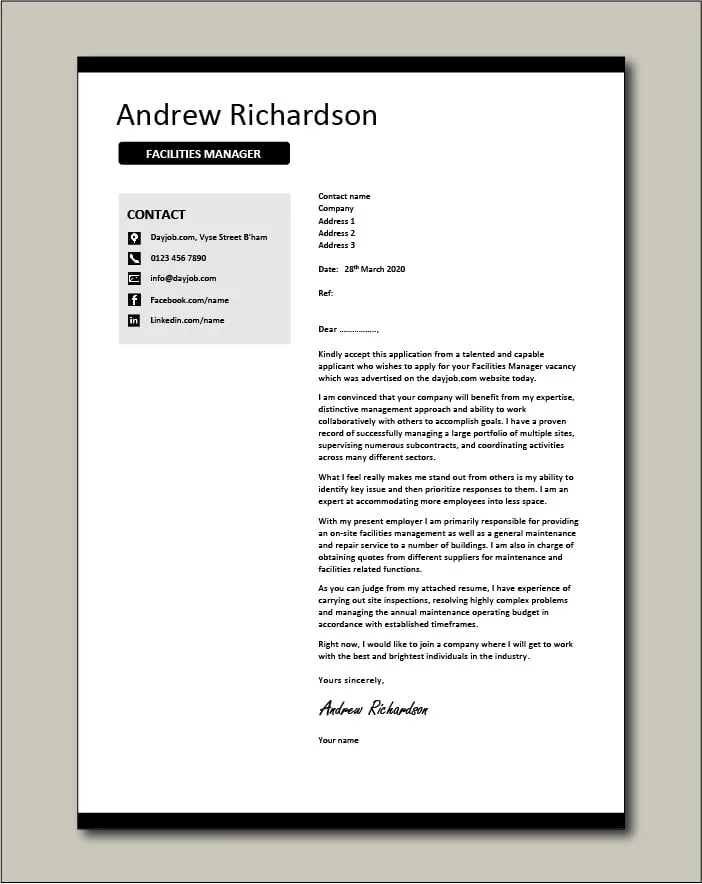
Highlighting Your Facilities Management Skills
A well-crafted cover letter is your initial opportunity to demonstrate your expertise as a Facilities Manager. It’s more than a mere summary of your resume; it’s a chance to show how your skills directly address the specific needs of the employer. Begin by clearly stating your objective—the precise position you’re applying for—and immediately highlight the skills that make you an ideal candidate. Focus on abilities central to facilities management, such as property maintenance, vendor management, budget control, and safety compliance. Employ concise and impactful language to capture the reader’s attention, emphasizing your proficiency in managing, maintaining, and improving physical environments efficiently. By doing so, you create a favorable first impression, encouraging the employer to delve deeper into your capabilities and experience.
Key Skills for Facilities Management
Effective cover letters for Facilities Managers spotlight a variety of essential skills. Emphasize your proficiency in property management, including maintenance, repairs, and ensuring a safe and functional environment. Show your financial acumen by mentioning budget management, cost control, and experience with financial reporting. Vendor management is crucial; demonstrate your capability to negotiate contracts, foster relationships with service providers, and guarantee high-quality service. Communication and leadership are equally important; highlight your ability to communicate with diverse stakeholders, lead a team, and coordinate projects effectively. Furthermore, familiarity with relevant software, like CMMS (Computerized Maintenance Management Systems), is a valuable asset. Tailor your cover letter to reflect these key skills, incorporating examples to illustrate how you’ve applied them in previous roles to achieve tangible results.
Property Management and Maintenance Expertise

Property management and maintenance are fundamental to a Facilities Manager’s role. In your cover letter, offer specific instances of your experience in overseeing property upkeep. This encompasses managing preventative maintenance schedules, addressing emergency repairs, and coordinating with maintenance staff or contractors. Detail your experience with building systems, such as HVAC, electrical, plumbing, and security systems. Highlight any projects you’ve overseen, like renovations or upgrades, and outline the outcomes—improved efficiency, cost savings, or enhanced user satisfaction. Demonstrate your proactive approach to maintenance, emphasizing your ability to identify and resolve potential issues before they escalate. Use quantifiable achievements, such as reducing maintenance costs or improving response times, to demonstrate your value. Showcasing your expertise in property management and maintenance positions you as a practical and results-driven candidate.
Budget Management and Cost Control
Budget management and cost control are essential competencies for Facilities Managers. Your cover letter should clearly demonstrate your ability to create, manage, and adhere to budgets. Discuss your experience in forecasting expenses, monitoring spending, and identifying opportunities for cost savings. Highlight any successful initiatives you’ve led to reduce operational costs—such as renegotiating vendor contracts, implementing energy-efficient practices, or streamlining maintenance procedures. Provide specific examples, such as achieving a percentage reduction in utility bills or staying within budget on major projects. Include your experience in financial reporting, and how you track and analyze financial data to make informed decisions. Emphasizing your financial acumen showcases your value to potential employers, illustrating your capacity to manage resources effectively and contribute to the organization’s financial health.
Vendor Management and Negotiation
Vendor management and negotiation skills are crucial in facilities management. Detail your experience in selecting, managing, and evaluating vendors to ensure high-quality services at competitive prices. Highlight your ability to negotiate contracts, manage service agreements, and build strong, collaborative relationships with vendors. Provide examples of successful negotiations that led to cost savings or improved service quality. Discuss how you monitor vendor performance and ensure compliance with service level agreements (SLAs). Mention any experience with bidding processes, vendor selection criteria, and vendor risk management. Showcasing your vendor management skills demonstrates your ability to procure and manage essential services, maintaining a well-functioning facility while controlling costs.
Compliance and Safety Regulations

A competent Facilities Manager must be well-versed in compliance and safety regulations. Your cover letter should highlight your knowledge of relevant safety standards and building codes. Describe your experience in developing and implementing safety programs, conducting regular inspections, and ensuring the facility meets all regulatory requirements. Mention your familiarity with OSHA guidelines, fire safety protocols, and other relevant industry regulations. Provide examples of how you’ve maintained a safe work environment, reduced safety incidents, and ensured compliance. You might detail your experience in conducting safety training, managing emergency response plans, and coordinating with regulatory agencies. Emphasizing your commitment to safety demonstrates your dedication to creating a secure and compliant environment, a critical aspect of facilities management.
Your Professional Experience
When discussing your professional experience, focus on demonstrating the impact you’ve made in previous roles. Instead of merely listing job duties, describe your achievements and the results you delivered. Use the STAR method (Situation, Task, Action, Result) to structure your examples, providing context, describing the challenges, detailing your actions, and quantifying the outcomes. For example, instead of stating, “Managed maintenance staff,” describe how you “Reduced maintenance response times by 20% by implementing a new work order system.” Highlight relevant experience that aligns with the job requirements, and provide specific examples of your successes. Quantify your achievements whenever possible, using numbers to demonstrate your value. Tailor your experience section to match the specific requirements of the job posting, emphasizing skills and experiences most relevant to the employer’s needs.
Tailoring Your Cover Letter
Customizing your cover letter is critical for demonstrating your genuine interest in the role and the company. Start by carefully reviewing the job description and identifying the key requirements. Research the company to understand its mission, values, and recent initiatives. Use this information to tailor your cover letter, highlighting how your skills and experience align with the company’s specific needs and goals. Address the hiring manager by name if possible, and personalize your letter to resonate with the company culture. Refer to the company’s website, social media, and any recent news or press releases to show that you’ve done your homework. By demonstrating that you’ve taken the time to understand the company and tailor your application accordingly, you significantly increase your chances of making a positive impression.
Researching the Company

Thoroughly researching the company before you write your cover letter is a vital step in tailoring your application. Visit the company’s website to learn about its products, services, mission, and values. Explore their social media profiles to get a sense of their culture and recent activities. Search for any news articles or press releases about the company, which can provide valuable insights into their current projects and priorities. This research will help you identify the specific needs and challenges the company faces. By understanding the company’s environment, you can better align your skills and experiences with their requirements. This targeted approach will show the hiring manager that you are genuinely interested in the position and have taken the initiative to understand the company.
Showcasing Achievements
Showcasing your achievements is more impactful than listing job responsibilities. Use your cover letter to highlight specific accomplishments that demonstrate your value to the employer. Quantify your achievements whenever possible; instead of saying “Improved efficiency,” state “Increased operational efficiency by 15% through the implementation of a new scheduling system.” Focus on results that directly benefit the employer, such as cost savings, improved operational efficiency, or enhanced safety records. Use action verbs to describe your accomplishments, and provide specific examples to support your claims. Showcasing your achievements allows you to demonstrate your capabilities and make a strong case for why you’re the ideal candidate for the Facilities Manager position. This focused approach is much more effective than simply listing tasks.
Quantifying Your Accomplishments
Quantifying your accomplishments makes your cover letter more compelling and credible. Use numbers and data to demonstrate the impact of your work. Instead of saying, “Managed projects successfully,” specify, “Successfully managed over 20 projects, delivering them on time and within budget.” Instead of, “Improved energy efficiency,” specify, “Reduced energy consumption by 10% resulting in $15,000 annual savings.” Provide measurable results that highlight your ability to deliver tangible outcomes. Quantifiable data makes your achievements more tangible and memorable, setting you apart from other applicants and underscoring your value as a Facilities Manager. This approach provides concrete evidence of your capabilities and demonstrates your commitment to achieving results.
Format and Structure

The format and structure of your cover letter are crucial for making a positive impression. Begin with a professional heading that includes your contact information and the date. Address the hiring manager by name, if possible. The body of your cover letter should be concise and well-organized. Use clear paragraphs to highlight your key skills, experience, and achievements. Maintain a professional tone and use proper grammar and spelling. Keep the letter to one page in length, and use a clean, easy-to-read font such as Arial or Times New Roman. Structure your letter logically, with a strong opening that captures attention, a body that showcases your qualifications, and a closing that expresses your enthusiasm and thanks the hiring manager for their time. Ensure your cover letter is visually appealing, well-formatted, and easy to read, as this is essential for making a positive first impression.
Proofreading and Editing
Proofreading and editing are the final and essential steps in preparing your cover letter. Before submitting your application, carefully review your cover letter for any grammatical errors, spelling mistakes, or formatting inconsistencies. Use spell check and grammar check tools, but also read the letter aloud to catch any awkward phrasing or unclear sentences. Ask a friend or colleague to review your cover letter as a fresh pair of eyes can often spot errors you might miss. Ensure that your contact information is accurate and that the letter is free from typos. A polished, error-free cover letter demonstrates your attention to detail and professionalism. Proofreading and editing is a crucial step for making a positive impression and ensuring your application is taken seriously.