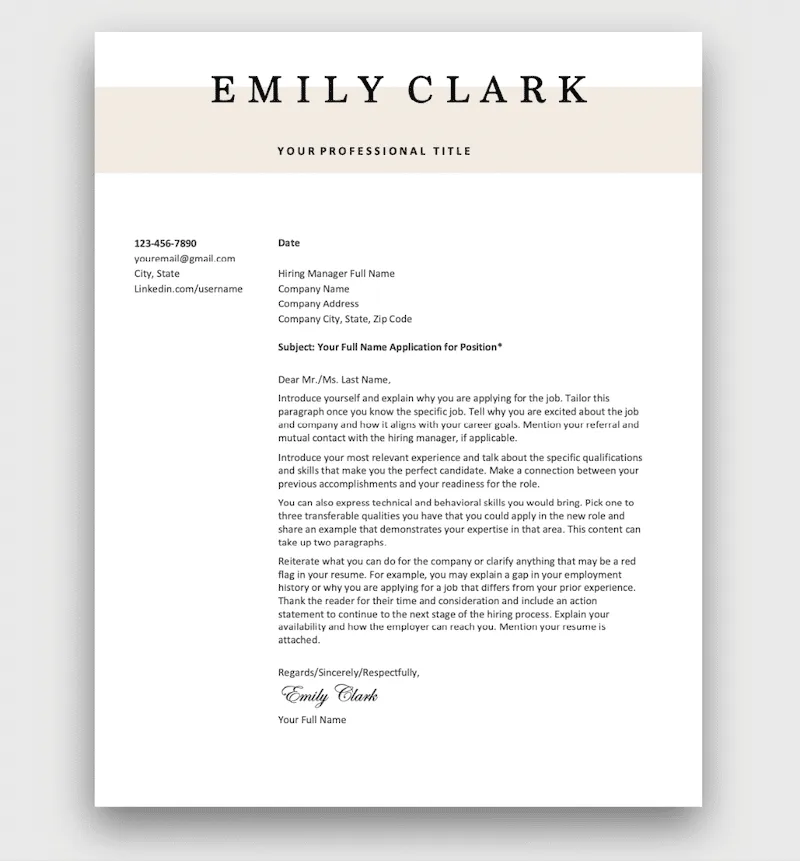
In today’s competitive job market, a well-crafted resume cover letter is often the key to unlocking new opportunities. It’s your chance to make a strong first impression and showcase why you’re the perfect fit for a specific role. But creating a compelling cover letter from scratch can be a time-consuming task. Fortunately, free resume cover letter templates offer a convenient and effective solution, providing a solid foundation to help you stand out from the crowd and land your dream job. Let’s explore how to leverage these resources to create a cover letter that gets results.
What is a Resume Cover Letter?
A resume cover letter is a one-page document that accompanies your resume when you apply for a job. It serves as an introduction to the hiring manager, providing context and highlighting your most relevant skills, experiences, and achievements. Unlike your resume, which is a concise overview of your qualifications, the cover letter allows you to elaborate on your qualifications, explain your career goals, and express your enthusiasm for the specific opportunity. It’s your chance to connect with the employer on a more personal level and demonstrate why you’re the ideal candidate for the position. A well-written cover letter can significantly increase your chances of getting an interview.
Why You Need a Cover Letter
Many job seekers wonder if a cover letter is still necessary. The answer is a resounding yes. While a resume provides a snapshot of your qualifications, a cover letter allows you to tell your story and make a compelling case for why you should be hired. It provides an opportunity to highlight your personality, express your interest in the company, and explain how your skills align with the specific job requirements. Without a cover letter, you risk appearing generic and impersonal, making it harder to stand out from other applicants. A cover letter provides a platform to address any potential gaps in your resume, such as career transitions or employment gaps, giving you a chance to clarify and provide context.
Benefits of Using a Free Resume Cover Letter Template

Free resume cover letter templates offer numerous advantages, making them an invaluable resource for job seekers. First and foremost, they save you time and effort. Instead of starting from scratch, you can adapt a pre-designed template to suit your specific needs, significantly reducing the time it takes to create a professional-looking cover letter. Secondly, templates ensure you include all the essential elements of a cover letter, such as contact information, a compelling introduction, a skills section, and a strong conclusion. This helps you avoid overlooking crucial details that could impact your application. Lastly, using a template allows you to focus on the content of your cover letter rather than worrying about the formatting and design, enabling you to showcase your qualifications and skills more effectively.
Finding the Right Free Resume Cover Letter Template
The internet is filled with free resume cover letter templates, but it’s important to choose one that aligns with your needs and the job you’re applying for. Look for templates that are professional, well-formatted, and easy to customize. Consider the layout and design, ensuring it’s visually appealing and easy to read. Make sure the template is compatible with your preferred word processing software, such as Microsoft Word or Google Docs. It’s also beneficial to select a template that offers different options, such as chronological, functional, or combination formats, to best highlight your skills and experience. Review the template’s structure to make sure it includes all the essential sections of a cover letter.
Popular Free Resume Cover Letter Template Sources
Several websites and resources offer high-quality free resume cover letter templates. Microsoft Word and Google Docs provide a variety of built-in templates you can customize to your liking. Websites such as Canva offer an array of visually appealing templates, with options to design and format your cover letter. Additionally, job search websites like Indeed and Resume.com often provide downloadable templates tailored to various professions and experience levels. When selecting a source, prioritize reputable websites and consider the user reviews to ensure the template meets your specific requirements. Explore a few options to find the one that best suits your needs and enhances your job application.
How to Customize Your Free Resume Cover Letter

Customizing a free resume cover letter template is crucial for making a strong impression. Begin by replacing the placeholder text with your own information, including your name, contact details, and the specific job you’re applying for. Carefully review the template’s content, adapting it to match the job description and the skills and experiences that align with the role. Highlight your relevant accomplishments using action verbs and quantifiable results whenever possible. Tailor the letter to the company by researching its values, mission, and recent activities, and then incorporate relevant information in your cover letter. Ensure that your customized cover letter speaks to your unique value and demonstrates a genuine interest in the position and the organization. Remember to personalize your cover letter for each application.
Key Sections to Include in Your Cover Letter
A well-structured cover letter typically includes the following sections: a header with your contact information, a personalized salutation addressing the hiring manager by name, a brief and engaging opening paragraph stating your interest in the position and mentioning how you learned about the opportunity, a body section highlighting your skills and experiences relevant to the job requirements, and a closing paragraph summarizing your key qualifications and expressing your enthusiasm for the opportunity. Ensure each section is clear, concise, and tailored to the specific job and company. Properly structured cover letters make a strong impact on the hiring manager.
Your Contact Information
Your contact information is a crucial part of your cover letter and should be included at the top of the document. Make sure to include your full name, address, phone number, and professional email address. Double-check all contact details for accuracy to ensure that the hiring manager can easily reach you. Consider including a link to your LinkedIn profile to provide the hiring manager with additional information about your background and experience. This ensures that the hiring manager can quickly and easily reach you for further information.
Address the Hiring Manager

Addressing the hiring manager by name demonstrates that you’ve done your research and are genuinely interested in the position. Whenever possible, find out the name of the hiring manager or recruiter responsible for the role and use it in your salutation. You can often find this information on the company’s website or LinkedIn. If you can’t find a specific name, use a professional salutation such as “Dear Hiring Manager” or “Dear [Department Name] Hiring Team.” Avoid generic greetings such as “To Whom It May Concern.” Personalizing the salutation shows that you’ve taken the time to learn more about the company and the role.
State Your Objective
In the opening paragraph of your cover letter, clearly state the position you are applying for and where you saw the job posting. Briefly mention your interest in the company and the role, and highlight one or two key skills or experiences that make you a strong candidate. Avoid generic statements like “I am writing to express my interest…” Instead, convey your enthusiasm and provide a concise overview of your qualifications and why you’re a good fit for the job. Keep your objective focused and relevant to the specific job requirements.
Highlight Your Skills and Experience
The body of your cover letter should highlight your relevant skills and experiences, demonstrating how they align with the job requirements. Refer to the job description and identify the key skills and qualifications the employer is seeking. Provide specific examples of how you’ve demonstrated these skills in previous roles or projects. Use action verbs to describe your accomplishments and quantify your achievements whenever possible. For example, instead of saying “Managed a team,” say “Managed a team of 10 employees, resulting in a 15% increase in productivity.” Tailor your examples to the specific job and demonstrate the value you bring to the company. Highlight your core competencies to make a strong impression.
Showcase Your Achievements

Beyond highlighting your skills and experiences, showcase your achievements to make a strong impression on the hiring manager. Provide specific examples of how you’ve achieved positive results in previous roles. Quantify your accomplishments whenever possible, using numbers and data to demonstrate the impact of your work. For example, instead of saying “Improved customer satisfaction,” say “Improved customer satisfaction scores by 20% through implementing a new training program.” Focus on accomplishments that are most relevant to the job requirements and highlight how your achievements have benefited previous employers. Your accomplishments are a strong indicator of your future success.
Express Your Enthusiasm for the Role
Throughout your cover letter, express your genuine enthusiasm for the role and the company. Show that you’ve researched the company and understand its mission, values, and recent activities. Explain why you are particularly interested in this opportunity and what excites you about the prospect of joining the team. Highlight any aspects of the job or company that resonate with your career goals and personal interests. Your enthusiasm will help you stand out from other applicants and demonstrate your passion for the opportunity.
Use Action Verbs
Using strong action verbs throughout your cover letter is essential for creating a compelling narrative and making a positive impression. Action verbs demonstrate your accomplishments and make your qualifications more impactful. Start your sentences with verbs that describe your actions and responsibilities, such as “Managed,” “Developed,” “Implemented,” “Led,” “Created,” “Achieved,” “Improved,” “Increased,” “Collaborated,” and “Analyzed.” Avoid passive voice and instead use active language that clearly conveys your contributions and abilities. Action verbs will give your cover letter more dynamism, making the content more readable and showing you taking initiative.
Proofread and Edit Your Cover Letter

Before submitting your cover letter, proofread and edit it carefully to ensure it is free of errors. Check for any spelling mistakes, grammatical errors, and typos. Ensure that the formatting is consistent and professional. Read your cover letter aloud to catch any awkward phrasing or unclear sentences. Ask a friend, family member, or career advisor to review your cover letter and provide feedback. A polished and error-free cover letter demonstrates your attention to detail and professionalism, increasing your chances of making a positive impression on the hiring manager.
Tips for a Standout Cover Letter
To make your cover letter truly stand out, consider these additional tips. Tailor your letter to each job, highlighting the skills and experiences most relevant to the specific requirements of the position. Keep your letter concise, aiming for a single page, and use a professional tone throughout. Focus on the value you can bring to the company and demonstrate your enthusiasm for the opportunity. Proofread carefully, and ensure the formatting is clean and easy to read. By following these tips, you can craft a cover letter that captures the hiring manager’s attention and increases your chances of getting an interview. Remember to showcase your relevant qualifications to get the best results.
Tailor Your Letter to the Job
One of the most important tips for writing a standout cover letter is to tailor it to each job you apply for. Avoid using a generic cover letter and customize it to align with the specific requirements and responsibilities outlined in the job description. Research the company and the role to understand its needs and challenges. Highlight the skills and experiences that are most relevant to the position and demonstrate how you can contribute to the company’s success. Tailoring your letter shows that you have taken the time to understand the opportunity and are genuinely interested in the role.
Keep it Concise

Hiring managers often have limited time to review applications, so it’s crucial to keep your cover letter concise and to the point. Aim for a single-page letter, and focus on the most important information. Use clear, concise language and avoid unnecessary jargon or overly long sentences. Get straight to the point, highlighting your key qualifications and experiences in a brief and engaging manner. Keeping your cover letter brief will make it easier for the hiring manager to quickly understand your qualifications and assess your suitability for the job.
Use a Professional Tone
Maintain a professional tone throughout your cover letter. Use formal language and avoid slang, contractions, and informal expressions. Proofread your letter carefully to ensure there are no spelling mistakes, grammatical errors, or typos. Demonstrate your respect for the hiring manager by using a polite and respectful tone. A professional tone conveys your professionalism and makes a positive impression on potential employers, showing your attention to detail and your serious approach to the job application process.
Format Your Cover Letter Correctly
Proper formatting is essential for creating a professional and visually appealing cover letter. Choose a clear and easy-to-read font, such as Times New Roman, Arial, or Calibri, and use a font size of 11 or 12 points. Use standard margins (1 inch on all sides) and single-space your text, leaving a space between paragraphs. Use clear headings and subheadings to organize your content and make it easy for the reader to scan. Ensure that the overall layout is neat and well-organized, making it easy for the hiring manager to quickly find the information they need. Proper formatting enhances readability and conveys professionalism.
Common Mistakes to Avoid
Avoiding common mistakes can significantly improve the effectiveness of your cover letter. One of the most common errors is not tailoring the letter to the specific job requirements. Avoid using a generic cover letter that doesn’t reflect the unique needs of the role. Another mistake is using generic language and clichés. Steer clear of phrases that don’t convey your personality or make you unique. Spelling and grammar errors can damage your credibility, so it’s essential to proofread carefully. Overly long cover letters can lose the reader’s attention, so keep your letter concise and to the point. Avoid formatting issues like inconsistent spacing or font choices, which can detract from your professionalism. Remember to personalize for each job application.
Not Tailoring Your Letter
Failing to tailor your cover letter to the specific job requirements is a common mistake. A generic cover letter that doesn’t address the unique needs of the role is unlikely to capture the hiring manager’s attention. Review the job description carefully and highlight the skills and experiences that are most relevant to the position. Demonstrate how your qualifications align with the specific requirements outlined in the job posting. Tailoring your letter shows that you have taken the time to understand the opportunity and are genuinely interested in the role, making you a more attractive candidate.
Using Generic Language
Using generic language and clichés can make your cover letter sound unoriginal and impersonal. Avoid using phrases that don’t convey your personality or make you stand out from other applicants. Instead, use your own words to describe your skills, experiences, and accomplishments. Be specific and provide concrete examples of how you’ve demonstrated your abilities in previous roles. Show your enthusiasm for the role in your own voice, and use language that reflects your individual strengths and qualities. Original language is essential to showcase your personality.
Grammar and Spelling Errors
Grammar and spelling errors can significantly undermine the credibility of your cover letter. Proofread your letter carefully to ensure it is free of errors. Use a spell checker and grammar checker, but don’t rely on them completely. Read your cover letter aloud to catch any awkward phrasing or unclear sentences. Ask a friend, family member, or career advisor to review your cover letter and provide feedback. A polished and error-free cover letter demonstrates your attention to detail and professionalism, making a positive impression on the hiring manager. Pay close attention to detail.
Overly Long Cover Letters
Overly long cover letters can quickly lose the reader’s attention. Keep your cover letter concise and to the point, aiming for a single-page letter. Focus on the most important information and avoid unnecessary details. Use clear and concise language and get straight to the point. Highlight your key qualifications and experiences in a brief and engaging manner. A concise cover letter will make it easier for the hiring manager to quickly understand your qualifications and assess your suitability for the job.
Formatting Issues
Formatting issues can detract from the professionalism of your cover letter. Ensure that your cover letter is well-formatted and easy to read. Choose a clear and easy-to-read font, and use standard margins and spacing. Use clear headings and subheadings to organize your content and make it easy for the reader to scan. Ensure the layout is neat and well-organized, making it easy for the hiring manager to quickly find the information they need. Consistent formatting enhances readability and conveys professionalism.
Resources for Further Assistance
If you need further assistance with writing your resume cover letter, several resources are available. Many online career websites, such as LinkedIn Learning and Coursera, offer courses and tutorials on cover letter writing. Career counselors and resume writers can provide personalized feedback and guidance. Your university’s career services department may offer resume and cover letter review services. When seeking assistance, make sure you use credible sources and consider your specific career goals. Utilize these resources to refine your cover letter and improve your chances of landing your dream job.
In conclusion, a free resume cover letter template can be a valuable asset in your job search. By using these templates, you can create a professional, well-structured cover letter that highlights your qualifications and makes a strong impression on potential employers. Remember to customize your cover letter to match the job requirements and demonstrate your enthusiasm for the opportunity. By avoiding common mistakes and utilizing available resources, you can write a cover letter that helps you stand out from the competition and achieve your career goals. Good luck!