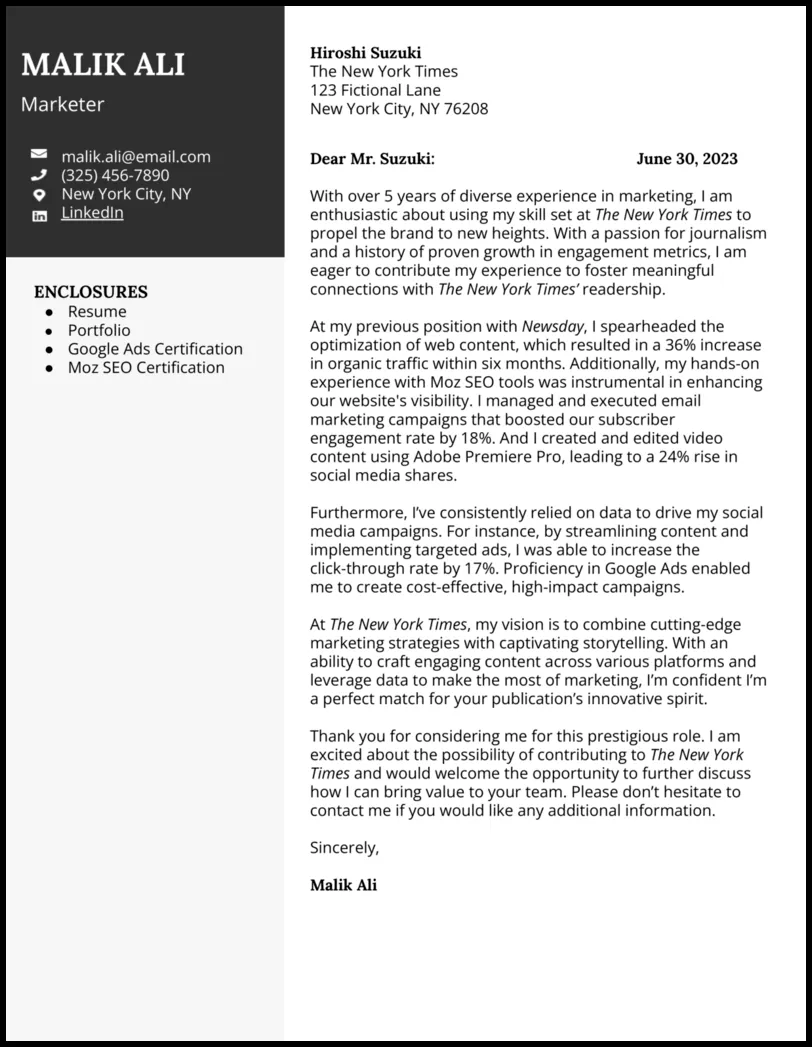
What is a Marketing Cover Letter?
A marketing cover letter is a crucial document that accompanies your resume when applying for marketing positions. It serves as your first introduction to a potential employer, providing an opportunity to showcase your personality, skills, and enthusiasm for the role. Unlike a resume, which provides a factual overview of your experience, a cover letter allows you to tell a story, demonstrating how your qualifications align with the specific requirements of the job and the company’s culture. A well-crafted cover letter can significantly increase your chances of getting noticed and securing an interview, making it an indispensable part of your job application strategy. It’s your chance to make a memorable first impression and convince the hiring manager that you are the perfect fit.
Why is a Strong Marketing Cover Letter Important?
In the competitive field of marketing, a strong cover letter is not just important it is essential. It’s your chance to differentiate yourself from other applicants and highlight why you are the best candidate for the job. A well-written cover letter demonstrates your communication skills, attention to detail, and genuine interest in the position and the company. It allows you to elaborate on your experiences and skills, providing context and depth that a resume alone cannot offer. By personalizing your letter to the specific job and company, you show that you have taken the time to understand their needs and are genuinely interested in contributing to their success. It can be the deciding factor between getting an interview and being overlooked. A compelling cover letter can transform a standard application into a personalized pitch.
Essential Elements of a Marketing Cover Letter

A successful marketing cover letter comprises several key elements that work together to create a strong impression. These elements include a professional header with your contact information, a personalized greeting, a captivating opening paragraph, a section highlighting your relevant marketing skills and experience, and a clear call to action. Moreover, it is essential to demonstrate your understanding of the company and the specific role. Quantifiable achievements and metrics help to showcase the impact of your skills. Ensure your letter is well-formatted, easy to read, and free of errors. Each component plays a vital role in telling your story and persuading the hiring manager to invite you for an interview. A structured approach will help you create a cover letter that stands out from the competition.
Header and Contact Information
Your header should be professional and contain your full name, address, phone number, and email address. It’s important to use a professional email address, avoiding nicknames or unprofessional phrasing. This information should be clearly displayed at the top of the letter. Following your contact information, include the date and the hiring manager’s name and title, if known. If you are unable to identify the specific hiring manager, address the letter to the ‘Hiring Manager’ or the department in charge. The header establishes professionalism and ensures that the recruiter or hiring manager can easily contact you. The format is consistent with formal business correspondence, setting a professional tone from the start.
Personalized Greeting
Personalize your greeting by addressing the hiring manager by name. Research the company website or LinkedIn to find out who will be reviewing your application. Avoid generic greetings such as ‘Dear Sir/Madam’ or ‘To Whom It May Concern’ as they indicate a lack of effort and attention to detail. Addressing the letter to a specific person demonstrates that you have done your research and are genuinely interested in the position. If you cannot find a name, you can use a department or role-specific title. A personalized greeting immediately grabs the reader’s attention and sets a tone of respect and professionalism, signaling that you have taken the time to understand the role and the organization.
Hooking the Reader with a Compelling Opening

The opening paragraph is your opportunity to grab the reader’s attention and make a strong first impression. Avoid generic statements like ‘I am writing to express my interest.’ Instead, begin with a compelling sentence that highlights your most relevant skill or accomplishment. Briefly mention the position you are applying for and how you learned about it. Show enthusiasm and connect with the company’s mission. For example, you could start with a statement about a successful marketing campaign that you led, mentioning impressive results, or show a skill relevant to the role. The opening needs to provide a snapshot of your value proposition. The goal is to make the hiring manager eager to read the rest of your letter and learn more about you and your qualifications.
Highlighting Your Marketing Skills and Experience
In the body of your cover letter, detail your relevant marketing skills and experience, tailoring your examples to the specific requirements of the job. Refer back to the job description and mention the skills and experience the company values most. Provide specific examples of how you have demonstrated these skills in previous roles, using the STAR method (Situation, Task, Action, Result) to structure your responses. For instance, if the job requires content creation skills, describe a successful content marketing campaign you managed, including the strategies you used, the challenges you overcame, and the positive outcomes. Always link your skills and experience to the company’s needs, illustrating how you can contribute to their success. This helps to show the hiring manager that you have what it takes.
Quantifiable Achievements
Include quantifiable achievements to demonstrate the impact of your work. Instead of simply stating you improved website traffic, quantify it by saying you ‘increased website traffic by 30% in six months through SEO optimization.’ Use numbers, percentages, and statistics to showcase the results of your marketing efforts. Metrics show the value you bring to the table and make your achievements more credible and memorable. Examples include increased sales, improved conversion rates, higher social media engagement, or cost savings. Use these metrics to demonstrate how your skills and expertise can benefit the company. The data and achievements provide concrete evidence of your capabilities.
Showcasing Your Understanding of the Company

Demonstrate your understanding of the company by researching their mission, values, products, and recent marketing campaigns. Highlight how your skills and experience align with their goals. In your cover letter, mention specific projects or initiatives of the company that resonate with you. This shows that you have taken the time to learn about the company and are genuinely interested in working for them. You can also explain how your skills can help them address current challenges or capitalize on opportunities. By showcasing your knowledge, you display your genuine interest and initiative, which makes a strong impression on the hiring manager. This also reflects your understanding of the market and the company’s position.
Expressing Your Enthusiasm and Fit
Express your enthusiasm for the position and explain why you are a good fit for the company culture. Show your passion for marketing and how your values align with the company’s. Mention what specifically attracts you to the role or the company. This could be their innovative marketing strategies, their company culture, or their commitment to a particular cause. Be specific about how you envision yourself contributing to the team. Demonstrating your excitement and highlighting your alignment with the company’s values creates a positive impression. Share your genuine interest in the position and the company, and let your personality shine through to demonstrate your passion for marketing and willingness to contribute to the team. It makes a positive impression.
Call to Action
End your cover letter with a clear call to action. Request an interview and express your availability to discuss your qualifications further. Thank the hiring manager for their time and consideration. Make it easy for them to contact you by reiterating your contact information. Your call to action should be direct and professional, and provide a positive close to your cover letter. It gives the reader the next step. A clear call to action helps the hiring manager remember you and move your application forward. A well-structured call to action ensures that the hiring manager knows the next step in the process.
Proofreading and Editing Your Cover Letter

Proofreading and editing your cover letter is critical to ensuring it is free of errors. Check for grammatical errors, spelling mistakes, and typos. Review the letter for clarity, conciseness, and flow. It is helpful to ask a friend, mentor, or career advisor to review your cover letter. Fresh eyes can often spot mistakes you may have missed. Ensure your cover letter aligns with your resume and showcases your qualifications effectively. A polished, error-free cover letter demonstrates your attention to detail, professionalism, and commitment to quality. Proofreading and editing is one of the most important steps, which often gets skipped. It highlights your attention to detail.
Formatting for Readability
Format your cover letter for readability to make it easy for the hiring manager to read and comprehend. Use a professional font like Arial, Calibri, or Times New Roman, and ensure the font size is readable (typically 11 or 12 points). Use single spacing within paragraphs and double spacing between paragraphs. Keep your paragraphs concise and to the point, avoiding long blocks of text. Use clear headings and bullet points to break up the text and highlight key information. Align your text to the left and avoid justified text, which can create awkward spacing. A well-formatted cover letter is visually appealing and improves readability, making a positive impression on the reader. Simple formatting principles increase readability.
Cover Letter Do’s and Don’ts
Do’s

- Customize your cover letter for each job application
- Use a professional format and tone
- Highlight your relevant skills and experience
- Quantify your achievements with metrics
- Showcase your understanding of the company
- Express your enthusiasm for the role and company
Don’ts
- Use generic cover letters
- Make grammatical errors or typos
- Exceed one page in length
- Be negative or overly critical
- Focus solely on your needs
- Forget to include a call to action
Final Thoughts
Writing a marketing cover letter requires careful planning, attention to detail, and a strategic approach. Start by understanding the job requirements, researching the company, and identifying the skills and experience you want to highlight. Write a captivating opening, providing quantifiable achievements and express your enthusiasm for the role and company. Customize your cover letter to reflect the specific requirements and company culture. Use clear formatting and proofread carefully. By following these guidelines, you can create a cover letter that effectively showcases your qualifications and secures your marketing job. The cover letter is a tool that can help you stand out from other applicants. A strong cover letter can open doors to many opportunities.