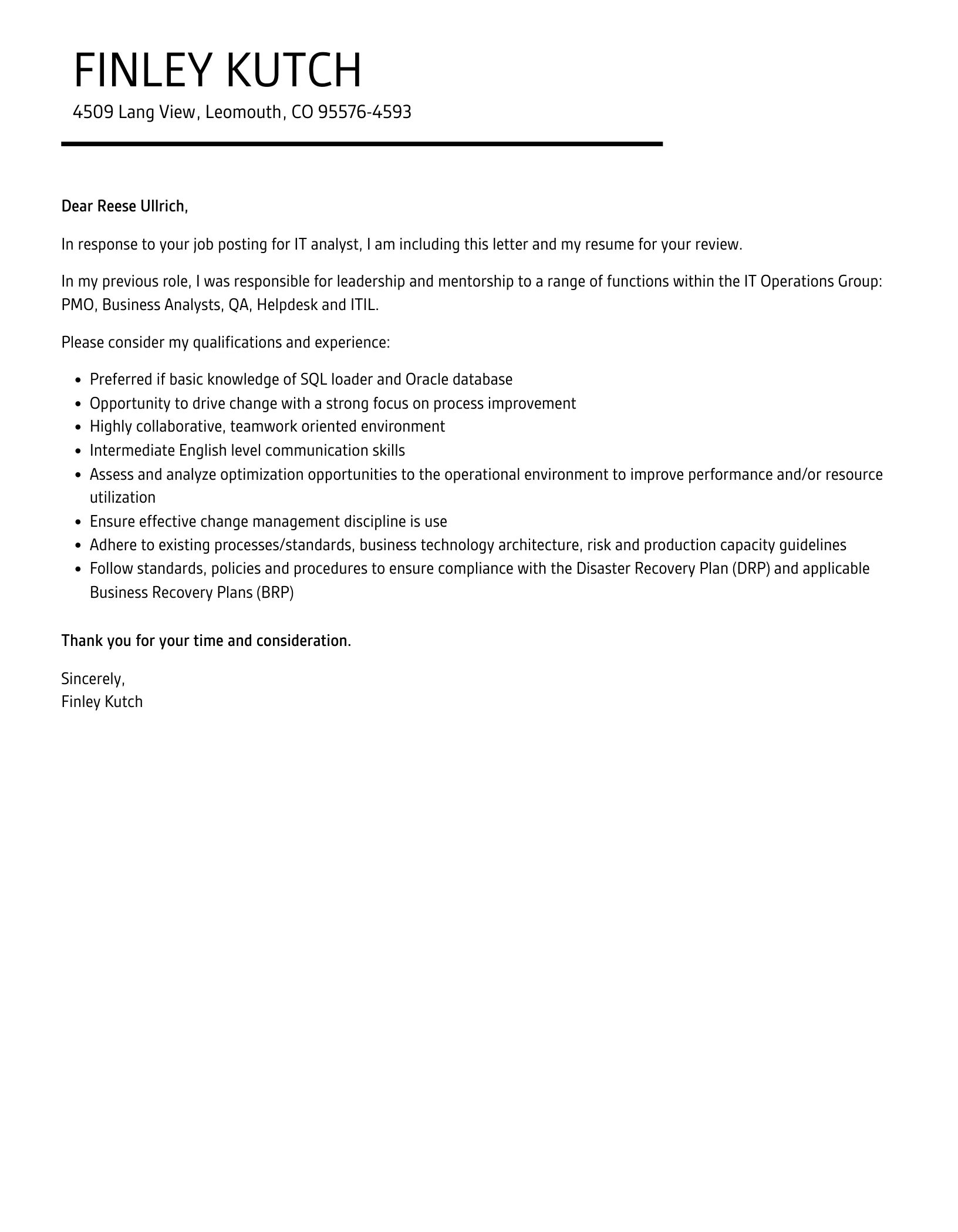
Essential Elements of an IT Analyst Cover Letter
Crafting an effective IT analyst cover letter is crucial for making a strong first impression on potential employers. A well-written cover letter not only complements your resume but also provides an opportunity to highlight your skills, experience, and enthusiasm for the role. By following key guidelines, you can significantly increase your chances of getting noticed and landing an interview. This guide will walk you through the essential components of an IT analyst cover letter, providing insights and tips to help you create a compelling document that showcases your qualifications and sets you apart from the competition.
Contact Information and Formatting
Start your cover letter with your contact information, including your full name, phone number, email address, and LinkedIn profile URL (if applicable). Ensure this information is easily accessible and up-to-date. Use a professional font like Arial, Calibri, or Times New Roman, and maintain consistent formatting throughout the document. Keep the letter concise, typically one page in length. Use clear and concise language, and avoid using jargon that the hiring manager may not understand.
Proper Salutation

Address the hiring manager by name whenever possible. Research the company’s website or use LinkedIn to find the name of the hiring manager or the specific person responsible for reviewing applications. If you cannot find a specific name, use a professional salutation such as “Dear Hiring Manager” or “Dear [Department Name] Team.” Avoid generic greetings like “To Whom It May Concern,” as they can make your letter seem impersonal. A personalized salutation demonstrates that you have taken the time to research the company and the role.
Opening Paragraph
The opening paragraph should immediately capture the reader’s attention and state the purpose of your letter. Clearly mention the specific IT analyst position you are applying for and where you found the job posting. Briefly introduce yourself and express your interest in the role. Highlight your key skills or a significant achievement that aligns with the job requirements. For example, “I am writing to express my enthusiastic interest in the IT Analyst position at [Company Name], as advertised on [Platform]. With my proven track record of [relevant achievement] and strong analytical abilities, I am confident I can contribute to your team’s success.”
Highlighting Skills and Experience
This section is the core of your cover letter, where you showcase your relevant skills and experience. Tailor this section to the specific requirements outlined in the job description. Provide examples of how you have utilized your skills in previous roles and the results you achieved. Use keywords from the job posting to demonstrate that you possess the desired qualifications. Be specific and provide concrete examples to support your claims, illustrating how your expertise aligns with the company’s needs.
Technical Skills

List the technical skills relevant to the IT analyst role, such as proficiency in specific software, programming languages, or IT systems. Provide examples of your experience using these tools and technologies. For instance, mention your experience with data analysis tools like SQL or Python, or your familiarity with networking protocols and security measures. Quantify your skills whenever possible. Instead of saying “Experience with SQL,” state “Developed and maintained SQL databases, resulting in a 15% improvement in data retrieval efficiency.”
Analytical Skills
IT analysts must possess strong analytical skills. In your cover letter, emphasize your ability to analyze complex data, identify trends, and solve problems. Provide examples of how you have used your analytical skills in previous roles. For example, describe a time you analyzed user data to improve system performance or identified bottlenecks in a business process. Highlight your problem-solving approach, and the methods you used to arrive at solutions. Showcase your critical thinking and decision-making abilities.
Communication Skills
IT analysts need excellent communication skills. Showcase your ability to communicate technical information clearly and concisely to both technical and non-technical audiences. Describe instances where you successfully explained complex technical concepts to stakeholders, collaborated with cross-functional teams, or presented findings to management. Mention any experience with documentation, report writing, and presentations. Emphasize your ability to actively listen, understand diverse perspectives, and convey information effectively in both written and verbal forms.
Quantifiable Achievements

Quantifying your achievements is a powerful way to demonstrate the impact you have made in previous roles. Use numbers, percentages, and specific metrics to illustrate your accomplishments. This helps the hiring manager understand the value you bring to the table and the tangible results you have achieved. Avoid generic statements and instead provide concrete examples of how you improved efficiency, reduced costs, or increased productivity. This section should provide a compelling snapshot of your capabilities and potential.
Showcasing Accomplishments
Instead of just listing your responsibilities, focus on your accomplishments. For each role or project, mention the specific problems you addressed and the positive outcomes you achieved. Quantify your results using numbers whenever possible. For example, “Implemented a new data backup system, which reduced data recovery time by 30%.” or “Led a project to streamline IT processes, resulting in a 20% reduction in operational costs.” Highlighting accomplishments helps the hiring manager visualize your value and capabilities.
Using Action Verbs
Use strong action verbs to start each bullet point or sentence when describing your responsibilities and achievements. This makes your cover letter more dynamic and engaging. Some examples include: managed, developed, implemented, analyzed, improved, resolved, led, collaborated, designed, and optimized. Action verbs convey confidence and highlight your active role in achieving results. Avoid using passive language; instead, frame your accomplishments in an assertive and impactful manner.
Tailoring Your Letter

Customizing your cover letter for each job application is essential. Generic cover letters rarely impress hiring managers. Tailor your letter to the specific requirements and culture of each company and position. This demonstrates that you have taken the time to understand the role and are genuinely interested in the opportunity. Research the company and the specific needs of the role, and then align your skills and experience accordingly.
Researching the Company
Before writing your cover letter, research the company and the IT analyst role. Visit the company’s website, read about their products or services, and understand their values and mission. Use LinkedIn or other professional networking sites to learn more about the company’s employees and culture. Understanding the company helps you tailor your cover letter to address their specific needs and demonstrate your genuine interest in the organization.
Addressing Specific Requirements
Carefully review the job description and identify the key requirements. Highlight how your skills and experience align with these specific requirements. Use keywords from the job posting to demonstrate that you possess the desired qualifications. Address each of the essential requirements, providing specific examples of how you have met similar challenges in the past. This focused approach demonstrates your understanding of the role and your ability to perform its key responsibilities.
Closing and Follow-Up

The closing section should reiterate your interest in the position and express your enthusiasm for the opportunity. It should also include a call to action, encouraging the hiring manager to take the next step. A well-crafted closing ensures that your cover letter leaves a lasting positive impression. Ensure that the closing is professional and reflects your confidence and eagerness to move forward in the hiring process.
Professional Closing
End your cover letter with a professional closing. Avoid overly casual phrases. Use a closing such as “Sincerely,” “Respectfully,” or “Best regards.” Following the closing, leave space for your signature (if submitting a hard copy). Type your full name below the closing. This formalizes the document and reinforces your professionalism and attention to detail. A polished closing statement reinforces your commitment to the position and your professionalism.
Call to Action
Include a clear call to action. Express your eagerness to discuss your qualifications further and thank the hiring manager for their time and consideration. State your availability for an interview and provide your contact information again. For example, “Thank you for considering my application. I am eager to discuss my qualifications in an interview and can be reached at [phone number] or [email address]. I look forward to hearing from you soon.” This prompts the hiring manager to take the next step.
Proofreading and Editing

Before submitting your cover letter, proofread and edit it meticulously. Errors in grammar, spelling, and punctuation can undermine your credibility and suggest a lack of attention to detail. Use a grammar and spell-checking tool, but also manually review the document. Ask a friend or colleague to read your cover letter for feedback. Ensure that the letter flows logically and that your points are clearly and concisely articulated. A well-proofread cover letter demonstrates professionalism and attention to detail, significantly improving your chances of getting noticed.
In conclusion, a well-crafted IT analyst cover letter is a powerful tool in your job search. By following the guidelines above, you can create a cover letter that highlights your skills and experience, demonstrates your enthusiasm, and sets you apart from the competition. Remember to tailor each letter to the specific job, quantify your achievements, and proofread carefully. With a polished cover letter, you’ll increase your chances of landing an interview and taking the next step in your IT analyst career.