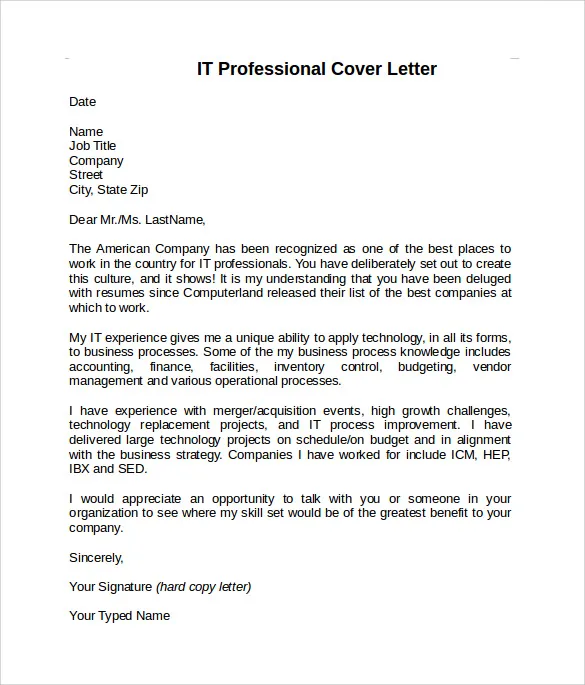
What is an IT Cover Letter
An IT cover letter is a crucial document that accompanies your resume when applying for IT-related positions. It serves as your first introduction to a potential employer, providing an opportunity to showcase your personality, skills, and enthusiasm for the role. Unlike a resume, which lists your qualifications, a cover letter allows you to elaborate on your experiences, explain why you are a good fit for the specific job, and express your genuine interest in the company. It’s your chance to make a strong first impression and persuade the hiring manager to read your resume more closely. A well-crafted IT cover letter can significantly increase your chances of landing an interview and ultimately, securing your dream job. The cover letter should be tailored specifically for each position you apply for, highlighting the most relevant aspects of your skills and experience that align with the job requirements.
The Importance of a Great Cover Letter
In the competitive IT job market, a great cover letter can set you apart from other applicants. It’s an opportunity to demonstrate your communication skills, which are essential in most IT roles. The cover letter allows you to provide context to your resume. For example, you can describe how your skills align with the job description and why you’re interested in the specific company. It also helps you demonstrate your understanding of the role and the company’s needs. A well-written cover letter often reveals your attention to detail, professionalism, and genuine interest in the position, all of which can give you an edge over candidates who might have similar qualifications on paper. Furthermore, a compelling cover letter shows that you’ve invested time and effort into the application process, a sign of your commitment and dedication.
Why Cover Letters Still Matter

Despite the rise of online applications and automated systems, cover letters still hold significant importance. They offer a personalized touch that can’t be replicated by a resume alone. Many hiring managers and recruiters still value a well-written cover letter as it provides insight into a candidate’s personality, communication skills, and genuine interest in the role. A cover letter allows you to explain any gaps in your employment history or highlight career changes, which might require additional context. Moreover, it gives you the chance to elaborate on your skills, especially those that are difficult to quantify on a resume. In a world of standardized applications, a thoughtful cover letter can truly make you stand out and demonstrate your individual value to a potential employer. Think of it as your personal sales pitch. If you want to land your dream IT job, then you have to provide some insight on your skills.
Key Components of a Winning IT Cover Letter
Contact Information and Date
Begin your cover letter with your contact information, including your name, phone number, email address, and optionally, your LinkedIn profile URL. Ensure your contact information is up-to-date and professional. Following your contact information, include the date, which should be the date you are submitting the application. This section sets a professional tone and makes it easy for the employer to contact you if needed. You may choose to include the hiring manager’s name and address if you know it, as addressing the letter to a specific person adds a personal touch, demonstrating that you’ve taken the time to research the company and position. Accurate and accessible contact details are critical for the recruiter, ensuring they can quickly reach out to you for interviews or further inquiries. This also starts your cover letter with the correct format, therefore the recruiter knows you are a professional.
Professional Greeting

Your greeting should be professional and appropriate for the context. Whenever possible, address the hiring manager or the specific person listed in the job posting. If you are unsure of the name, use a general greeting such as ‘Dear Hiring Manager’ or ‘Dear [Company Name] Team’. Avoid overly casual greetings. Addressing the recipient by name can significantly increase the impact of your letter. If the job posting doesn’t specify a contact person, a general greeting is a safe bet. Always ensure correct spelling and grammar, as this shows you’ve paid attention to detail. The greeting sets the tone for the entire letter, so it’s essential to create a positive and respectful impression from the outset. Starting with a professional greeting immediately signals your respect for the opportunity and the company. It also shows that you have taken the time to find the right person to address the letter to.
Opening Paragraph
The opening paragraph should grab the reader’s attention and clearly state the purpose of your letter. Mention the specific position you are applying for and where you found the job posting. Briefly express your enthusiasm for the role and the company. This is your chance to make a strong first impression and highlight your initial interest. Make a confident statement about why you are the ideal candidate. You should also showcase your genuine interest in the company and mention something specific that attracted you to the role or the organization. A well-crafted opening creates a positive impression and encourages the hiring manager to read further. Keep it concise and focused, setting a positive tone for the rest of your letter. The opening paragraph is your first opportunity to capture the hiring manager’s interest and create a compelling narrative around your candidacy.
Highlighting Relevant Skills and Experience
In the body of your cover letter, emphasize the skills and experience that align with the job requirements. Refer to the job description and tailor your letter to match the listed qualifications. Provide specific examples of your achievements and how you’ve applied your skills in previous roles. Use action verbs to describe your responsibilities and accomplishments. Focus on what you can offer the company and explain how your skills and experience make you a strong candidate for the position. This section should be compelling and well-organized, using specific examples to showcase your value. Clearly demonstrate your understanding of the role and explain how your skills and experience make you the perfect fit. When writing your cover letter, you must analyze the job description. This shows the recruiter you paid attention to detail, thus making you a good candidate.
Quantifiable Achievements

Whenever possible, quantify your achievements to demonstrate your impact. Instead of saying ‘Improved network performance,’ state ‘Improved network performance by 20%.’ Use numbers and data to showcase your accomplishments and results. Provide tangible evidence of your successes and highlight the value you brought to previous employers. This will show that you understand what you have done in the past. Numbers add credibility and make your claims more compelling. The more data-driven your examples are, the more convincing your letter will be. Quantifying your achievements is crucial because it provides concrete evidence of your abilities and the value you can bring to the company. They also give the hiring manager a clear understanding of your abilities. This also shows that you can deliver results.
Tailoring Your Cover Letter
Customization is the key to writing a successful cover letter. Avoid using a generic template and instead tailor your letter to each specific job. Research the company and the role, and address the specific needs and requirements outlined in the job description. Highlight the skills and experience that are most relevant to the position and explain why you are a good fit for the company culture. Tailoring your cover letter to each specific job shows that you have invested time and effort into your application and that you are genuinely interested in the role. This shows that you want this job more than a candidate who just sends a generic cover letter. Showcasing your knowledge of the company and role demonstrates your interest and suitability for the position. Make sure you review and edit to make sure you are not making any errors.
Call to Action and Closing
In the closing paragraph, reiterate your interest in the role and express your enthusiasm for the opportunity. Include a call to action, such as inviting the hiring manager to contact you for an interview or to discuss your qualifications further. Thank the hiring manager for their time and consideration. Keep the tone positive and professional. A strong closing paragraph leaves a lasting impression and encourages the hiring manager to take the next step. This section should be concise and leave a lasting positive impression. It should also summarize the main points of your cover letter and emphasize your commitment to the role. Remember to thank the hiring manager for their time and consideration. If you have a chance to land an interview, you are one step closer to your dream IT job.
Common Mistakes to Avoid

Generic Cover Letters
One of the biggest mistakes is sending a generic cover letter that isn’t tailored to the specific job or company. These letters often lack the personal touch and specific details that demonstrate your interest and qualifications. Always customize your letter to reflect the unique requirements of the position. Use a template that’s a base for your letter, but never a template to be sent out to various companies. The more generic, the less of a chance you have of being selected. Generic letters show a lack of effort and a lack of genuine interest. To make a good impression, research the company and role, and address the specific needs outlined in the job description. Show the company that you are taking the time to get this role.
Typos and Grammatical Errors
Typos and grammatical errors can undermine your credibility and professionalism. Proofread your cover letter carefully before submitting it. Ensure that your letter is free of spelling mistakes, grammatical errors, and inconsistencies. Have someone else review your cover letter to catch any errors you might have missed. These small errors can create a negative impression and suggest a lack of attention to detail. Remember, attention to detail is crucial in IT. Careful proofreading is essential to maintaining a professional image. Make sure you are confident with the cover letter before sending it in. Correct spelling and grammar errors show that you are professional and that you take time to craft a great cover letter.
Lack of Enthusiasm

A lack of enthusiasm in your cover letter can make it seem like you are not genuinely interested in the role. Express your passion for IT and your excitement about the opportunity. Show your interest in the company’s work and mission. Be sure to demonstrate your knowledge of the company. Avoid using generic or impersonal language. Use clear, passionate language to convey your genuine interest in the role and the company. This is not a time to be shy about your accomplishments and your goals. Show the recruiter why you are interested in the role. Let them know that you are interested in getting the role. Show your personality.
Formatting Issues
Poor formatting can make your cover letter difficult to read and can distract from your message. Use a clear, professional font, such as Times New Roman, Arial, or Calibri. Use a standard font size (11 or 12 points) and ensure proper spacing between paragraphs. Avoid using excessive colors, fonts, or formatting. Always be consistent with your formatting. A well-formatted cover letter is easy to read and presents a professional image. A clean layout and consistent formatting will highlight the content and make it easier for the hiring manager to assess your qualifications. The formatting must look professional and well-organized. This shows that you are organized as well.
IT Cover Letter Examples
Sample Cover Letter for a Software Engineer

Dear [Hiring Manager Name], I am writing to express my keen interest in the Software Engineer position at [Company Name], as advertised on [Platform]. With my [Number] years of experience in software development, including expertise in [List key technologies], I am confident I can significantly contribute to your team. My background includes developing and maintaining [Specific project or software], where I was responsible for [Key responsibilities and achievements]. In my previous role at [Previous Company], I successfully [Quantifiable achievement, e.g., reduced bug reports by 15%]. I am proficient in [Programming languages] and passionate about creating efficient, high-quality code. I am impressed by [Company Name]’s work in [Specific project or area] and believe my skills align perfectly with your company’s goals. I am eager to learn more about this opportunity and discuss how I can contribute to [Company Name]’s continued success. Thank you for your time and consideration. Sincerely, [Your Name].
Sample Cover Letter for a Network Administrator
Dear [Hiring Manager Name], I am writing to apply for the Network Administrator position at [Company Name], as advertised on [Platform]. With [Number] years of experience managing and maintaining complex network infrastructures, I am eager to bring my expertise to your team. My experience includes designing, implementing, and troubleshooting network systems. I possess a strong understanding of [Specific networking protocols and technologies], and I have successfully [Quantifiable achievement, e.g., reduced network downtime by 10%]. At [Previous Company], I was responsible for [Key responsibilities and achievements]. I am proficient in [Relevant certifications and skills] and committed to ensuring network security and optimal performance. I am particularly drawn to [Company Name]’s commitment to [Specific company value or project] and am excited about the opportunity to contribute to your network infrastructure. Thank you for your time and consideration. Sincerely, [Your Name].
Sample Cover Letter for a Cybersecurity Analyst
Dear [Hiring Manager Name], I am writing to express my strong interest in the Cybersecurity Analyst position at [Company Name], as advertised on [Platform]. With [Number] years of experience in cybersecurity, specializing in [Specific areas of expertise], I am confident in my ability to contribute to your organization’s security posture. My background includes conducting security assessments, implementing security protocols, and responding to security incidents. I have experience with [Specific security tools and technologies] and have successfully [Quantifiable achievement, e.g., improved incident response time by 20%]. In my previous role at [Previous Company], I was responsible for [Key responsibilities and achievements]. I am committed to maintaining a secure environment and protecting sensitive data. I admire [Company Name]’s dedication to cybersecurity and believe my skills and experience align well with your requirements. I am eager to discuss how I can protect [Company Name]’s assets. Thank you for your time and consideration. Sincerely, [Your Name].
Final Tips for Writing an Effective Cover Letter

To conclude, writing an effective IT cover letter requires careful planning and execution. Always customize your cover letter for each job, highlighting the relevant skills and experiences from your resume. Proofread your cover letter meticulously to avoid typos and grammatical errors, ensuring a professional image. Express your enthusiasm for the role and the company, showcasing your passion for IT. Use clear, concise language and keep your letter focused on what you can offer. Provide quantifiable achievements whenever possible to demonstrate your value and impact. Finally, make sure to review your cover letter one last time before submitting it, ensuring it is polished and free of errors. A well-crafted cover letter can greatly increase your chances of landing your dream job. By following these tips, you’ll be well on your way to writing a cover letter that gets you noticed and secures that all-important interview. Make sure your cover letter showcases your interest and skills.