Highlighting Your Potential
As a junior web developer with no prior professional experience, the cover letter becomes your primary opportunity to demonstrate your potential and enthusiasm for the role. It’s your chance to persuade the hiring manager that you are a promising candidate, even without a lengthy resume filled with work history. This section focuses on how to effectively communicate your eagerness to learn, your proactive approach to skill development, and your understanding of the web development field. Highlighting your potential involves showcasing your passion for coding, your commitment to continuous learning, and your adaptability to new technologies. These are the key factors that employers often consider when evaluating junior candidates. The aim here is to paint a picture of a highly motivated individual who is ready and willing to contribute to the team and grow within the company.
Showcasing Relevant Skills
Even without professional experience, you likely possess a set of skills that are directly relevant to web development. Whether it’s through academic projects, personal coding endeavors, or online courses, identify and highlight these skills in your cover letter. Begin by thoroughly reviewing the job description to understand the required skills and technologies. Then, pinpoint the skills you’ve acquired that align with these requirements. For example, if the job posting mentions HTML, CSS, and JavaScript, be sure to emphasize your proficiency in these areas. Furthermore, don’t hesitate to include any other skills that might be beneficial, such as knowledge of version control systems (like Git), understanding of responsive design principles, or familiarity with any relevant frameworks or libraries. The goal is to showcase the skills you have, even if gained outside a formal work environment.
Understanding the Importance of a Cover Letter

A well-crafted cover letter can significantly increase your chances of securing an interview. It provides you with an opportunity to explain your career goals, express your passion for web development, and demonstrate your unique qualifications. A cover letter allows you to give context to your resume. While your resume lists your skills and experiences, the cover letter enables you to explain why you’re a good fit for the specific role and the company. It’s an avenue to address any gaps in your experience, such as a lack of professional work history, and to convince the hiring manager that you’re a valuable asset. Understanding the significance of a cover letter is crucial for a junior web developer, as it allows you to make a strong first impression and set yourself apart from other candidates, especially those with more experience.
Formatting Your Junior Web Developer Cover Letter
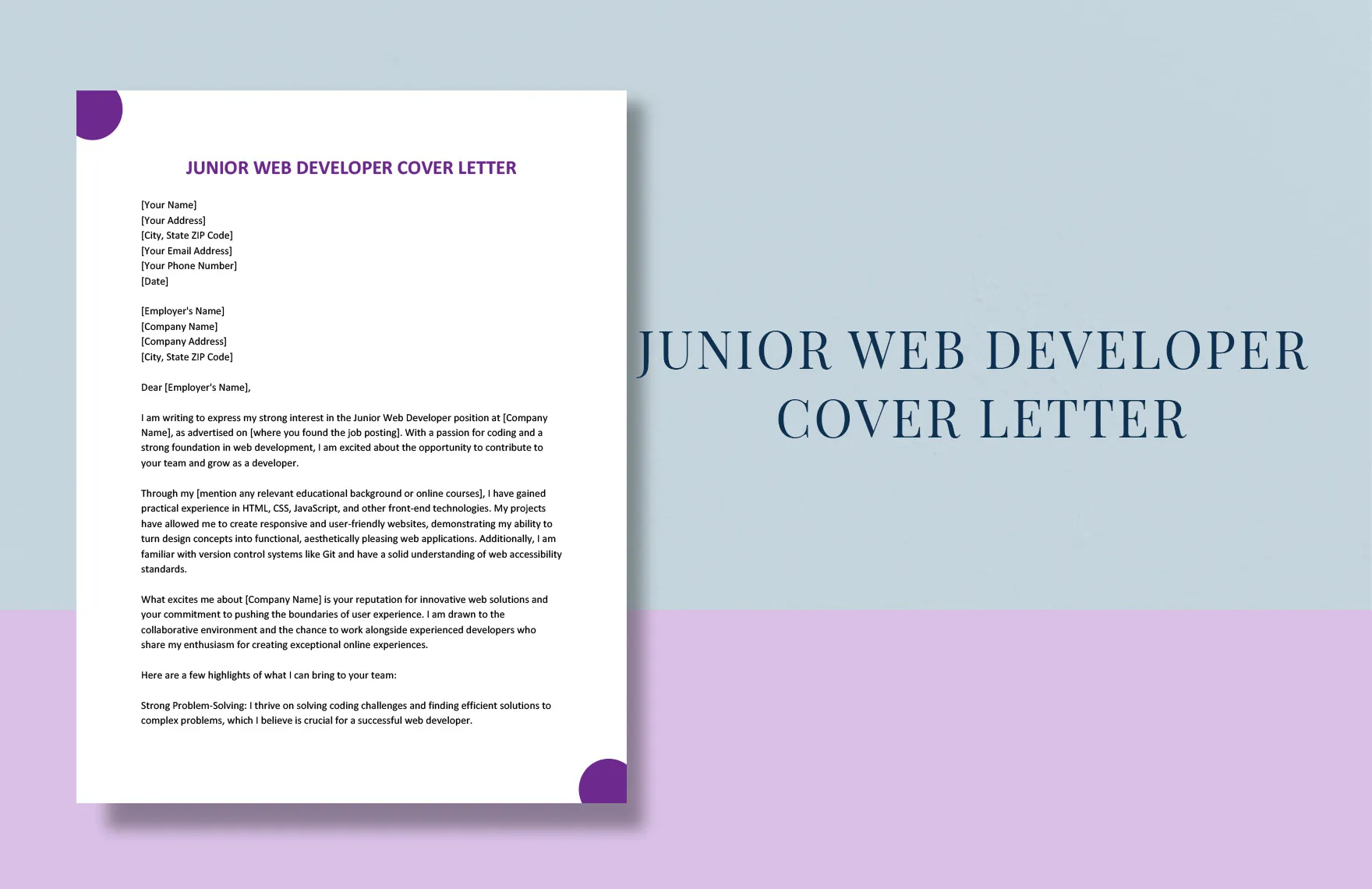
The formatting of your cover letter can greatly impact how it is perceived. Begin with a professional header that includes your contact information — name, phone number, email address, and optionally, your LinkedIn profile or personal website URL. Next, include the date and the hiring manager’s name, title, and company address, if available. The body of the cover letter should be divided into clear, concise paragraphs, typically no more than five or six. Use a standard, easy-to-read font like Arial or Times New Roman, and ensure the text is well-spaced. Avoid overly long paragraphs; break up your thoughts to make the document easier to read. Maintain a professional tone throughout the letter, and proofread meticulously to eliminate any grammatical or spelling errors. Proper formatting will enhance the readability and professionalism of your cover letter, making a positive impression on the reader.
Contact Information and Salutation
Your contact information should be at the top of your cover letter. This includes your full name, phone number, email address, and optionally, a link to your online portfolio or LinkedIn profile. Make sure your email address is professional, such as using your full name. Following your contact information, include the date and the recipient’s details, if available, such as the hiring manager’s name, their title, and the company’s address. This demonstrates attention to detail and professionalism. For the salutation, use a formal greeting. If you know the hiring manager’s name, use “Dear Mr./Ms. [Last Name]”. If you don’t know the name, use “Dear Hiring Manager” or “Dear [Company Name] Team.” Avoid overly casual greetings like “Hello” or “Hi”. The salutation sets the tone for the entire letter, so ensure it is professional and respectful.
The Opening Paragraph

The opening paragraph is crucial for capturing the hiring manager’s attention. It’s your first chance to make a strong impression and convince them to read the rest of your cover letter. Start by clearly stating the position you are applying for and where you found the job posting. Then, concisely express your enthusiasm for the role and the company. If something specific about the company or the role interests you, mention it briefly. In the opening paragraph, avoid generic statements. Instead, show your personality and convey your unique perspective. For example, you might mention a project that you particularly enjoyed or an accomplishment you are proud of. The aim is to make the hiring manager interested in learning more about you, and to immediately understand why you are a suitable candidate for the junior web developer position.
Body Paragraphs
The body paragraphs are where you elaborate on your skills, experiences, and qualifications. These paragraphs provide an opportunity to delve deeper into your value proposition. Divide the body into two or three well-structured paragraphs. Each paragraph should focus on a specific aspect, such as highlighting your technical skills, showcasing projects, or demonstrating your passion for web development. Use clear and concise language. Avoid jargon or overly technical terms that the reader may not understand. Back up your claims with specific examples from your projects, coursework, or other experiences. For instance, if you claim to have proficiency in JavaScript, mention a project where you used JavaScript and what you accomplished. The body paragraphs must provide a complete picture of your ability and aptitude. They should clearly outline your alignment with the job description requirements.
Highlighting Skills Without Experience
Since you have no professional experience, it is crucial to focus on skills gained through other means, such as academic projects, personal coding endeavors, or online courses. Thoroughly review the job description and identify the required skills. Then, list the skills you possess that align with those requirements. For example, if the job posting mentions HTML, CSS, and JavaScript, make sure you emphasize your proficiency in these areas. When describing your skills, provide concrete examples. Instead of just saying you know JavaScript, describe a project where you used JavaScript and the outcome. Use action verbs to describe what you did and what you accomplished, such as “Developed,” “Implemented,” “Designed,” or “Managed.” Quantify your accomplishments whenever possible. This could mean the number of lines of code written or the number of users who interacted with a project. By focusing on your skills and providing concrete examples, you can show that you’re a capable candidate.
Showcasing Projects

Even without professional experience, you can leverage your projects to demonstrate your abilities. Projects showcase your practical skills and understanding of web development concepts. Whether they’re from academic assignments, personal initiatives, or online tutorials, include projects in your cover letter. Briefly describe each project, specifying its purpose, your role, and the technologies you used. If possible, include a link to your project on GitHub or a live website. Quantify your contributions when discussing the project. Instead of saying you designed a website, mention the number of pages, the technologies used, and any positive results. Highlighting your projects provides concrete examples of your abilities and gives the hiring manager a real picture of what you can do. This approach also shows your initiative and your passion for web development.
Quantifiable Achievements
To make your cover letter more compelling, use quantifiable achievements. Whenever possible, quantify your accomplishments to provide concrete evidence of your skills and the impact you’ve made. For example, instead of saying “improved website performance,” say “reduced page load times by 20%.” Instead of just mentioning that you completed a project, state how many users interacted with it. Quantifiable achievements make your claims more credible and show your ability to achieve results. If you don’t have directly quantifiable achievements, try to approximate. For instance, if you developed a project that enhanced a process, estimate how much time or resources it saved. Quantifying your achievements provides concrete evidence of your abilities and makes your cover letter more persuasive.
Demonstrating Passion and Enthusiasm
Employers seek candidates with a genuine passion for web development. Demonstrate your enthusiasm by expressing your interest in the field and the company. Mention why you’re excited about the role and what you hope to contribute. Showcase your knowledge of the company’s work and its place in the industry, showing you’ve done your research. If there’s a specific project or technology the company uses that you admire, mention it to show that you’re genuinely interested in working there. Expressing your passion can set you apart from other candidates. Genuine enthusiasm goes a long way in making a positive impression, making the hiring manager believe in your potential and see you as a good fit.
The Closing Paragraph
The closing paragraph should reiterate your interest in the role and thank the hiring manager for their time and consideration. Briefly restate your enthusiasm and remind them of your key qualifications. Avoid sounding generic; make sure your closing reflects the specific job and the company’s values. Ensure the closing is polite and professional, and express your availability for an interview. A strong closing paragraph can reinforce the positive impression made by the rest of your cover letter, and it is an excellent way to end the letter on a positive note, ensuring the hiring manager remembers you favorably. Ensure the closing is well-crafted and leaves the hiring manager with a lasting positive impression of your candidacy.
Call to Action
Include a clear call to action in your cover letter. This is a direct statement that tells the hiring manager what you want them to do next. The most common call to action is to request an interview. In the closing paragraph, state your availability and express your eagerness to discuss your qualifications further. For instance, you could write, “I am eager to learn more about this opportunity and discuss how my skills and enthusiasm can benefit your team. I am available for an interview at your earliest convenience.” A well-placed call to action reinforces your interest in the position, and it encourages the hiring manager to take the next step in the hiring process. Including a clear call to action guides the hiring manager and increases your chances of getting an interview.
Proofreading and Editing
Proofreading and editing are essential steps. Errors in your cover letter can make a negative impression. Carefully review your cover letter for grammatical errors, spelling mistakes, and typos. It’s always a good idea to have someone else review your cover letter. A fresh pair of eyes can easily spot errors that you might miss. Pay attention to the overall flow and clarity of your writing. Is your message easy to understand? Is the tone professional? Make sure that your cover letter represents you positively and showcases your skills and enthusiasm. A well-proofread and edited cover letter demonstrates your attention to detail and commitment to quality.