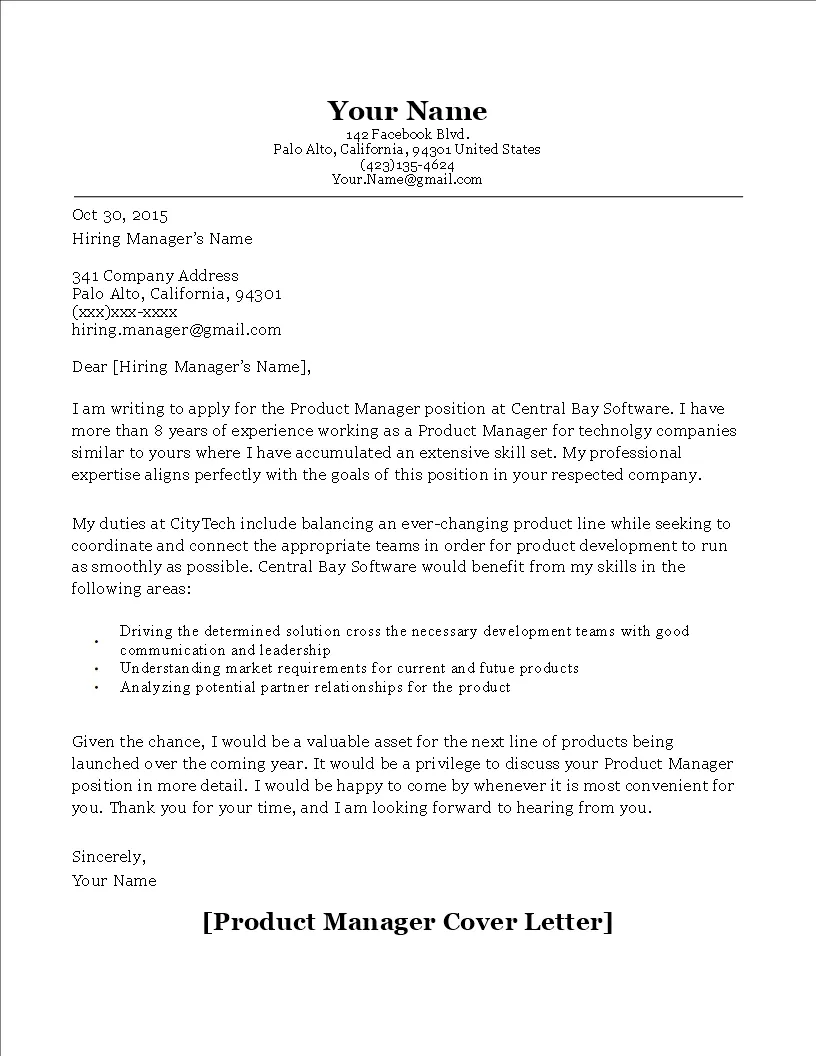
Cover Letter Product Manager - Introduction
A Product Manager cover letter is your first chance to make a strong impression on a potential employer. It’s a crucial document that complements your resume, providing a deeper understanding of your qualifications, experience, and enthusiasm for the role. A well-crafted cover letter should not only highlight your skills but also demonstrate your understanding of the company, the product, and the specific requirements of the job. Think of it as a personal introduction that sets the stage for your application and encourages the hiring manager to read your resume with keen interest. It’s an opportunity to showcase your personality, communication skills, and how you can contribute to the company’s success. Neglecting to write a cover letter, or submitting a generic one, can be a missed opportunity to stand out from the competition.
Cover Letter Product Manager - Key Components
A compelling Product Manager cover letter contains several key components that work together to tell your story. Each part contributes to painting a complete picture of your suitability for the role. Starting with a strong opening, clearly stating the position you’re applying for and where you saw the job posting. Then, the body of the letter should highlight your key skills and accomplishments. Don’t simply reiterate your resume; instead, focus on how your experience aligns with the specific needs of the company. Quantify your achievements whenever possible and show the impact you’ve made in previous roles. Lastly, your letter should end with a strong call to action and express your eagerness to discuss your qualifications further. A well-structured cover letter will increase your chances of securing an interview.
Summary of Your Skills and Experience

Begin by providing a concise summary of your skills and experience relevant to the Product Manager role. Think of this as your ’elevator pitch’. Briefly mention your expertise in areas like product strategy, market analysis, user research, or agile development. Highlight your ability to prioritize features, manage product roadmaps, and work with cross-functional teams. It’s about showcasing the skills that make you an effective product leader. Use this section to immediately capture the reader’s attention by demonstrating your core competencies. Mention specific tools and methodologies you’re proficient in, such as Jira, Confluence, or various product management frameworks. This ensures the hiring manager knows at a glance that you have what it takes.
Highlighting Relevant Product Management Experience
Dive deeper into your relevant product management experience. Provide specific examples of projects you’ve led, products you’ve launched, or challenges you’ve overcome. This is where you bring your resume to life, providing context and detail that a bullet point list cannot. Describe the product, your role, and the specific responsibilities you held. Focus on demonstrating your skills such as market analysis, user research, creating product roadmaps, and working with cross-functional teams. Mention specific instances where you identified market opportunities, defined product requirements, or managed product launches. Show the hiring manager that you’ve successfully navigated the complexities of product management and delivered results.
Quantifying Your Achievements
Always quantify your achievements. Rather than simply saying ‘Improved user engagement,’ state ‘Increased user engagement by 30% within six months through the implementation of X strategy.’ Numbers add credibility and demonstrate the impact you’ve made in previous roles. Use data to showcase your successes. For example, mention revenue growth, user acquisition, customer satisfaction scores, or any other metrics that demonstrate your ability to drive product success. This is particularly important for Product Manager roles, where the ability to measure and analyze results is crucial. Numbers create a compelling narrative and prove your worth, making you stand out from other applicants.
Tailoring Your Cover Letter to the Job

Customize your cover letter for each job application. Generic cover letters are easily spotted and often discarded. Take the time to research the company and the specific requirements of the role. Align your skills and experience with the job description, highlighting the relevant aspects. Show the hiring manager that you understand their needs and have the skills to meet them. Your application should be specific to the particular product and company you’re targeting. Mention the product, the market, and the company’s challenges to showcase that you are very interested in the position.
Researching the Company and the Role
Before writing, conduct thorough research. Visit the company website, explore their products, and understand their mission and values. Review the job description carefully to identify the key skills and qualifications. Research the product you’ll be managing or working with. Understand the industry, the target market, and the current challenges the company faces. This information will enable you to tailor your cover letter and show that you’re genuinely interested in the role. Demonstrate your knowledge of the company’s products, its competitors, and the overall market landscape. This will make you stand out from candidates who simply submit a generic application.
Matching Skills to Requirements
Carefully analyze the job description and identify the key skills and requirements. Then, review your skills and experience to determine how they match the job requirements. In your cover letter, explicitly state how your skills align with their needs. Provide examples of how you have demonstrated these skills in past roles. Use keywords from the job description to make your cover letter more relevant. By specifically addressing the requirements of the role, you show the hiring manager that you’re a strong fit and have what it takes to succeed. This focused approach proves that you’ve considered the company’s needs and are capable of solving their problems.
Demonstrating Your Passion for the Product

Express your enthusiasm for the product and the company. Product Managers need to be passionate about the products they work on. Talk about why you’re excited about the product, its potential, and its impact on the market. Show that you understand the product’s value proposition and are eager to contribute to its success. Mention any personal experiences or insights that showcase your genuine interest. A genuine passion for the product and the company is a significant differentiator that makes you more likely to be selected for an interview. The best cover letters demonstrate both your skill set and your sincere desire to contribute.
Cover Letter: Product Manager - Writing Style
The writing style of your Product Manager cover letter is crucial to making a positive impression. It should be professional, clear, concise, and engaging. A well-written cover letter demonstrates your communication skills and helps you stand out from other applicants. The tone should be professional, but not overly formal. The goal is to present yourself as a confident and capable individual who can communicate effectively. Avoid jargon and industry buzzwords that might confuse the hiring manager. Focus on clear and concise language that highlights your qualifications.
Use of Action Verbs
Use action verbs to describe your accomplishments and responsibilities. Action verbs add energy and impact to your writing. Instead of saying ‘Responsible for,’ use verbs like ‘Led,’ ‘Managed,’ ‘Launched,’ ‘Developed,’ or ‘Improved.’ Action verbs convey a sense of initiative and achievement. They show that you took action and achieved results. This makes your cover letter more dynamic and engaging. Make your experience more vivid and compelling by choosing strong action verbs.
Show, Don’t Tell

Instead of simply stating that you have a certain skill, show it. Provide specific examples of how you’ve used that skill in the past. For example, instead of writing, ‘I am a good communicator,’ describe how you effectively communicated complex ideas to cross-functional teams. This approach is more compelling and credible. Use stories and anecdotes to illustrate your abilities. Show the hiring manager, don’t just tell them. Demonstrate the impact of your work by providing measurable results and tangible outcomes. This makes your claims more convincing and memorable.
Keeping it Concise and Engaging
Keep your cover letter concise and engaging. Hiring managers often have limited time to read cover letters, so it’s essential to get to the point quickly. Make every word count, and avoid unnecessary jargon or filler. Focus on the most important information and highlight your key qualifications. Use a conversational tone to make your letter more engaging. This will make the hiring manager more likely to read your letter carefully. A well-written cover letter should captivate the reader and keep them interested in what you have to say. Keep the tone professional but personable.
Cover Letter: Product Manager - Formatting and Layout
The formatting and layout of your cover letter are important for readability and professionalism. Your cover letter should be easy to read, well-organized, and visually appealing. A clean and professional format reflects your attention to detail and makes it easier for the hiring manager to assess your qualifications. Good formatting can significantly improve the first impression and showcase you as a polished professional.
Professional Appearance

Use a professional font, such as Times New Roman, Arial, or Calibri, in a readable size (11 or 12 points). Ensure your cover letter has a clean and consistent appearance. Avoid excessive use of bolding, italics, or different font styles. Keep the formatting consistent throughout the document to ensure it looks professional. A well-formatted cover letter shows you care about presenting yourself in the best possible light. Your goal is to look like a competent professional ready to step into the role.
Proper Formatting
Include your contact information at the top of the cover letter, including your name, phone number, email address, and LinkedIn profile URL. Use appropriate spacing and margins to create a visually appealing layout. Use a professional business letter format, including the date, the recipient’s name and title, and the company’s address. Use single spacing within paragraphs and double spacing between paragraphs to improve readability. Maintain consistent margins throughout the document. Ensure the text is aligned to the left and justified for a clean look.
Proofreading and Editing
Proofread your cover letter carefully for any grammatical errors, spelling mistakes, or typos. Errors can undermine your credibility and make you appear careless. Use a grammar checker, but also read the letter aloud to catch any mistakes. Consider having a friend or colleague review your cover letter for a fresh perspective. Proper proofreading demonstrates your attention to detail. Make sure the sentences flow smoothly and the overall message is clear and concise. A flawless cover letter is an indication of the high standard you apply to your work. Taking time to proofread is an easy way to make a good impression.
Cover Letter: Product Manager - Examples of Successful Cover Letters

Reviewing examples of successful Product Manager cover letters can provide valuable insights. These examples can help you understand how to structure your letter, highlight your accomplishments, and tailor your message to specific job requirements. By analyzing different cover letters, you can get inspiration and improve your own writing skills. Remember to adapt these examples to your own experience and the specific job you are applying for. Consider each example as a guide, not a template to copy. Tailor each cover letter to reflect your personal experience and the specifics of the product or the company.
Example 1 - Focus on Impact
This example emphasizes the impact the applicant made in their previous roles. It showcases their ability to achieve results, measure outcomes, and drive product success. The candidate describes specific projects and quantifying the achievements. The goal is to show tangible benefits to the company. The focus is on delivering results, and it provides hard numbers to justify this.
Example 2 - Demonstrating a Growth Mindset
This example highlights the applicant’s growth mindset. It shows a willingness to learn, adapt, and take on new challenges. It demonstrates a proactive approach to product development and the candidate’s curiosity. The goal is to showcase not just skills but also the ability to evolve with market trends and business needs. The applicant is showing that they have a desire to stay relevant.
Example 3 - Highlighting Technical Skills
This example highlights the technical skills relevant to the Product Manager position. This is important for product managers who need to understand the technical aspects of product development. The candidate showcases the technical skills and experience with tools, and technologies. The goal is to demonstrate a strong understanding of the product development process and a comfort level working with technical teams. This highlights a specific technical skill, such as data analysis, product analytics, or specific product management methodologies.
Cover Letter: Product Manager - Conclusion
A well-crafted cover letter is a powerful tool in your job search. It offers the perfect opportunity to make a great first impression on the hiring manager. Remember to tailor your cover letter to each job, highlight your key skills and experience, quantify your achievements, and express your passion for the product. A professional and polished cover letter will show the hiring manager you’re qualified and detail-oriented. By following these guidelines and incorporating best practices, you can create a cover letter that will open doors to your product management career. The effort you put into your cover letter will be well worth it. Good luck!