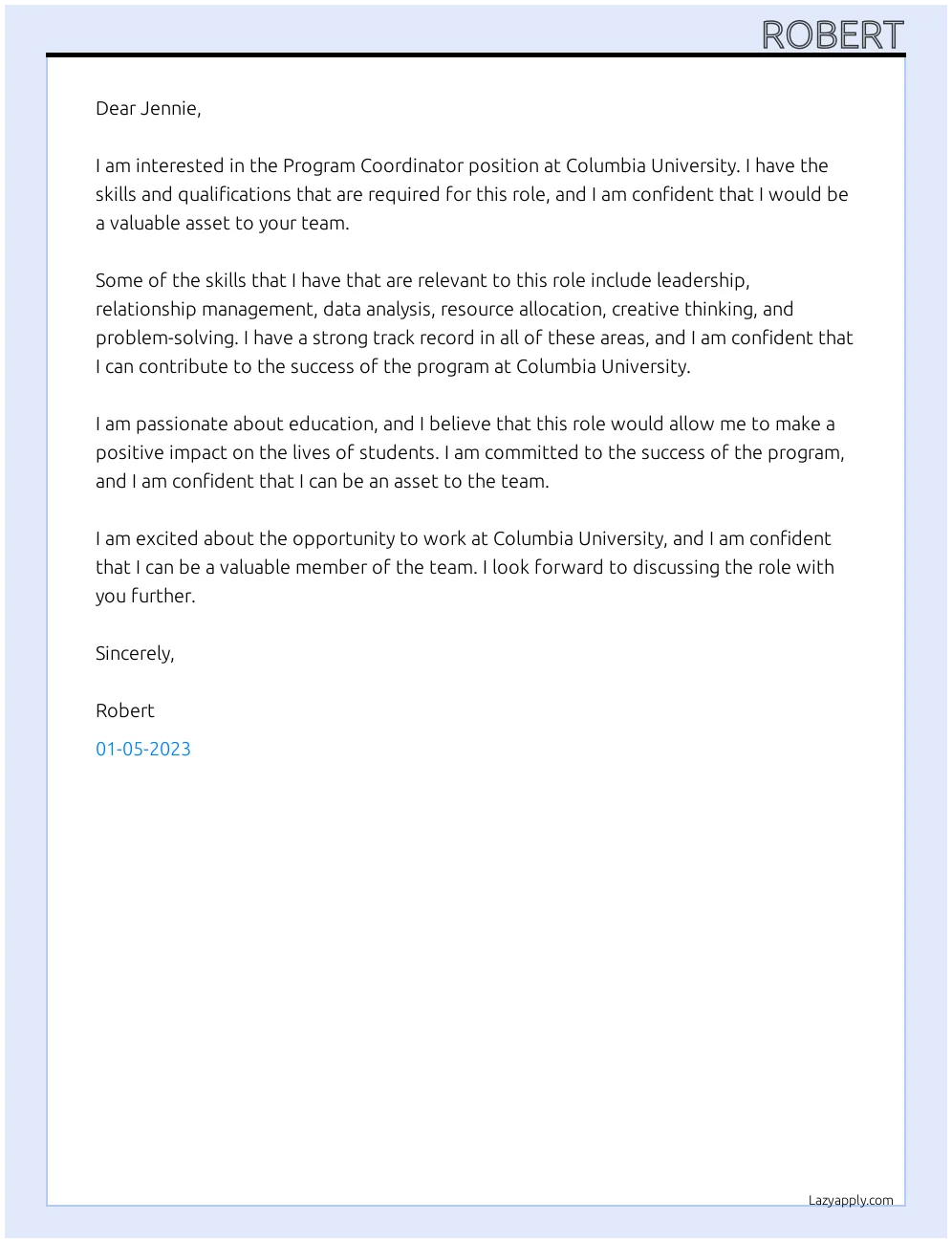
Program Coordinator Cover Letter Essentials
A program coordinator cover letter is your first chance to make a positive impression on a potential employer. It’s a critical document that supplements your resume, offering a more personalized and detailed account of your qualifications and enthusiasm for the role. A well-crafted cover letter not only showcases your skills and experiences but also demonstrates your understanding of the job requirements and your genuine interest in the organization. This guide will break down the essentials of creating a compelling cover letter that grabs attention and increases your chances of landing an interview. To truly stand out from the crowd and make a positive impression, you need to create a cover letter that showcases your skills and qualifications.
Understanding the Purpose of a Cover Letter
The primary purpose of a program coordinator cover letter is to introduce yourself to the hiring manager and explain why you are the ideal candidate for the position. Unlike a resume, which provides a factual overview of your experience, a cover letter allows you to tell your story, highlighting your key skills, achievements, and career goals in a way that’s relevant to the specific job. It’s a chance to connect your experiences with the employer’s needs and demonstrate your genuine interest in the organization and the program coordinator role. It’s an opportunity to show the hiring manager you understand what the role entails and that you have the necessary qualifications to thrive.
Key Components of a Program Coordinator Cover Letter

A strong cover letter is made up of several key components. Each part plays a crucial role in conveying your qualifications and making a positive impression. It must include a proper header, a compelling opening, a skills and experience section, an enthusiasm statement, a professional closing, and careful proofreading. This comprehensive structure ensures that your letter is clear, concise, and persuasive. Your cover letter should be as informative and organized as your resume, and the most important thing is to ensure it is easy to read and comprehend. Here’s a breakdown of the essential elements to include in your program coordinator cover letter.
Header and Contact Information
The header of your cover letter should contain your contact information and the hiring manager’s contact information. This ensures the hiring manager can easily reach you if they are interested in you and your experience. Make sure the formatting and style is professional, and it looks clean. This section is very important because it starts the professional tone of your letter.
Applicant’s Contact Information
At the top of the letter, include your full name, address, phone number, and professional email address. Ensure your email address is professional; avoid using nicknames or unprofessional usernames. Double-check that your contact information is accurate and up-to-date so the hiring manager can easily reach you.
Hiring Manager’s Contact Information

If possible, address your cover letter to a specific person, such as the hiring manager or the program director. Research the hiring manager’s name and title. If you cannot find a name, you can use a general greeting such as ‘Dear Hiring Manager’ or ‘Dear [Department Name] Team.’ Include the hiring manager’s name, title, and the organization’s address below your contact information.
Salutation
Begin your cover letter with a professional salutation. If you know the hiring manager’s name, use ‘Dear Mr./Ms./Mx. [Last Name]’. If you don’t know the name, use ‘Dear Hiring Manager’ or ‘To Whom It May Concern’. Avoid overly casual greetings, and maintain a formal tone throughout your letter.
Writing a Compelling Opening
Your opening paragraph is your first opportunity to grab the reader’s attention. Begin by stating the position you are applying for and where you saw the job posting. Briefly mention why you are interested in the role and the organization. Highlight one or two key skills or experiences that make you a strong fit for the position. Make your introduction concise and engaging, setting the tone for the rest of your letter.
Highlighting Relevant Skills and Experience

The body of your cover letter should focus on your relevant skills and experiences. Review the job description carefully and identify the key requirements. Provide specific examples from your work history that demonstrate how you meet these requirements. Use action verbs to describe your accomplishments and quantify your achievements whenever possible. Tailor your letter to the specific needs of the organization, emphasizing the skills and experiences that are most relevant to the role.
Quantifiable Achievements
Quantify your accomplishments to demonstrate your impact. Use numbers, percentages, and specific data to illustrate your achievements. For example, instead of saying ‘Managed program logistics,’ you could say ‘Managed logistics for a program with 100+ participants, resulting in a 15% increase in event satisfaction.’ Providing quantifiable achievements makes your qualifications more tangible and persuasive.
Tailoring to the Specific Job
Customize your cover letter for each job application. Don’t use a generic template. Research the organization and the specific program. Show that you understand the organization’s mission, values, and goals. Align your skills and experiences with the specific requirements outlined in the job description. This level of personalization shows the hiring manager that you are genuinely interested in the role and the organization, and that you did the work to submit a professional cover letter.
Showcasing Your Enthusiasm

Express your enthusiasm for the role and the organization in your cover letter. Explain why you are excited about the opportunity and what you hope to achieve in the position. Demonstrate your passion for the field and your commitment to contributing to the organization’s success. Your enthusiasm can make a significant difference in making a strong impression, so always be sure to express your true feelings in the letter.
Closing the Letter
Your closing paragraph should summarize your key qualifications and reiterate your interest in the position. Thank the hiring manager for their time and consideration. State your willingness to discuss your qualifications further in an interview. Include a call to action, such as ‘I look forward to the opportunity to speak with you further about this position.’
Formal Closing and Signature
End your cover letter with a professional closing, such as ‘Sincerely,’ ‘Best regards,’ or ‘Thank you.’ Leave space for your signature (if printing the letter) and type your full name below the closing. If sending your cover letter electronically, you can type your name. This ensures that the cover letter has a professional tone, and that you come across as a professional.
Proofreading and Formatting

Before submitting your cover letter, meticulously proofread it for any errors in grammar, spelling, and punctuation. Ensure that your formatting is consistent and professional. A well-formatted and error-free cover letter demonstrates attention to detail and professionalism. Use a clear, easy-to-read font, and maintain a consistent font size throughout the document. Proofreading is crucial for making sure that your cover letter is up to par.
Formatting Guidelines
Use a professional font like Times New Roman, Arial, or Calibri with a font size between 10 and 12 points. Set margins to 1 inch on all sides. Use single-spaced lines within paragraphs and double-space between paragraphs. Align the text to the left, and use bolding sparingly to highlight important information. The formatting is important to ensure the cover letter is easy to read, and a bad format can lead to your letter being dismissed.
Common Mistakes to Avoid
Avoid common mistakes that can hurt your chances. Do not use generic templates. Don’t include irrelevant information. Refrain from using jargon or slang. Don’t exceed one page in length. Avoid exaggerating or lying about your qualifications. Ensure the cover letter is free of errors in grammar and spelling. By avoiding these common pitfalls, you can significantly improve the effectiveness of your cover letter.
In conclusion, creating a program coordinator cover letter requires careful planning, attention to detail, and a strategic approach. By following these guidelines, you can craft a compelling cover letter that highlights your skills, experiences, and enthusiasm, ultimately increasing your chances of landing an interview. Remember to tailor your letter to each job application and always proofread it thoroughly before submitting. Your cover letter is your chance to shine and demonstrate why you are the perfect fit for the program coordinator role.