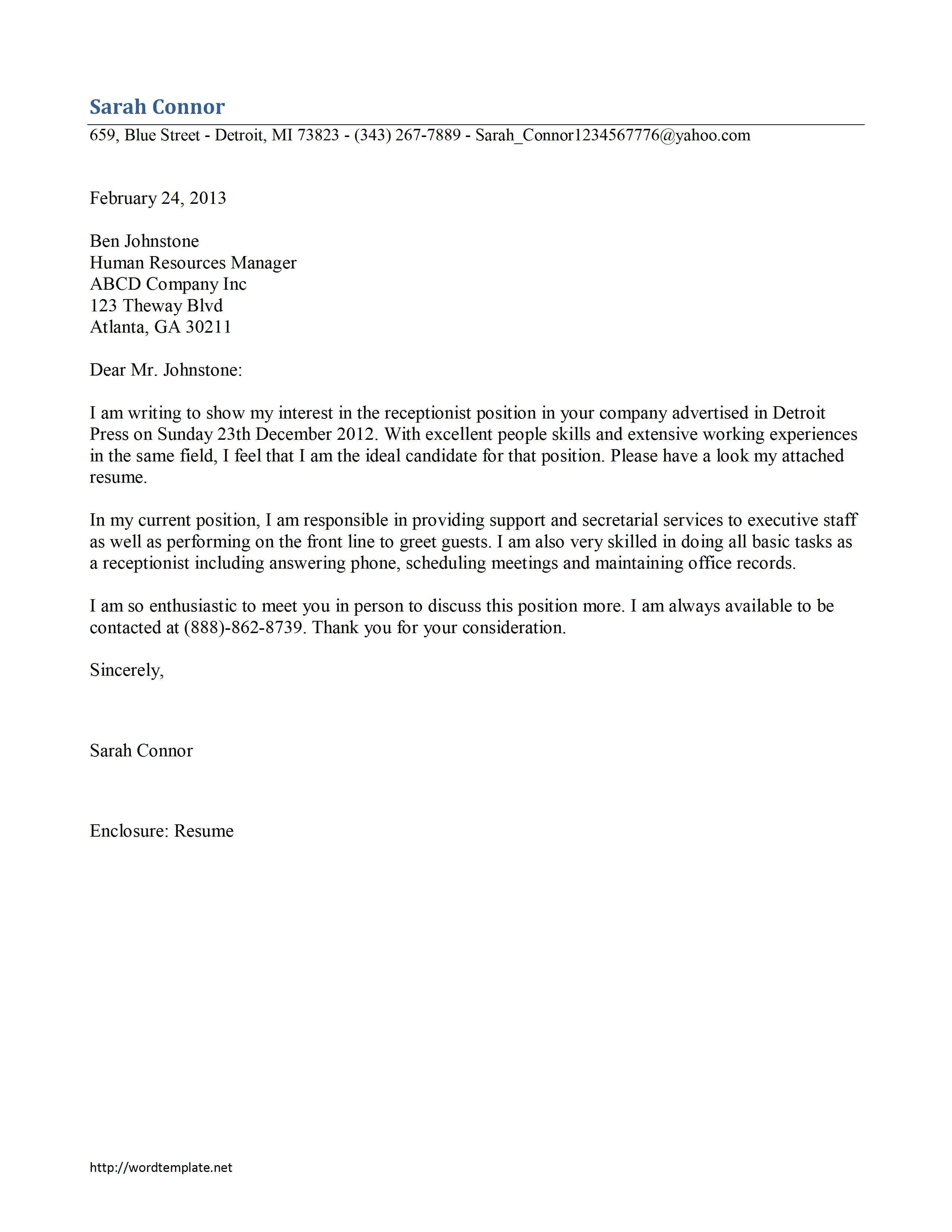
The Importance of a Receptionist Cover Letter
A well-crafted cover letter is your initial opportunity to make a positive impression on a potential employer. For a receptionist position, where first impressions are critical, your cover letter serves as your ambassador. It provides a platform to showcase your personality, skills, and enthusiasm for the role. Unlike a resume, which provides a factual overview of your experience, the cover letter allows you to demonstrate your communication skills, express your interest in the specific company, and highlight how your qualifications align with their needs. A compelling cover letter can significantly increase your chances of securing an interview, ultimately leading to a job offer. Remember, it’s your chance to stand out from the crowd and demonstrate why you’re the perfect fit for the position. This document is a powerful tool in your job-seeking arsenal, so crafting a great cover letter for receptionist roles is essential for job seekers.
Highlighting Your Relevant Skills
Receptionist roles require a diverse set of skills, and your cover letter should effectively highlight those most relevant to the position. The goal is to showcase your ability to handle various responsibilities, from managing phone calls and greeting visitors to handling administrative tasks. Tailor your letter to the specific requirements mentioned in the job description. Don’t simply list your skills; provide concrete examples of how you’ve utilized these skills in past roles. Quantify your achievements whenever possible. Did you improve office efficiency? Mention the percentage. Did you streamline a scheduling system? Explain the process. By providing tangible evidence of your abilities, you make a more compelling case for why you’re the right candidate. Focus on how your skills align with the company’s needs and how you can contribute to their success.
Communication and Interpersonal Skills

Excellent communication and interpersonal skills are paramount for a receptionist. You’re the first point of contact for clients, customers, and colleagues, and your interactions shape their perception of the company. In your cover letter, emphasize your ability to communicate clearly, professionally, and empathetically, both verbally and in writing. Provide examples of how you’ve handled difficult customers, resolved conflicts, or provided exceptional customer service. Highlight your ability to actively listen, understand needs, and respond appropriately. Your tone should be friendly, approachable, and reflect a positive attitude. Emphasize your ability to represent the company in a positive light and create a welcoming environment for everyone who interacts with you. These soft skills are just as important as hard skills in the role of a receptionist.
Organizational and Time Management Skills
Receptionists often juggle multiple tasks simultaneously, requiring strong organizational and time management skills. Demonstrate your ability to prioritize tasks, manage schedules, and meet deadlines effectively. Mention any experience with scheduling software, managing appointments, or coordinating meetings. Provide examples of how you’ve maintained an organized workspace, managed incoming and outgoing mail, or handled administrative tasks efficiently. Highlight your ability to multitask, remain calm under pressure, and maintain a high level of accuracy. Employers are looking for candidates who can handle the demands of a busy office environment, so showcasing your organizational prowess is crucial. Consider mentioning any systems or processes you’ve used to improve efficiency in previous roles.
Technical Proficiency
In today’s digital age, technical proficiency is essential for receptionists. Familiarity with common software and office equipment is expected. In your cover letter, highlight your experience with phone systems, email software, word processing programs, and any other relevant technologies. If the job description specifies particular software, make sure to mention your experience with those programs. Mention your typing speed and accuracy. If you’re proficient in any specialized software, such as customer relationship management (CRM) systems, be sure to include that information. Demonstrating your technical skills can significantly increase your value to the employer, making you a more competitive candidate. Be sure to mention your skills in the job cover letter.
Showcasing Your Professionalism

Your cover letter should reflect a high level of professionalism, mirroring the standards expected in a receptionist role. Pay meticulous attention to detail, ensuring your letter is free of grammatical errors, typos, and formatting inconsistencies. Use a professional tone throughout, avoiding slang or overly casual language. Your letter should be well-organized, easy to read, and clearly convey your message. Address the hiring manager by name whenever possible, and research the company’s culture to tailor your language and style appropriately. Proofread your letter multiple times, and consider having a friend or family member review it for you. A polished and professional cover letter demonstrates your commitment to excellence and your understanding of workplace etiquette.
Formatting Your Cover Letter Correctly
Proper formatting is crucial for a cover letter. Use a standard, easy-to-read font, such as Times New Roman or Arial, in a 10- or 12-point size. Maintain consistent margins and spacing throughout the document. Use a professional letterhead, including your contact information, and the date. Keep the letter concise, typically no more than one page. The format should be clean and easy to navigate. Break up long blocks of text with paragraphs and bullet points to improve readability. Ensure your letter is visually appealing and reflects your attention to detail. A well-formatted cover letter shows that you are organized and respect the reader’s time. A standard format ensures the reader can easily review your qualifications.
Contact Information and Salutation
Begin your cover letter with your contact information, including your name, address, phone number, and email address. This information should be clearly displayed at the top of the letter. Address the hiring manager by name, if possible. Research the company’s website or LinkedIn to find the appropriate person. If you’re unable to find a specific name, use a professional salutation, such as “Dear Hiring Manager” or “Dear [Company Name] Team.” Avoid generic greetings like “To Whom It May Concern.” Addressing the recipient by name shows that you’ve taken the time to personalize your letter and increases your chances of making a positive impression. The salutation sets the tone for the entire letter, so make sure to be professional and respectful from the start.
Body Paragraph Structure

The body of your cover letter should be structured logically. Start with a brief introduction stating the position you’re applying for and where you saw the job posting. In the subsequent paragraphs, highlight your relevant skills and experience, providing specific examples to support your claims. Explain how your qualifications align with the job requirements and what value you can bring to the company. Keep each paragraph concise and focused, emphasizing the most important information. Use strong action verbs to describe your accomplishments and avoid generic statements. Clearly communicate your interest in the role and the company, demonstrating that you’ve researched their values and mission. The body paragraphs are where you sell yourself, so make sure to highlight your key strengths.
Closing the Letter Effectively
Conclude your cover letter with a strong closing paragraph. Reiterate your interest in the position and thank the reader for their time and consideration. Express your availability for an interview and provide your contact information again. If you’re following up with a call, mention that in your closing. Keep the tone professional and enthusiastic, expressing your eagerness to learn more about the opportunity. Avoid clichés and generic closing statements. A well-crafted closing paragraph can leave a lasting positive impression on the hiring manager. End with a professional closing, such as “Sincerely” or “Best regards,” followed by your typed name. This final impression is essential.
Tailoring Your Letter to the Job
One of the most critical tips for a successful receptionist cover letter is tailoring it to each specific job. Avoid using a generic template that you send to every employer. Instead, carefully review the job description and identify the key skills and qualifications the employer is seeking. Customize your letter to address those specific requirements, highlighting your relevant experience and providing examples of how you’ve demonstrated those skills in the past. Research the company and its culture to understand their values and mission, and use this information to tailor your language and style appropriately. Show the employer that you understand their needs and that you’ve taken the time to learn about their organization. This personalized approach will make your cover letter stand out from the competition.
Researching the Company

Before writing your cover letter, research the company thoroughly. Visit their website, read their “About Us” page, and explore their social media presence. Understand their mission, values, and culture. This will help you tailor your letter to their specific needs and demonstrate your genuine interest in working for them. Look for information about their products or services, their target audience, and their recent achievements. Use this information to personalize your letter, demonstrating that you understand their business and how you can contribute to their success. Showing that you’ve done your homework will make a positive impression on the hiring manager and demonstrate your initiative.
Matching Skills to Job Requirements
Carefully analyze the job description and identify the key skills and qualifications the employer is seeking. Then, tailor your cover letter to match those requirements. Highlight your relevant experience and provide concrete examples of how you’ve demonstrated those skills in the past. Use keywords from the job description to show that you understand the employer’s needs and that you’re a good fit for the role. Don’t simply list your skills; provide specific examples of how you’ve used those skills to achieve results. Quantify your achievements whenever possible, such as improving efficiency or increasing customer satisfaction. Demonstrate that you possess the skills and experience necessary to excel in the receptionist position and contribute to the company’s success.
Proofreading and Editing
Before submitting your cover letter, proofread and edit it meticulously. Errors in grammar, spelling, or punctuation can create a negative impression and undermine your credibility. Read your letter aloud to catch any awkward phrasing or unclear sentences. Have a friend or family member review your letter for you, as a fresh pair of eyes can often spot errors you may have missed. Ensure that your letter is well-organized, easy to read, and free of any inconsistencies. Proofreading is essential for a polished and professional final product. A clean and error-free cover letter demonstrates your attention to detail and your commitment to excellence, significantly increasing your chances of getting noticed. The final edit is an important step for a receptionist job application.