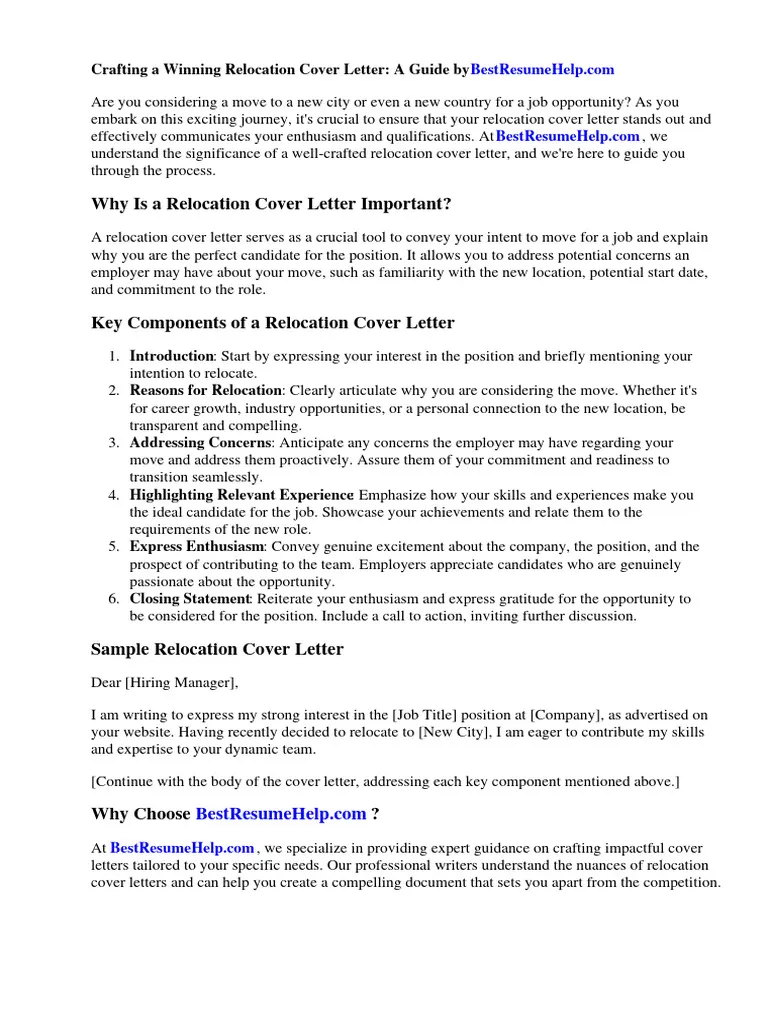
What is a Relocation Cover Letter
A relocation cover letter is a specialized type of cover letter that accompanies your resume when you’re applying for a job and need to relocate to a new city or state. This letter serves to inform the potential employer about your willingness to move and explain the reasons behind your decision. Unlike a standard cover letter, a relocation cover letter proactively addresses the elephant in the room — the fact that you don’t currently live in the area where the job is located. It is a crucial document in the job application process, as it can significantly impact your chances of securing an interview and ultimately, the job itself. The main goal is to convince the hiring manager that your relocation won’t be a burden but rather an asset to their team. This requires a strategic approach that combines professionalism, clarity, and a strong understanding of the employer’s needs. The letter should highlight your relevant skills and experience while directly addressing your relocation plans, making it clear that you are serious about the opportunity.
Why You Need a Relocation Cover Letter
Including a relocation cover letter is essential because it provides context and reassurance to the hiring manager. Without it, your resume might be overlooked simply because the employer assumes you’re not local. A well-crafted cover letter demonstrates your genuine interest in the role and the company, proactively addressing any concerns the employer might have about your relocation. This is particularly important in today’s competitive job market, where employers often receive numerous applications. By taking the initiative to explain your situation, you set yourself apart from other candidates who may not have addressed their relocation status. The letter also gives you an opportunity to explain your reasons for moving, highlighting any ties you might have to the area or specific reasons for your interest in the job. Furthermore, it can be a powerful tool for showcasing your communication skills, your attention to detail, and your overall professionalism, all of which are crucial aspects of a successful job application.
Address the Reasons for Relocation

One of the primary functions of a relocation cover letter is to provide a brief and compelling explanation for your move. This is not just about stating that you’re willing to relocate; it’s about explaining why. Are you moving to be closer to family, seeking new career opportunities, or simply drawn to the lifestyle of the new location? Whatever the reason, be clear and concise. For example, you might mention that you’re relocating to be closer to your family and are seeking a position that aligns with your skills and experience. Avoid overly personal details; instead, focus on how the relocation aligns with your career goals and how it benefits both you and the employer. If you have ties to the area, such as family or a strong interest in the local culture, be sure to mention them as this shows your commitment to the area. The goal is to demonstrate your commitment to the move and your enthusiasm for the opportunity, assuring the employer that your relocation is a well-thought-out plan and not a fleeting impulse.
Highlight Your Skills and Experience
While addressing your relocation is important, don’t let it overshadow the core purpose of your cover letter: to sell your skills and experience. Tailor the content to the specific job description and highlight the qualifications that make you an ideal candidate. Use concrete examples to showcase your accomplishments and explain how your skills can benefit the company. Quantify your achievements whenever possible; for instance, you might mention that you increased sales by a certain percentage or streamlined a process, saving the company time and resources. This will make your letter more impactful. The relocation aspect of your letter should support the overall message about your suitability for the job. Focus on demonstrating how your unique skills, experience, and qualifications align with the job requirements. This balanced approach ensures the employer understands both your willingness to relocate and your ability to excel in the role.
Emphasize Your Enthusiasm for the Role
Expressing genuine enthusiasm for the job and the company is crucial. Let the hiring manager know why you’re excited about this specific opportunity. This might involve referencing the company’s mission, its products or services, or its company culture. Show that you have done your research and that you understand what makes this job and this company a great fit for you. Explain why you are particularly interested in this specific role and how it aligns with your career goals. Enthusiasm can be conveyed through your tone, choice of words, and the overall structure of your letter. Make it clear that you see this opportunity as a significant step forward in your career. This not only increases your chances of being considered but also makes you stand out as a candidate who is genuinely invested in the success of the company. By doing so, you demonstrate your commitment to the job and your motivation to perform well.
How to Write a Relocation Cover Letter

Use a Professional Tone
Maintaining a professional tone is critical when writing a relocation cover letter. Your language should be clear, concise, and respectful. Avoid slang, jargon, or overly casual language, as this can undermine your credibility. The tone should convey confidence and competence while also being friendly and approachable. Ensure your writing is free of errors and that your formatting is professional and consistent. Address the hiring manager by name whenever possible, and use a formal greeting and closing. Even though the letter is about your personal relocation plans, keep the focus on how your skills and experience can benefit the employer. The goal is to present yourself as a serious and reliable candidate. This includes demonstrating an understanding of workplace etiquette. Consider your tone as another way to showcase your professionalism, as it reflects your attention to detail and commitment to presenting yourself in the best possible light. Your goal is to make a strong impression that gets you noticed.
Customize Your Letter
A generic cover letter rarely makes a good impression. Tailor your relocation cover letter to each specific job application. This means carefully reviewing the job description and highlighting the skills and experiences that are most relevant to the role. Customize your letter to reflect the specific requirements of the position and to demonstrate that you understand the company’s needs. Mention the company by name and show that you have researched its products, services, or culture. This level of personalization demonstrates your interest and attention to detail, making you a more appealing candidate. By making these adjustments, you show the employer that you are not just sending out a generic application but are genuinely interested in the specific opportunity. Be specific about your reasons for wanting to work for that company, and explain how your skills and experiences align with their values and objectives. This extra effort is noticeable and greatly increases your chances of making a positive impression.
Proofread Carefully

Before submitting your relocation cover letter, proofread it thoroughly. Errors in grammar, spelling, and punctuation can undermine your credibility. These errors can create a negative impression and suggest a lack of attention to detail. Always read through your letter multiple times, and consider using grammar and spell-checking tools. It’s also helpful to have someone else read your letter to catch any mistakes you might have missed. Look for inconsistencies in formatting or tone. Ensure the letter is clear, concise, and easy to understand. A polished, error-free letter shows that you are a professional who cares about their presentation. Take the time to review every aspect of your letter and ensure it is free from errors. Proofreading is an essential step in the writing process; it demonstrates your attention to detail and improves your chances of making a good impression on potential employers.
Relocation Cover Letter Template
Contact Information
At the top of your cover letter, include your contact information. This should include your full name, phone number, email address, and optionally, your LinkedIn profile URL. Make sure the contact information is current and professional. Ensure that your email address is appropriate for professional correspondence, and consider setting up a professional voicemail greeting. Your contact information should be easy to find and clearly visible. This will allow the hiring manager to quickly reach you if they are interested in moving forward with your application. Double-check the accuracy of your contact details to prevent any miscommunication or missed opportunities. Presenting this information clearly at the beginning of your letter helps the employer easily connect with you and facilitates the hiring process. Having a professional presentation is key to the hiring process.
Greeting

Start your cover letter with a professional greeting. If possible, address the hiring manager by name. Research the company’s website or use LinkedIn to find out the name of the hiring manager. If you can’t find a specific name, use a general greeting such as “Dear Hiring Manager.” Avoid generic greetings such as “To Whom It May Concern,” as they can make your letter seem less personalized. Your greeting sets the tone for the rest of your letter, so make sure it’s professional and respectful. A personalized greeting demonstrates that you have taken the time to learn about the company and the role. It is often the first thing a hiring manager sees, so it should be impactful. Using the hiring manager’s name also shows that you are proactive in your job search and that you have a genuine interest in the position.
Body Paragraphs
The body paragraphs are where you make your case for the job. The first paragraph should state the position you’re applying for and where you saw the job posting. This helps the hiring manager quickly understand the context of your application. In the following paragraphs, discuss your relevant skills, experience, and achievements, as well as your relocation plans. Explain why you are interested in this role and the company. Make sure to highlight how your qualifications align with the job requirements. Then, explain the reasons for your relocation and your timeline for moving. Be specific about your reasons and emphasize that your relocation is well-planned and won’t be an inconvenience. If you have ties to the area, mention them to strengthen your commitment. Each paragraph should have a clear focus and contribute to your overall message. Remember, your goal is to convince the employer that you are a perfect fit for the role and the company.
Closing
End your letter with a strong closing paragraph and a call to action. Thank the hiring manager for their time and consideration, and reiterate your interest in the position. Clearly state that you are available for an interview and provide your contact information again. This makes it easy for the hiring manager to reach you. Use a professional closing, such as “Sincerely” or “Best regards.” Avoid overly casual or informal closings. Your closing should leave a positive lasting impression. Proofread your closing paragraph to ensure it is grammatically correct and free of errors. Make sure your tone remains professional throughout the closing. By including a call to action, you encourage the hiring manager to take the next step and contact you. This demonstrates your enthusiasm and commitment to securing the job opportunity.
Common Mistakes to Avoid

Ignoring the Employer’s Needs
One of the most common mistakes in a relocation cover letter is failing to address the employer’s needs. Your letter shouldn’t be solely focused on your relocation; it should also highlight what you can do for the company. You must demonstrate that you understand their needs and how your skills and experience align with the job requirements. Focus on the value you bring to the role and how you can contribute to their success. Tailor your letter to the specific job description, mentioning relevant skills, experiences, and achievements. Do your research on the company and demonstrate that you are genuinely interested in working for them. Show how your relocation benefits the employer. For example, by highlighting your availability and readiness to start working, as well as your enthusiasm for the opportunity. Remember, the employer wants to know how you can help them, so make sure your cover letter is focused on their needs.
Being Vague
Avoid being vague. Instead of making general statements, be specific and provide concrete examples to illustrate your points. When describing your skills and experience, use quantifiable results and provide details of how you have contributed to success in past roles. For instance, rather than saying you are a good communicator, explain how you have successfully led presentations or managed complex projects. Instead of just stating you are willing to relocate, explain your reasons for moving and your timeline. Avoid using clichés or generic phrases that could apply to any job. Be specific about why you want to work for this company and how your background matches their requirements. The more specific you are, the more convincing your letter will be. Demonstrating your qualifications with concrete examples will make your letter stand out from the crowd and show that you are prepared for the job.
Focusing Too Much on Yourself

It’s crucial to balance explaining your relocation with highlighting your value to the employer. Avoid making your cover letter overly focused on your personal situation without connecting it to the job. While you need to explain your reasons for moving, always frame this within the context of your career goals and how the opportunity aligns with your professional aspirations. Make the employer the focal point of the letter. Show how your skills and experience can benefit the company, and express your enthusiasm for the role and the company’s mission. Focus on what you can bring to the table rather than what you hope to gain from the role. By maintaining this balance, you demonstrate a genuine interest in the job and a commitment to the company’s success. By keeping the focus on the employer, you show that you are thinking about them. This will make a much more positive impression.
Relocation Cover Letter Examples
Example 1 - Experienced Professional
Dear [Hiring Manager Name],
I am writing to express my strong interest in the [Job Title] position at [Company Name], as advertised on [Platform]. Having followed [Company Name]’s work in [Industry] for some time, I am impressed with [Specific Achievement/Project]. With over [Number] years of experience in [Industry], I have consistently exceeded expectations in roles involving [Key Responsibilities].
I am planning to relocate to [City, State] by [Date] to be closer to family and seeking a long-term career opportunity. My relocation will be fully completed by the time the position is available, and I am available for interviews immediately.
In my previous role at [Previous Company], I [Key Accomplishment 1] and [Key Accomplishment 2], demonstrating my ability to [Relevant Skill 1] and [Relevant Skill 2]. I am confident that my skills align well with the requirements of this position.
Thank you for considering my application. I have attached my resume for your review and welcome the opportunity to discuss my qualifications further. I can be reached at [Phone Number] or [Email Address].
Sincerely, [Your Name]
Example 2 - Recent Graduate
Dear [Hiring Manager Name],
I am writing to express my keen interest in the [Job Title] position at [Company Name], as advertised on [Platform]. I am a recent graduate of [University Name] with a degree in [Major], and I am eager to launch my career in [Industry].
I am excited about the opportunity to relocate to [City, State]. I have strong family ties and believe this role is a great fit for my career goals and interests. My relocation will be fully completed by the time the position is available.
During my studies, I [Key Achievement 1] and [Key Achievement 2], which I believe will greatly benefit the role at [Company Name]. I am excited to apply my knowledge of [Relevant Skills] to your company.
Thank you for considering my application. I have attached my resume for your review and welcome the opportunity to discuss my qualifications further. I can be reached at [Phone Number] or [Email Address].
Sincerely, [Your Name]
Conclusion
A relocation cover letter is a powerful tool for job seekers who are planning to relocate. By addressing the employer’s concerns about your relocation, you can significantly increase your chances of landing an interview and the job. By following the guidelines and templates provided in this guide, you can write a compelling and professional cover letter that highlights your skills, experience, and enthusiasm for the role. Remember to tailor your letter to each specific job application, emphasizing what you can offer the employer, and showcasing your genuine interest in the opportunity. With a well-crafted relocation cover letter, you can make a strong first impression and set yourself apart from the competition. Good luck in your job search!