
Why Your SAP Cover Letter Matters
In the competitive world of SAP jobs, a well-crafted cover letter can be your key to unlocking the door to your dream career. It is more than just a formality; it is your first opportunity to make a lasting impression on potential employers. Your resume provides a snapshot of your experience and skills, but your cover letter allows you to tell your story, showcase your personality, and highlight why you are the perfect fit for the role. It’s your chance to demonstrate your enthusiasm, your understanding of the company’s needs, and your unique value proposition. In a stack of applications, a compelling cover letter helps you stand out and significantly increases your chances of landing an interview. A strong cover letter acts as a personalized introduction, helping you connect with the hiring manager on a deeper level and setting you apart from other candidates who might have similar qualifications. Furthermore, it allows you to address any potential gaps in your resume, explain career transitions, and demonstrate your genuine interest in the specific opportunity, ultimately proving your suitability for the SAP role.
Highlighting Your SAP Skills and Experience
Your SAP cover letter should prominently feature your skills and experience, acting as a bridge between your qualifications and the job requirements. Start by clearly stating your SAP-related skills, using keywords from the job description to demonstrate that you possess the necessary expertise. Be specific; instead of simply stating ‘SAP experience,’ mention the specific modules you’re proficient in such as SAP S/4HANA, SAP ERP, SAP ABAP, SAP SuccessFactors, or SAP BusinessObjects. Also, describe your experience in each module and project. Then, provide examples of how you have applied these skills to solve business challenges and achieve tangible results. Highlight specific SAP projects you have worked on, detailing your role, responsibilities, and the outcomes you achieved. Use quantifiable results whenever possible – for instance, ‘Reduced processing time by 20%’ or ‘Improved data accuracy by 15%’. By providing concrete examples, you prove the value you bring to the table and make your cover letter much more compelling and persuasive.
Key SAP Skills to Showcase

To effectively showcase your SAP skills, tailor your cover letter to the specific role and the requirements outlined in the job description. Highlight skills that are most relevant to the position, such as configuration, implementation, data migration, or user training. Include both technical skills, like ABAP programming, system administration, or functional module expertise (e.g., FI/CO, MM, SD, HR), and soft skills, such as problem-solving, communication, teamwork, and project management. Mention certifications you have earned, such as SAP Certified Professional, as these can significantly boost your credibility and demonstrate your commitment to the field. Use action verbs to describe your skills and experience; for example, ‘Implemented SAP modules,’ ‘Managed SAP projects,’ or ‘Trained end-users’. Always align your skills with the company’s needs, showing that you are a great fit for the role.
SAP Project Experience Quantify Your Achievements
Quantifying your achievements in your SAP cover letter is crucial for making a strong impression. Instead of vaguely describing your responsibilities, use numbers and data to demonstrate the impact of your work. Start by providing context for each project: what was the problem, and what did your work involve? Then, use quantifiable metrics to showcase your achievements. For example, ‘Led the implementation of SAP S/4HANA for the finance department, resulting in a 25% reduction in month-end closing time’ is much more compelling than ‘Implemented SAP S/4HANA’. Include metrics such as cost savings, efficiency gains, improved data accuracy, or successful project completion rates. The more data you provide, the more credible and convincing your cover letter will be. Quantifiable results show a clear understanding of how you create value and contribute to business success. Include these metrics to showcase your contributions and the impact of your work in SAP projects.
Tailoring Your Cover Letter to the Job
One of the most critical steps in writing a successful SAP cover letter is tailoring it to the specific job you are applying for. Generic cover letters that are sent to multiple companies rarely make a strong impression. The hiring manager can easily recognize a cover letter that isn’t specific to their organization or the role. To tailor your cover letter, begin by carefully analyzing the job description, identifying the key skills, experience, and qualifications the employer is seeking. Research the company to understand its values, culture, and recent projects. Then, customize your cover letter to address these specific requirements, highlighting how your skills and experience align with the role’s needs and the company’s objectives. Show that you understand the company’s challenges and can contribute to its success. The goal is to make it clear that you have taken the time and effort to understand the position and that you are genuinely interested in the opportunity and the organization.
Analyzing the SAP Job Description

Analyzing the SAP job description is the foundation of a targeted cover letter. Carefully review the job posting, looking for keywords, required skills, and specific responsibilities. Identify the primary duties and responsibilities, the required technical skills (e.g., SAP modules, programming languages), and any soft skills mentioned (e.g., communication, teamwork, problem-solving). Pay attention to any specific projects, technologies, or industries the employer mentions. Use the job description as a roadmap for structuring your cover letter, aligning your skills and experience with the employer’s needs. This analysis enables you to emphasize your most relevant skills and experience, providing specific examples of how you meet each of the requirements. It also helps you avoid generic language and ensures your cover letter addresses the unique needs of the position.
Matching Your Skills to the Requirements
Once you’ve analyzed the job description, the next step is to match your skills and experience to the requirements. Create a clear connection between your qualifications and the employer’s needs. Use the keywords you identified in the job description to describe your skills and experiences, ensuring that your language matches the employer’s. Provide specific examples of your achievements, highlighting how you have used your skills to solve problems or achieve positive results in previous roles. For each requirement listed in the job description, explain how your experience aligns with that particular need. By clearly demonstrating the link between your skills and the job requirements, you make it easy for the hiring manager to see that you are a great candidate. This personalized approach proves your serious interest in the role and demonstrates your ability to contribute to the company’s success.
Formatting Your SAP Cover Letter for Impact
The format of your SAP cover letter can significantly influence the reader’s first impression. A well-formatted cover letter is easy to read and visually appealing, demonstrating professionalism and attention to detail. Use a clear, readable font like Arial or Times New Roman, and maintain consistent formatting throughout the document. Keep your letter concise, aiming for one page, and use bullet points to break up large blocks of text and highlight key skills or accomplishments. Ensure your letter has appropriate spacing between paragraphs and sections. Include a professional header with your contact information and the date, and address the hiring manager by name, if possible. A well-formatted cover letter is not only easier to read, but it also conveys a message about your professionalism, making a positive first impression that can significantly increase the likelihood of you getting an interview.
Header and Contact Information

The header of your SAP cover letter is the first thing a hiring manager sees, so it’s crucial to ensure it’s clear, professional, and complete. Include your full name, address, phone number, and professional email address. Make sure the email address is appropriate and reflects your professionalism. Include the date and the hiring manager’s name and title, and the company’s name and address. Make sure your contact information is up to date and easily accessible. If you have a LinkedIn profile, consider including the URL. The header not only provides the recruiter with necessary contact details, but it also offers your first opportunity to demonstrate attention to detail and organizational skills. By ensuring the header is accurate and well-formatted, you set a positive tone and signal to the employer that you’re organized and professional, demonstrating that you take your job search seriously.
The Opening Paragraph Grab Attention
The opening paragraph of your SAP cover letter is crucial; it is your first opportunity to grab the reader’s attention and create a positive impression. Avoid generic openings like ‘I am writing to apply for the SAP Consultant position.’ Instead, start with a strong hook that showcases your enthusiasm, highlights a relevant accomplishment, or expresses your knowledge of the company. Clearly state the position you are applying for and where you found the job listing. Briefly summarize your key skills and experience, emphasizing your value to the company. Show that you have researched the company and understand its needs, and explain why you are interested in this specific opportunity. A well-crafted opening paragraph sets the tone for the rest of your cover letter, encouraging the hiring manager to continue reading and learn more about your qualifications. Make the opening compelling and attention-grabbing to immediately set yourself apart from other applicants.
Body Paragraphs Showcasing Your Value
The body paragraphs are where you provide the details that support your claims and demonstrate your value to the employer. These paragraphs should expand on your skills and experience, providing concrete examples of your achievements and how you have contributed to the success of previous projects. Use the STAR method (Situation, Task, Action, Result) to provide context, explain your role, describe the actions you took, and quantify the results. Highlight your proficiency in specific SAP modules, your experience with relevant projects, and any certifications you hold. Tailor your examples to the specific requirements of the job, demonstrating how your skills align with the company’s needs. Be concise and use action verbs to describe your accomplishments. Clearly demonstrating how you can solve the employer’s problems and achieve its goals is key to showcasing your value in the body paragraphs of your SAP cover letter.
The Closing Paragraph Call to Action
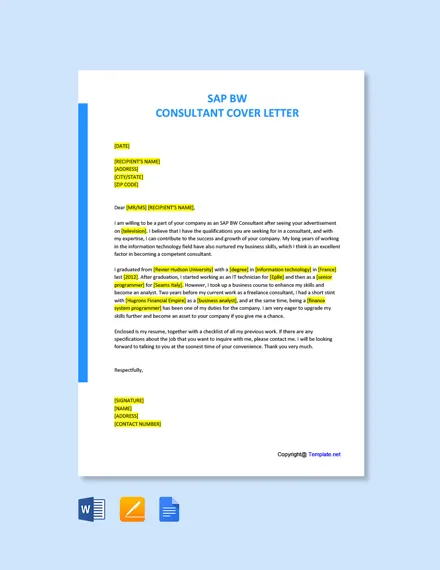
Your closing paragraph should summarize your interest in the position and include a call to action, prompting the hiring manager to take the next step. Reiterate your enthusiasm for the opportunity and emphasize how your skills and experience make you a great fit for the role. Express your gratitude for their time and consideration. Then, include a clear call to action, such as ‘I am eager to discuss how my skills and experience can contribute to your team’s success. I look forward to hearing from you soon’ or ‘I am available for an interview at your earliest convenience.’ Make it easy for the hiring manager to move forward by providing a direct path to the next step. A strong closing paragraph leaves a positive final impression, reaffirming your interest in the position and encouraging the employer to contact you.
Proofreading and Editing Your Cover Letter
Proofreading and editing your SAP cover letter is an essential step that should never be overlooked. Errors in grammar, spelling, and punctuation can undermine your credibility and create a negative impression. Before submitting your letter, carefully review it for any mistakes. Read it aloud, or have a friend or colleague proofread it to catch any errors you might have missed. Check for consistency in formatting, such as font style, spacing, and bullet points. Ensure that your contact information is accurate and up to date. Double-check all the company’s names, and job titles to make sure they are correct. A polished, error-free cover letter demonstrates professionalism and attention to detail, increasing your chances of getting hired. Proofreading is an investment in your career that can significantly impact your success.
Common Mistakes to Avoid in Your SAP Cover Letter
Avoiding common mistakes in your SAP cover letter can significantly increase your chances of landing an interview. Some frequent errors that can hurt your application include using generic language, focusing on what you want rather than the company’s needs, and ignoring the company culture. Generic cover letters don’t demonstrate a clear understanding of the role or the company, and focusing on your desires without mentioning what you can bring to the table is a missed opportunity. Ignoring the company culture shows that you haven’t researched the organization and can suggest a lack of fit. By avoiding these mistakes, you can showcase your professionalism and increase your chances of getting hired.
Generic Language

Using generic language in your SAP cover letter is a common mistake that can make your application blend in with all the others. Avoid generic phrases like ‘I am a team player’ or ‘I am hard-working’ without providing specific examples to support your claims. Generic language doesn’t provide any unique information about you, and it fails to demonstrate how your skills and experience align with the job requirements. Instead, use specific details and quantify your achievements with data. For example, instead of stating ‘I have experience with SAP,’ mention the specific modules you have worked on and the results you achieved. Always customize your cover letter to match the company’s needs. Replacing general statements with specific, impactful language is crucial for making your cover letter stand out.
Focusing on What You Want
While it’s important to show your interest in the position, focusing solely on what you want from the role can be a significant mistake. The main goal of your cover letter is to show what you can offer to the employer, not to describe what you’re looking for. A cover letter that prioritizes personal gain over company needs often conveys a lack of understanding of the role and a lack of genuine interest. Instead of emphasizing your career aspirations, focus on demonstrating your value to the company. Highlight your skills, experience, and how you can contribute to their success. Show that you understand the company’s objectives and can help them achieve their goals. Mentioning your career goals is fine, but always tie them back to how you can contribute to the company.
Ignoring the Company Culture
Ignoring the company culture is a mistake that can make you seem like a poor fit for the organization. Before writing your cover letter, research the company’s values, mission, and culture. This information can usually be found on their website, social media profiles, or through industry publications. Tailor your cover letter to reflect your understanding of the company’s culture and how your skills and experience align with their values. Highlight any examples of how you have demonstrated these values in previous roles. When you show that you’re a good cultural fit, you demonstrate that you not only have the skills for the job but that you will also thrive within their environment. Showing an understanding of the company’s culture can give you a significant advantage.
Finalizing and Submitting Your SAP Cover Letter

Once you have written, edited, and proofread your cover letter, it is time to finalize and submit your application. Before submitting, review your cover letter one last time to ensure all the details are accurate and consistent. Save your cover letter in a professional format, such as PDF, to ensure that the formatting remains intact when opened by the hiring manager. When submitting your cover letter, follow the instructions provided in the job posting. Some employers may require you to submit your cover letter and resume together. Others may have specific formatting or submission guidelines. By adhering to these instructions, you demonstrate your attention to detail and respect for the employer’s process. With a polished and customized cover letter, you will be well-positioned to make a strong first impression and increase your chances of landing an interview for your desired SAP role.