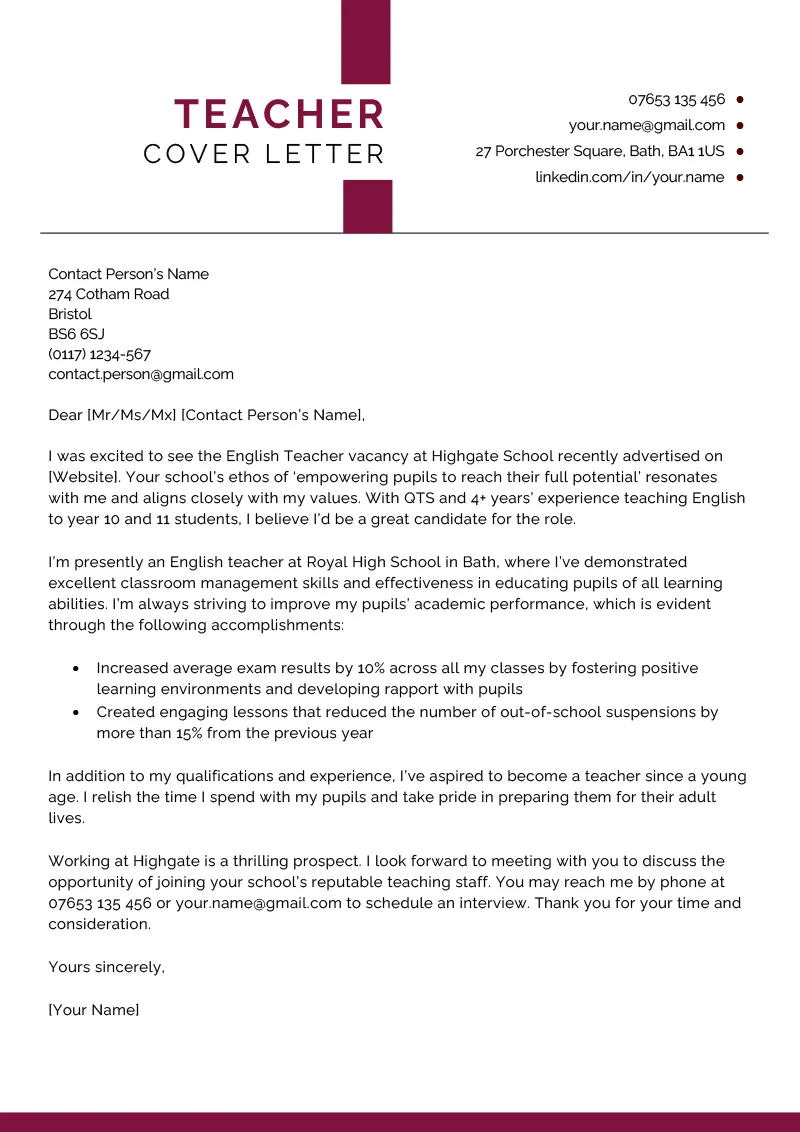
What is a Teacher Cover Letter?
A teacher cover letter is a crucial document that accompanies your resume when applying for a teaching position. It serves as your introduction to the hiring committee, providing a personalized glimpse into your qualifications, experience, and passion for education. Unlike a resume, which is a factual summary of your skills and accomplishments, a cover letter allows you to express your personality, teaching philosophy, and enthusiasm for the specific school and role. It is your opportunity to make a strong first impression and distinguish yourself from other applicants.
The Importance of a Teacher Cover Letter
In a competitive job market, a well-crafted teacher cover letter is essential. It’s often the first document a potential employer will see, and it sets the tone for your entire application. A compelling cover letter demonstrates your genuine interest in the position and the school, showcasing your understanding of their needs and how you can contribute. It provides a space to elaborate on your resume, explaining your experience, skills, and teaching philosophy in detail, making a strong case for why you are the ideal candidate. A cover letter can also highlight any unique skills or experiences not explicitly mentioned in your resume, further strengthening your application.
Essential Components of a Teacher Cover Letter

A successful teacher cover letter incorporates several key components. First, it starts with a professional header including your contact information. Next is addressing the hiring manager correctly. The opening paragraph grabs attention, and introduces the purpose of the letter. The body highlights qualifications, experience, and teaching philosophy. It then shows that your achievements quantify your achievements. Finally, it’s tailored to each specific school and role, and ending with a call to action and request for an interview. Proofreading for errors, formatting it correctly and using examples can make your cover letter stand out.
Header and Contact Information
Start your cover letter with a clean and professional header. Include your full name, phone number, email address, and professional social media links. Make sure the email address is professional and easy to read. Directly below your contact information, include the date and the hiring manager’s name, title, and the school’s address (if you know it). Using a professional layout ensures the reader can easily identify and contact you. It also demonstrates your attention to detail and organization skills, which are highly valued in educators. Ensuring your contact information is accurate and up-to-date is crucial to make it easy for a school to reach you.
How to Address the Hiring Manager
Addressing the hiring manager by name is a must to make a positive impression. If possible, research the name of the principal, hiring manager, or the person responsible for reviewing applications. If you cannot find a specific name, use a general salutation such as “Dear Hiring Committee,” or “Dear Principal/Superintendent”. Avoid generic greetings like “To Whom It May Concern,” as they indicate a lack of research and personalization. If the job posting doesn’t provide any clues, a quick search on the school’s website or LinkedIn can often help you find the right person to address.
Opening Paragraph Make a Strong First Impression

The opening paragraph sets the tone of your cover letter. Start with a strong statement that grabs the reader’s attention. State the specific position you’re applying for and where you saw the job posting. Immediately highlight your most relevant skills, experience, and qualifications that align with the job description. Show your enthusiasm for the role and the school, expressing your passion for teaching and your interest in their educational environment. Keep the opening concise and engaging, making the reader want to learn more about you. Consider mentioning a particular program, initiative, or school value that resonated with you.
Highlighting Your Qualifications and Experience
The main body of your cover letter should highlight your qualifications and experience. Connect your skills and experience to the specific requirements outlined in the job description. Focus on your achievements and how you’ve contributed to student success in previous roles. Provide specific examples of your teaching methods, classroom management techniques, and curriculum development experience. Use action verbs to describe your accomplishments and use the STAR method (Situation, Task, Action, Result) to provide context and demonstrate the impact of your work. This section is where you sell yourself, showing the hiring committee how your background aligns with their needs. Use
Showcasing Your Teaching Philosophy and Approach
Include a brief explanation of your teaching philosophy and approach. Describe your core beliefs about education, your approach to student engagement, and how you create a positive learning environment. Explain how you differentiate instruction to meet the needs of diverse learners. Emphasize your commitment to fostering a supportive and inclusive classroom where every student can thrive. Mention any specific teaching methodologies or strategies you use, such as project-based learning, differentiated instruction, or restorative justice. Show your passion for education and your dedication to student success.
Quantifying Your Achievements

Whenever possible, quantify your achievements to demonstrate your impact. Instead of saying “Improved student test scores,” state “Increased student test scores by 15% in one year through the implementation of [specific strategy].” Provide measurable results such as the number of students you’ve helped improve or the percentage of students who met or exceeded learning objectives. Including hard data in your cover letter shows that you are results-oriented and that you have a proven track record of success. Use metrics like test scores, student progress, and project outcomes to show the value you bring to the school.
Tailoring Your Cover Letter to the Specific School
Personalize your cover letter to show your interest in the specific school you are applying to. Research the school’s mission, values, and educational programs. Highlight any of your experiences or skills that align with their specific needs or initiatives. Mention any specific programs, technologies, or approaches used by the school that resonate with your teaching philosophy. Show how you can contribute to the school’s culture and goals. Doing this shows that you have gone above and beyond simply sending a generic application, and it demonstrates your genuine interest and commitment to the school’s success.
Closing Paragraph Call to Action
In your closing paragraph, summarize your key qualifications and reiterate your interest in the position. Reiterate your enthusiasm for the school and your ability to contribute to its success. State your availability for an interview and provide your contact information once again. Thank the hiring manager for their time and consideration. End with a professional closing such as “Sincerely,” or “Respectfully,”, followed by your name. Ensure your closing paragraph is concise, polite, and leaves the reader with a positive impression. Include an email signature for easy contact.
Proofreading and Editing Your Cover Letter

Before submitting your cover letter, carefully proofread it for any grammatical errors, typos, or inconsistencies. Ensure your writing is clear, concise, and error-free. Read your cover letter aloud to catch any awkward phrasing or sentences that need revision. Ask a friend, colleague, or mentor to review your letter for feedback and suggestions. Ensure the letter is well-formatted and easy to read. A polished, well-written cover letter demonstrates your professionalism and attention to detail, which are essential qualities for a teacher. Pay close attention to grammar, punctuation, and spelling. Ensure your tone is professional and enthusiastic throughout your letter.
Formatting and Presentation Tips
Pay attention to the formatting and presentation of your cover letter. Use a professional font such as Times New Roman, Arial, or Calibri, and maintain consistent formatting throughout. Use single-spacing within paragraphs and double-spacing between paragraphs to improve readability. Use standard 1-inch margins on all sides. Keep the length of your cover letter to one page. Make sure your cover letter is visually appealing and easy to read. Use bold or italicize headings and bullet points to highlight important information, but avoid overusing them. Save your cover letter as a PDF file to ensure that your formatting remains consistent when opened on different computers.
Cover Letter Examples for Teachers
Refer to cover letter examples to get inspiration and guidance. Look for examples that are tailored to the specific type of teaching position you are applying for, such as elementary, middle school, or high school. Analyze how other teachers showcase their qualifications, experience, and teaching philosophy. Adapt the structure and content to align with your own skills and experiences. Use the examples as a starting point and then personalize them to reflect your unique qualities. While you can draw ideas from examples, ensure your letter is original and reflects your own voice and experiences, not just a copy of someone else’s letter. There are many great online resources available.
Common Mistakes to Avoid
Avoid common mistakes that can undermine your application. Do not use generic cover letters; always customize your letter for each position. Avoid errors or typos, which signal a lack of attention to detail. Don’t go over the maximum length of one page. Do not use overly casual language or slang. Refrain from discussing salary expectations unless specifically requested. Avoid negative statements about previous employers or colleagues. Focus on what you can offer the school, rather than what you are looking for. Avoid generic statements that could apply to any teacher. By avoiding these common pitfalls, you can significantly enhance your chances of getting your cover letter noticed.
Submission and Follow-Up
After submitting your cover letter and resume, follow up with the hiring manager. If the job posting indicates a specific follow-up timeline, adhere to it. If not, send a brief email or make a phone call one or two weeks after the application deadline. Thank the hiring manager again for their time and reiterate your interest in the position. Reference your application and any specific skills or experiences you discussed in your cover letter. This proactive approach can show your enthusiasm and help keep you in the running. Be polite, professional, and concise in your follow-up communication. If you don’t hear back, consider sending a second follow-up email after a reasonable time.