Understanding the Web Developer Cover Letter
A web developer cover letter is more than just a formality; it’s your first introduction to a potential employer, a chance to make a strong first impression and differentiate yourself from other candidates. It’s a way to highlight your skills, experience, and passion for web development. The cover letter gives you the space to tell your story, explain why you’re the perfect fit for the role and company, and demonstrate your communication skills. A well-crafted cover letter can significantly increase your chances of landing an interview. It showcases your personality, enthusiasm, and genuine interest in the opportunity, setting the stage for a successful application and ultimately, a new career opportunity.
Why a Strong Cover Letter Matters
In a competitive job market, a strong cover letter can be the deciding factor. It provides context to your resume, elaborating on your accomplishments and explaining your career trajectory. Recruiters and hiring managers often use cover letters to assess your writing skills, attention to detail, and understanding of the role. A well-written letter demonstrates your professionalism and commitment to the application process. Moreover, it allows you to address any potential gaps in your resume or explain career changes. A compelling cover letter can transform your application from ordinary to extraordinary, making you a standout candidate and significantly boosting your chances of being noticed and considered for an interview.
Top 5 Tips for a Winning Web Developer Cover Letter

Crafting a winning web developer cover letter involves several key strategies. By following these tips, you can significantly increase your chances of impressing hiring managers and securing an interview. Focusing on these core elements ensures your cover letter is both informative and persuasive, making it a valuable tool in your job search.
Highlighting Relevant Skills and Technologies
Emphasize your technical skills and the specific technologies mentioned in the job description. Tailor your skills section to match the requirements of the position. Highlight programming languages, frameworks, and tools you’re proficient with, and provide concrete examples of how you’ve used them. This could include JavaScript, React, Node.js, HTML, CSS, and experience with databases or cloud platforms. Instead of simply listing skills, provide brief examples of how you’ve utilized these skills in projects. This demonstrates your practical knowledge and ability to apply your expertise to real-world scenarios. Refer to the job description to make sure you’re highlighting the skills that the employer considers most important. Showing your practical experience will help you stand out and demonstrate your value to the employer.
Tailoring Your Cover Letter to the Job Description
Customize your cover letter for each job application. Generic cover letters are easily spotted and often discarded. Research the company and role, and demonstrate your understanding of their specific needs and goals. Refer to the job description and use keywords from the description throughout your letter. Explain how your skills and experience align with the role’s requirements. Show that you understand the company’s values and mission, and explain why you’re interested in working there. This personalized approach shows initiative and commitment, setting you apart from candidates who submit generic applications. Tailoring your letter demonstrates your understanding of the company’s needs and your genuine interest in the position. This level of detail significantly increases your chances of getting noticed and making a positive first impression.
Showcasing Your Projects and Achievements

Provide concrete examples of your projects and accomplishments. Instead of just listing your responsibilities, describe specific projects you’ve worked on and the results you achieved. Use quantifiable results whenever possible. Did you increase website traffic by a certain percentage? Did you improve user engagement? Did you streamline a development process, leading to cost savings? Include links to your portfolio, GitHub, or live projects to allow the hiring manager to see your work directly. Highlight your role in each project, the technologies you used, and the challenges you overcame. This shows the practical application of your skills and demonstrates your ability to deliver results. Focus on demonstrating your practical skills, capabilities, and any other achievements you’ve accomplished.
Formatting and Structure for Maximum Impact
Your cover letter’s formatting and structure are just as important as its content. Use a professional and easy-to-read format with clear headings, concise paragraphs, and appropriate spacing. Keep your letter to one page to maintain the hiring manager’s interest. Use a professional font like Arial, Calibri, or Times New Roman, with a font size between 10 and 12 points. Start with a professional salutation, addressing the hiring manager by name if possible. Use action verbs to describe your accomplishments and skills. End with a strong call to action, expressing your enthusiasm for the role and inviting the hiring manager to contact you. The right format will help you make a strong first impression. Well-organized formatting makes it easier for recruiters and hiring managers to quickly grasp your qualifications and appreciate your skills.
Proofreading and Editing for Professionalism
Proofread your cover letter carefully for any typos, grammatical errors, or inconsistencies. Errors undermine your credibility and create a negative impression. Use a grammar and spell-checking tool, but also manually review the document. Consider asking a friend or colleague to proofread your letter. Ensure that your tone is professional and enthusiastic. Avoid using jargon or slang. Make sure the language is clear, concise, and reflects your personality and passion for web development. A well-edited cover letter demonstrates your attention to detail and commitment to excellence, and it showcases your writing ability.
Key Sections to Include in Your Cover Letter

A well-structured cover letter includes specific sections to provide essential information. These sections work together to present a comprehensive picture of your qualifications and enthusiasm, increasing your chances of making a positive impression.
Contact Information and Salutation
Start with your contact information, including your name, phone number, email address, and professional networking links. Then, address the hiring manager by name if possible; research the company’s website or LinkedIn to find the hiring manager’s name. If you can’t find a specific name, use a professional greeting like ‘Dear Hiring Manager.’ Using the correct name shows that you’ve done your homework and are making a personal connection. Including contact details is a must for the hiring manager to have quick access to your information and for them to reach out to you if they find your profile suitable for their requirement.
The Body Paragraphs Crafting Your Message
The body paragraphs are the core of your cover letter, where you elaborate on your skills, experience, and enthusiasm. Begin with a concise and compelling introduction that states the position you’re applying for and why you’re interested in the role and the company. In the subsequent paragraphs, highlight your relevant skills and experience, using specific examples to demonstrate your capabilities. Show how your skills and experiences align with the requirements of the job description. Focus on how your achievements and projects have benefited previous employers, using measurable results whenever possible. Conclude with a strong closing paragraph that reiterates your interest and includes a call to action, encouraging the hiring manager to contact you.
Closing and Call to Action

End your cover letter with a strong closing and a clear call to action. Reiterate your enthusiasm for the position and your interest in the company. Thank the hiring manager for their time and consideration. Include a call to action, such as, ‘I am eager to discuss my qualifications further in an interview’ or ‘I look forward to hearing from you soon.’ A strong closing leaves a lasting positive impression and encourages the hiring manager to take the next step. This demonstrates your initiative and eagerness, which can significantly increase your chances of getting an interview.
Common Mistakes to Avoid in Your Cover Letter
Avoiding common mistakes can significantly improve your cover letter. These mistakes can undermine your credibility and decrease your chances of getting an interview. Being aware of these pitfalls and actively avoiding them can help you present yourself professionally and positively.
Using Generic Language
Avoid using generic phrases that don’t highlight your unique skills or experience. Use tailored language specific to the job and company. Instead of generic phrases, use action verbs and provide specific examples to showcase your accomplishments. Generic language makes it difficult for hiring managers to understand what sets you apart from other candidates. Instead, emphasize specific details and show a deep understanding of the role. This shows that you’ve invested time and effort in your application. Be specific and personal so the hiring manager can easily notice your skills and experience.
Focusing Solely on Responsibilities

While mentioning your responsibilities is important, don’t make it the sole focus of your cover letter. Instead, highlight your accomplishments and the results you achieved. Quantify your accomplishments whenever possible, such as by mentioning a percentage increase in website traffic. Emphasize your contributions and the impact you made in previous roles. Focusing solely on responsibilities makes it difficult for the hiring manager to understand your actual capabilities. Use the STAR method (Situation, Task, Action, Result) to describe your accomplishments in detail. This helps to present your accomplishments in a structured and convincing manner.
Neglecting to Proofread
Failing to proofread your cover letter is a critical mistake. Typos, grammatical errors, and inconsistencies make a negative impression. Always proofread your cover letter multiple times. Use a grammar and spell-checking tool, but also manually review the document. Ask a friend or colleague to review your letter for a fresh perspective. A well-proofread cover letter shows that you pay attention to detail and take pride in your work. This demonstrates your professionalism and attention to detail, which are important qualities in web development and will show the hiring manager your true potential.
Web Developer Cover Letter Sample Example
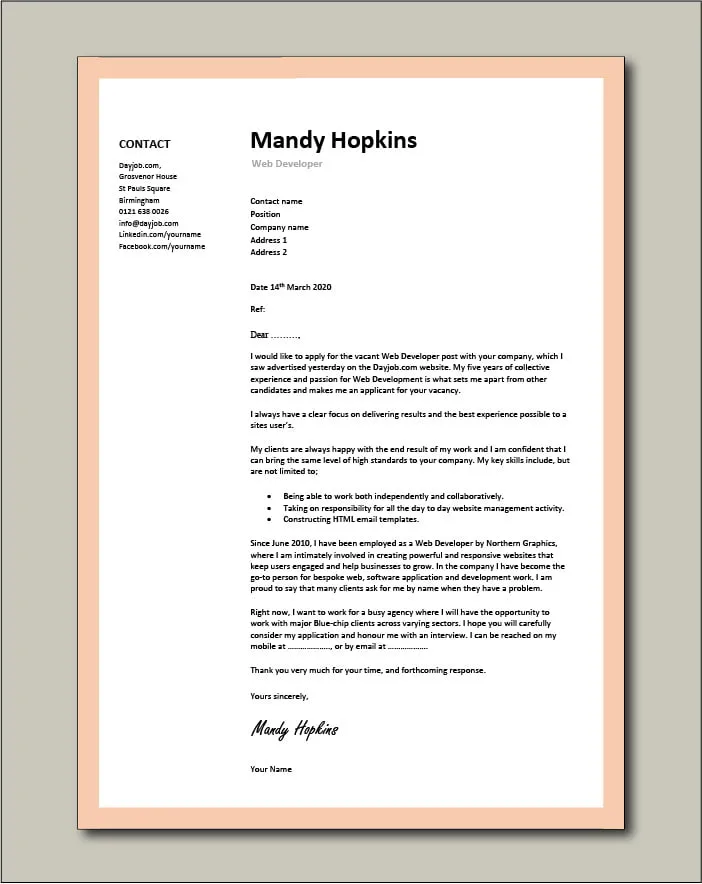
This is a general example that you can adapt to your profile. Replace the bracketed information with your specific details. A web developer cover letter should be tailored to the specific job and company, but this sample provides a solid foundation. Modify it to match the requirements mentioned in the job posting, ensuring you highlight your relevant experience and skills. Tailoring to each job application helps you make a strong impression.
Skills to mention in Cover Letter

When listing skills, be sure to mention both hard and soft skills. Hard skills, such as HTML, CSS, JavaScript, and React, show your technical proficiency. Soft skills, such as problem-solving, teamwork, and communication, demonstrate your ability to work effectively. Prioritize the skills listed in the job description, highlighting the ones that are most relevant to the role. Always provide specific examples of how you’ve used these skills in your projects. Highlighting the skills will definitely help you stand out from the crowd and get you hired.
Web Developer Cover Letter Example to Get you Started
Here is a cover letter example to help you get started. You can modify it based on the role to which you are applying. This sample helps you present yourself in the best possible light, making a strong impression on potential employers. Remember to customize the content to highlight your unique skills and experience, ensuring you stand out from the competition and secure your chance for an interview.